Beyond the grunt: Umpires mic up, and baseball changes a bit
Advertisement
Read this article for free:
or
Already have an account? Log in here »
To continue reading, please subscribe:

Digital Subscription
One year of digital access for only $205*
- Enjoy unlimited reading on winnipegfreepress.com
- Read the E-Edition, our digital replica newspaper
- Access News Break, our award-winning app
- Play interactive puzzles
*First annual payment billed as $205.00 + GST for one year. This annual subscription will automatically renew at $233.00 + GST every 52 weeks (10% off the regular annual price of $259.35). Offer available to new and qualified returning subscribers only. Cancel any time.
To continue reading, please subscribe:
Add Free Press access to your Brandon Sun subscription for only an additional
$1 for the first 4 weeks*
- Enjoy unlimited reading on winnipegfreepress.com
- Read the E-Edition, our digital replica newspaper
- Access News Break, our award-winning app
- Play interactive puzzles
*Your next Brandon Sun subscription payment will increase by $1.00 and you will be charged $17.95 plus GST for four weeks. After four weeks, your payment will increase to $24.95 plus GST every four weeks.
Read unlimited articles for free today:
or
Already have an account? Log in here »
Hey there, time traveller!
This article was published 04/10/2022 (1416 days ago), so information in it may no longer be current.
NEW YORK (AP) — After a century and a half of Major League Baseball — after generations of grunts and growls, of muffled shouts and dramatic arm gestures and a cultivated sense of remoteness — something quietly extraordinary happened to the national pastime this year: The umpires began talking to the world.
On April 5, umpire Ted Barrett spoke into a tiny microphone and said these 20 words: “After review, the call is confirmed. The batter was hit by the pitch. The Los Angeles Angels lose their challenge.” Suddenly, one of baseball’s most remote figures became a bit more human.
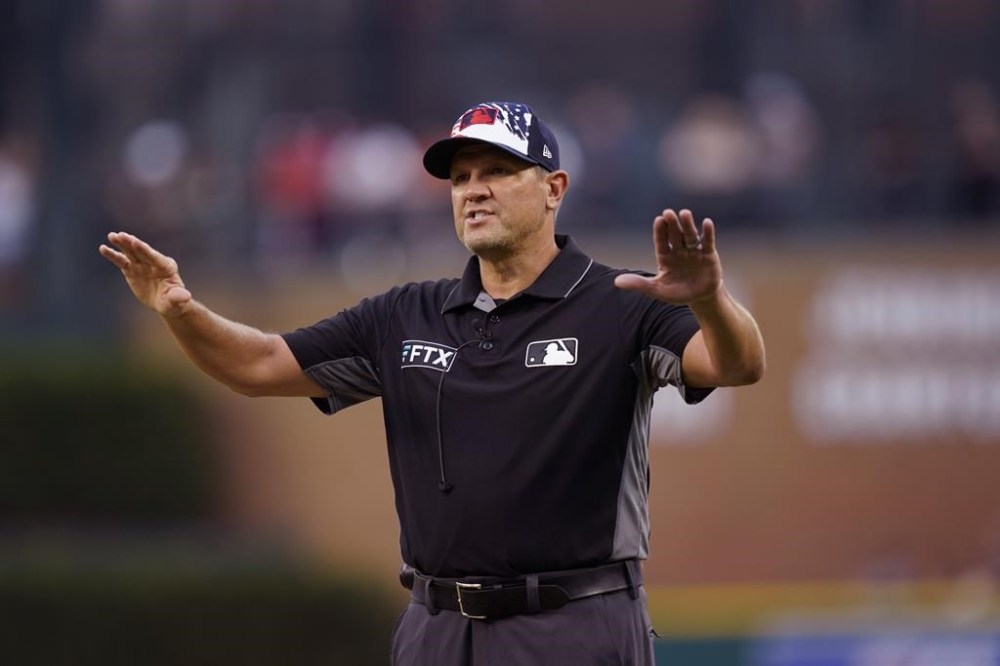
A policy change implemented at the beginning of the season, designed to explain on-field call challenges and outcomes, equipped umpires with tiny wireless microphones and — for the first time in baseball history — introduced their amplified voices to ballpark speakers, to the fans in their seats and to the world at home. They’ll be there on the sport’s biggest stage this month, too, during the playoffs and World Series.
Change in baseball is often measured in big things, loud things, significant things. Things like catchers being barred from blocking the plate. Like challenges adjudicated in a far-off room by out-of-sight officials. Like next season’s plans for bases getting bigger, shifts getting restricted and the time between pitches — in a game that never had a clock — finally being counted.
But baseball is, if nothing else, a game of subtleties. And the notion of hearing a mic’d-up ump’s voice explaining something feels oddly revolutionary, even after nearly an entire season of hearing it off and on.
“I think it is a good thing for the microphone to have replaced the megaphone, the booming oration, or mysterious hand signals,” says John Thorn, Major League Baseball’s official historian. “Instant replay, because it operates in (the) background, does require explanation, especially when an on-field call is reversed.”
Hearing officials’ voices is hardly new; it has been standard in the NFL and other sports for years. But with their whistles, bright shirts and maskless faces, those sports’ officials never felt quite as remote. The umpire has always carried an air of mystery and sequesteredness; for a sportswriter even to interview one can require special permission.
Yet it’s in keeping with the times. In most realms of entertainment, more access — and thus more content — seems to be the trend. Athletes are mic’d up all over the place to bring fans closer to the action, including players and managers doing in-game TV interviews in the dugout or on the field while the game is in progress.
It’s more than that, though. There’s something about a voice that personalizes and humanizes. It’s why people feel like they know the morning DJs and podcast hosts who they listen to while waking up or driving to work.
So hearing the normal voices of the men whose verbal expressions, in fans’ ears, have generally been restricted to grunts adds a dimension to watching a game — and adds information, too.
“In a small way, it can get people to understand that there’s actually a person in that uniform,” says retired MLB umpire Dale Scott, who knows something about the power of voice. In an earlier career, he was a disc jockey.
Scott says former colleagues went to empty stadiums to practice in the months leading up to the debut in April. After listening to some of them for a good chunk of this season, he says some seem much more at ease with it than others. “You’re going to see guys getting better with it and more comfortable with it.”
Being able to explain the game just a bit in real time, he says, is a sea change. He recalls a play in the 2015 ALDS when Toronto Blue Jays catcher Russell Martin threw a ball back to the pitcher that hit Texas Rangers batter Shin-Soo Choo. Scott was the home-plate umpire and says the ensuing disarray was complicated. He wishes he could have explained.
“There was mass confusion. A microphone then would have been very helpful,” says Scott, author of “ The Umpire Is Out: Calling the Game and Living My True Self.”
Greg Brown, the Pittsburgh Pirates’ longtime play-by-play announcer, watched with great interest through the season as more and more umpires got amplified. He approves. “To hear that voice is revealing. It seems like such a small thing, and then you peel it back,” Brown says.
But it is the clarity that comes when umpires can speak through mics — the information that makes the game more accessible — that impresses him the most.
“I always wondered: These other sports, why are they able to communicate with their fan base and we can’t? It was so frustrating,” Brown says. “It was a great relief to me that it finally got to the point where they were ready to embrace this opportunity to humanize these umpires but communicate with both the fans at the ballpark and the fans on radio and TV.”
In a way, this moment in baseball is a miniature version of what watching a movie was like in the late 1920s, when silent films were being replaced by “talkies.” Suddenly an entirely new layer of information became available.
“We’re a visual culture. But visually, you can’t always track everything. You turn on the sound to find out what happened,” says Shilpa Davé, a professor of media studies at the University of Virginia. “Our culture is really dependent on sound and voices right now — podcasts, voices in your ear. That intimacy of the voice is part of the equation now. It has been for a while, but vocal interactions like this are highlighting it a bit more.”

But does it raise the umpire’s profile higher than the game intended? Baseball’s most storied umpire, Bill Klem, who called balls and strikes from 1905 to 1941, had this to say about his craft: “The best-umpired game is the game in which the fans cannot recall the umpires who worked it.”
As 2022 draws to a close with umpires talking, that notion may be changing. Scott, for one, couldn’t be more pleased. “I would have loved to have done it,” he says. “This is right in my wheelhouse, man.”
But even with this step, Scott says, there’s one cliché of umpiring that may stick around no matter what. “When it’s all said and done,” he says, “whatever explanation you give, people may think you’re still a bum.”
___
Ted Anthony is director of new storytelling and newsroom innovation for The Associated Press. Follow him on Twitter at http://twitter.com/anthonyted
Related Articles
Angels keep Phil Nevin as manager for 2023 on 1-year deal




Advertisement Advertise With Us
Advertisement Advertise With Us