Historic drought behind B.C. wildfires, salmon die-off could continue, experts say

Advertisement

Advertise with us

VANCOUVER - Thousands of dead fish, a prolonged wildfire season and intense water shortages leading to ice rink closures are all symptoms of record-setting drought in parts of British Columbia.

Read this article for free:


or

Already have an account? Log in here »

To continue reading, please subscribe:

Subscribe and receive a limited-edition Free Press branded hat or tote.

Digital Subscription

One year of digital access for only $205*

  • Enjoy unlimited reading on winnipegfreepress.com
  • Read the E-Edition, our digital replica newspaper
  • Access News Break, our award-winning app
  • Play interactive puzzles

*First annual payment billed as $205.00 + GST for one year. This annual subscription will automatically renew at $233.00 + GST every 52 weeks (10% off the regular annual price of $259.35). Offer available to new and qualified returning subscribers only. Cancel any time.

To continue reading, please subscribe:

Add Free Press access to your Brandon Sun subscription for only an additional

$1 for the first 4 weeks*

  • Enjoy unlimited reading on winnipegfreepress.com
  • Read the E-Edition, our digital replica newspaper
  • Access News Break, our award-winning app
  • Play interactive puzzles
Start now

*Your next Brandon Sun subscription payment will increase by $1.00 and you will be charged $17.95 plus GST for four weeks. After four weeks, your payment will increase to $24.95 plus GST every four weeks.

Hey there, time traveller!
This article was published 09/10/2022 (1428 days ago), so information in it may no longer be current.

VANCOUVER – Thousands of dead fish, a prolonged wildfire season and intense water shortages leading to ice rink closures are all symptoms of record-setting drought in parts of British Columbia.

The Lower Mainland, Sunshine Coast and West Vancouver Island areas are experiencing Level 5 drought conditions — the most severe in the province’s classification scale, which the B.C. government’s drought information web page says means adverse impacts are “almost certain.”

John Richardson, a University of British Columbia professor in the department of forest and conservation sciences, said the current stretch of parched conditions is an anomaly for the province.
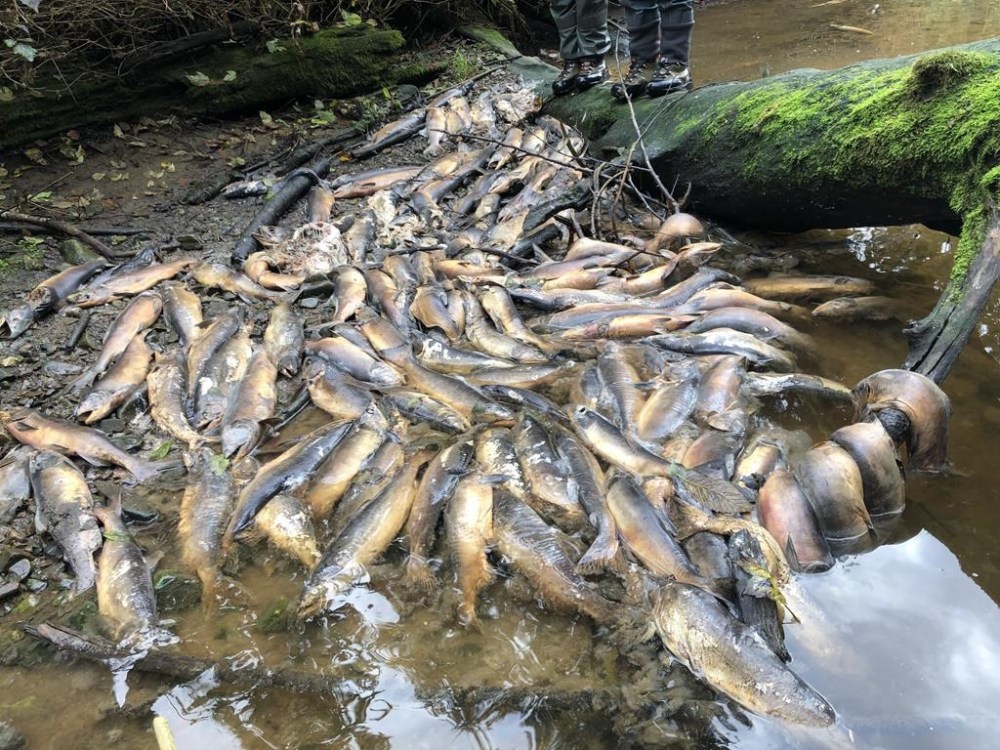
Dead fish are shown in the Neekas River on Heiltsuk territory, B.C. in this recent handout image provided by Sarah Mund. Thousands of dead fish, a prolonged wildfire season and intense water shortages leading to ice rink closures are all symptoms of record-setting drought in parts of British Columbia. THE CANADIAN PRES/HO-Sarah Mund
**MANDATORY CREDIT**
Dead fish are shown in the Neekas River on Heiltsuk territory, B.C. in this recent handout image provided by Sarah Mund. Thousands of dead fish, a prolonged wildfire season and intense water shortages leading to ice rink closures are all symptoms of record-setting drought in parts of British Columbia. THE CANADIAN PRES/HO-Sarah Mund **MANDATORY CREDIT**

“This is quite prolonged,” he said in an interview. “This is the warmest, driest September we’ve ever had on record.”

Though Environment Canada is calling for a chance of rain in some parts of the province Monday, David Campbell, head of the BC River Forecast Centre, said the dry weather could persist for at least another week, “if not several weeks.”

Experts say the drought conditions have already brought on significant adverse effects.

Thousands of dead wild salmon were found last week in the Neekas Creek, which runs through Heiltsuk Territory in the central coast region of the province.

William Housty, conservation manager for the Heiltsuk Integrated Resource Management Department, said he has seen pre-spawn mortality before “but never to this degree.”

“We’re looking at pretty much 100 per cent mortality of all the salmon that were in the creek at that time. It’s just unheard of at this time of year that we don’t have rain,” he said.

High tides and plentiful rain earlier in the season allowed the salmon to enter the river, Housty explained, but the following weeks of drought conditions dried out waterways and prevented the fish from spawning.

Oxygen levels dropped, the water temperature rose, and the result was massive die-off, he said.

“The Neekas is definitely the worst-case scenario. I don’t think the die-off that large is happening everywhere. But definitely what we’re seeing consistently across the board, is that the river levels are so low that the salmon just aren’t in them,” Housty said. “And if they are, they’re dead.”

Zoology professor Eric Taylor said though the images on social media of waterways clogged with floating dead fish are compelling, it’s important to understand that the drought impacts are local.

“You can’t really extend what’s happening in a reasonably limited area to across the province as a whole and infer Pacific salmon everywhere are under stress because of this,” Taylor said.

And it’s not the drought alone that is of concern for the salmon, he added.

“Fish can handle drought. They’ve handled it for thousands of years — it’s just one of a myriad of challenges that they face,” Taylor said. “It’s when these challenges pile on top of each other that the real issues for fish happen.”

He said the best solution is to ensure fish can easily access refuge areas, which would allow them to more easily adapt and survive during droughts.

Meanwhile, the Sunshine Coast Regional District delayed the opening of a local ice rink after the government implemented water restrictions amid concerns there wouldn’t be enough for homes, fire protection and the Sechelt Hospital.

The BC Wildfire Service also issued a news release ahead of Thanksgiving weekend urging people to use caution and remain vigilant to prevent human-caused fires. The government has banned open fires in much of the province.

“Sustained warm and dry weather will extend British Columbia’s wildfire season well into the fall,” the statement said.

As of Sunday, there were more than 185 wildfires still burning across the province.

The service said a cold front is expected to sweep across the province Monday, but that winds associated with the weather pattern may create “elevated fire behaviour conditions.”

“Very little precipitation is expected to accompany the front,” it said.

Even when the rain returns, Richardson warned the dry conditions could create greater flood risks.

“The soils have been drying, they become hydrophobic and so when they first get moisture, it takes a while for the moisture to soak in naturally,” he said. “So, initially, it’s very resistant and water runs off the surface and — especially on steep slopes — that leads to lots of erosion and potentially slope failures.”

But floods are a worst-case scenario that would also require heavy rainfall in a short amount of time, Richardson said.

“Best-case scenario is it starts to drizzle, and everything gets wetted up, and we don’t see anything happen at all,” he said.

This report by The Canadian Press was first published Oct. 9, 2022.

Report Error Submit a Tip

More Stories

Police issue silver alert for missing man

1 minute read Updated: Yesterday at 6:13 PM CDT

Winnipeg police are calling on the public to help locate a missing senior.

Thomas Lakie, 78, was last seen near Wilkes Avenue and Waverley Street around 4 a.m. Saturday, a weekend news release states. Police believe he may be in the Crestview neighbourhood.

Lakie is described as 5-8 with a medium build, has grey hair, blue eyes and walks with a limp. Police say he was last seen wearing a black baseball hat, a black t-shirt, green sweatpants with cargo pockets and brown runners with beige soles.

Anyone who may have information on Lakie's whereabouts is asked to call the missing persons unit at 204-986-6250.

Man who pleaded guilty to killing three cats dies before sentencing

Morgan Modjeski 3 minute read Preview

Man who pleaded guilty to killing three cats dies before sentencing

Morgan Modjeski 3 minute read Friday, Sep. 4, 2026

A Winnipeg man awaiting sentencing after admitting he strangled three cats to death and dumped two of their carcasses under a city bridge, has died, the Free Press has learned.

Randy Jensen, 25, pleaded guilty on May 13 to one count of wilfully causing injury or suffering to animals in connection to the 2024 killings.

He was scheduled to be sentenced in January.

“That’s not something that anybody wanted,” said Kristy Zamonsky, founder of Project Artemis Animal Advocates. “We were all hoping for justice through the courts.”

Read
Friday, Sep. 4, 2026

For newcomer pizza purveyors, it’s all about crafting solid foundations

David Sanderson 7 minute read Preview

For newcomer pizza purveyors, it’s all about crafting solid foundations

David Sanderson 7 minute read Yesterday at 2:00 AM CDT

A recent poll conducted by an Internet-based market-research firm determined that close to 20 per cent of people eschew their leftover pizza crust.

Some argued that the residual crust lacks flavour. Others submitted that it’s too hard or crunchy to enjoy sans toppings. Given that information, what are we to make of Crusty Craft Pizza, a five-month-old takeout spot whose owners are so confident in their European-style pizza crust that they’ve chosen to highlight it in their business moniker?

Whenever somebody informs them they don’t like pizza crust, their response is, well, they haven’t tried theirs, says Oleksii Samokvhal, who together with his wife, Iryna Mehedyn, opened Crusty Craft Pizza in early April, at 1311 Day St. in Transcona.

“It’s thin in the middle, with raised edges we hand-form ourselves,” says Mehedyn, a native of Ukraine who, like her Kyiv-born husband, relocated to Winnipeg to escape the conflict in their home country.

Read
Yesterday at 2:00 AM CDT

Wonderful wines to help welcome autumn

Ben Sigurdson 4 minute read Preview

Wonderful wines to help welcome autumn

Ben Sigurdson 4 minute read Yesterday at 3:00 AM CDT

As we creep ever closer to fall, many wine drinkers will start to think about popping corks (or screwcaps, as it were) on wines that suit cooler temperatures.

But summer’s not quite done yet. Here are six new and/or notable wines ideal for sipping as we make the transition from warmer weather into the first hints of autumn…

Wines of the weekThe Willm NV Blanc de Noirs Crémant d’Alsace Brut (Alsace, France — $28.99, Liquor Marts and beyond) is a French bubbly made from the Pinot Noir grape in the traditional method (secondary fermentation, which creates the bubbles, happens in the bottle rather than in tanks before bottling).

It’s pale gold with a hint of pink, and on the nose offers ripe cherry, cranberry, bread dough and strawberry compote notes. On the palate it’s light-bodied and mainly dry, with an almost-wild herbal component coming with the strawberry, tart peach, cranberry, raspberry and bread dough flavours.

Read
Yesterday at 3:00 AM CDT

Smith’s pretzel logic confuses

Editorial 4 minute read Preview

Smith’s pretzel logic confuses

Editorial 4 minute read Yesterday at 2:01 AM CDT

Alberta Premier Danielle Smith had both sides of her mouth working overtime on Aug. 30, when she spoke at an event in Calgary to commemorate Alberta Day, the annual celebration of the province’s entry into Confederation in 1905 (officially Sept. 1, it was celebrated on the weekend).

Smith’s comments — and the things she did not say — revealed a lot about the political tightrope the premier is trying to walk over the challenges currently faced by her province. At the top of that list of challenges is a persistent campaign to separate Alberta from the aforementioned Confederation. A campaign that Smith appears to both support and oppose, depending on which day of the week it is.

Her Alberta Day remarks were an excellent case in point.

Smith has decided that on Oct. 19, Albertans will vote on a series of non-binding propositions in a province referendum. One of those questions will ask Albertans whether they want to hold a referendum on separation, thus making this fall’s vote a “referendum on whether to hold a referendum,” as some observers have dubbed it.

Read
Yesterday at 2:01 AM CDT

‘Quite a journey’: dozens move into transitional housing downtown

Carol Sanders 4 minute read Preview

‘Quite a journey’: dozens move into transitional housing downtown

Carol Sanders 4 minute read Friday, Sep. 4, 2026

Dozens of residents have moved into transitional housing units in a former university building in downtown Winnipeg.

Housing, Addictions and Homelessness Minister Bernadette Smith said 42 residents have moved into suites on the third and fourth floors of a seven-storey building previously owned by Providence University College and Theological Seminary. There will be space for as many as 118 people who were in encampments or otherwise homeless.

The remaining units under renovation are expected to be ready and occupied in the coming weeks, Smith said.

“This has been two years in the making,” the minister said at a media event with residents, staff, neighbours and supporters. The building cost the province $24.4 million to purchase and renovate.

Read
Friday, Sep. 4, 2026