

Pointed argument
Balletic take on Margaret Atwood’s dystopian future is more relevant than ever

Advertisement
Read this article for free:
or
Already have an account? Log in here »
To continue reading, please subscribe:
Digital Subscription
One year of digital access for only $75*
- Enjoy unlimited reading on winnipegfreepress.com
- Read the E-Edition, our digital replica newspaper
- Access News Break, our award-winning app
- Play interactive puzzles
*Billed as $5.77 plus GST every four weeks. After 52 weeks, price increases to the regular rate of $19.95 plus GST every four weeks. Offer available to new and qualified returning subscribers only. Cancel any time.
Monthly Digital Subscription
$4.99/week*
- Enjoy unlimited reading on winnipegfreepress.com
- Read the E-Edition, our digital replica newspaper
- Access News Break, our award-winning app
- Play interactive puzzles
*Billed as $19.95 plus GST every four weeks. Cancel any time.
To continue reading, please subscribe:
Add Free Press access to your Brandon Sun subscription for only an additional
$1 for the first 4 weeks*
- Enjoy unlimited reading on winnipegfreepress.com
- Read the E-Edition, our digital replica newspaper
- Access News Break, our award-winning app
- Play interactive puzzles
*Your next Brandon Sun subscription payment will increase by $1.00 and you will be charged $17.95 plus GST for four weeks. After four weeks, your payment will increase to $24.95 plus GST every four weeks.
Read unlimited articles for free today:
or
Already have an account? Log in here »
Hey there, time traveller!
This article was published 11/10/2022 (1322 days ago), so information in it may no longer be current.
Far and away the most-used adjective to describe Margaret Atwood’s 1985 dystopian classic The Handmaid’s Tale — which envisions a harrowing theocracy in which women have no rights — is “prescient.”
Choreographer Lila York’s full-length ballet adaptation is also worthy of that description. Commissioned by the Royal Winnipeg Ballet, The Handmaid’s Tale premièred in Winnipeg back in October 2013 — before the 2016 U.S. presidential election put Donald Trump in office, before Atwood’s decades-old novel shot back up the bestseller lists in 2017, and before Hulu created a gritty television adaptation starring Elisabeth Moss that is now in its fifth season.
The ballet debuted before the #MeToo movement swelled in 2017, before people began eyeing the Supreme Court with fear in 2018 — a retooled version of the ballet would return to Winnipeg that year, too — and before Atwood released her Handmaid’s sequel, The Testaments, in 2019.
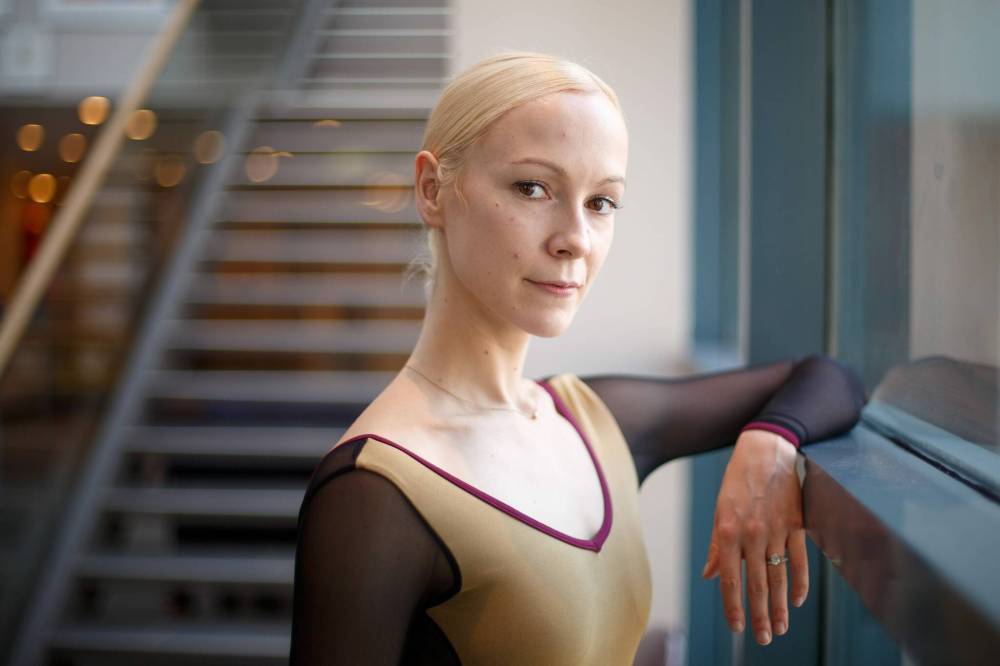
MIKE DEAL / WINNIPEG FREE PRESS
RWB principal dancer Elizabeth Lamont will alternate in the lead role of Offred in The Handmaid’s Tale.
And now, just months after Roe v. Wade was struck down in the U.S., York’s gripping dance drama returns to kick off the Royal Winnipeg Ballet’s 2022-23 season. With each passing year, it seems, the novel’s clarion call is put into sharper relief.
But the idea of doing a Handmaid’s Tale ballet — itself nearly 10 years old now — was, for a long time, “a hot potato” as York calls it. “Everybody was just like, ‘no, no, no — we’re not touching that one,’” she recalls with a laugh over the phone from New York City.
Everybody, that is, except RWB artistic director André Lewis. “It was an act of bravery for him to take this on,” York says. “Ballet companies really rely on more family-friendly ballets — Sleeping Beauty, Romeo & Juliet, Swan Lake. So, to take on a full-evening work that is clearly targeting an adult audience is a real act of courage I think.”
Indeed, The Handmaid’s Tale pushes the limits of the story ballet, eschewing the ethereal and escapist for the angular and bold, in everything from subject matter to choreography to the blood-red Handmaids’ costumes from Liz Vandal and Marie Chouinard.
It’s a highly stylized and abstract interpretation of its source material, but because it’s action-driven, one can easily follow the story of Offred and Moira, two of the state-sanctioned handmaids forced to bear children for powerful men called the Commanders and their Wives. “I was very careful in how I made this,” York says. “It’s a ballet. It’s not a movie.”
The Handmaid’s Tale requires physical stamina from its four leading women, who will be alternating in the roles of Offred and Moira, but portraying a handmaid night after night requires emotional endurance as well.
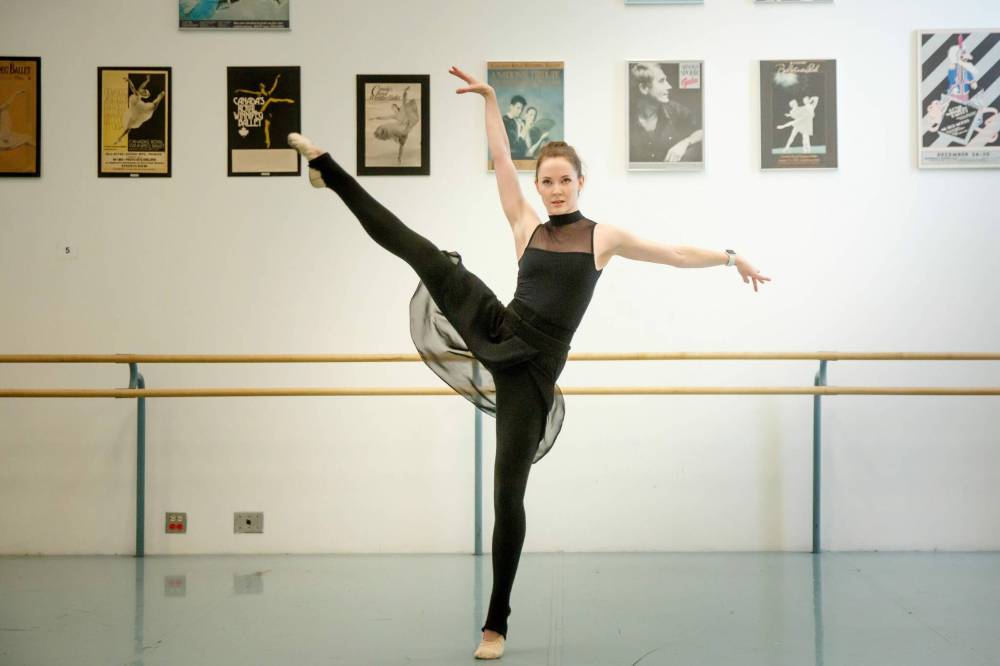
MIKE DEAL / WINNIPEG FREE PRESS
Katie Bonnell dances the role of Moira, whom she calls ‘a badass.’
“I think both characters are hard to let go of,” says principal dancer Alanna McAdie, who will be reprising her role as Offred along with principal dancer Elizabeth Lamont. “There’s particular moments, at least I find, that I have to just kind of walk away from the situation, take a few minutes, and then forcefully move on from it.”
“I agree,” says corps de ballet member Amanda Solheim, who will be dancing in the role of Moira along with second soloist Katie Bonnell. “Moira has a very aggressive scene with a partner and I feel like after that, I need to take a moment, I need to talk to my partner and be like, ‘OK, we’re good? We’re good’ and then take a deep breath and be like, ‘OK, let’s let that go for the day.’”
Both Lamont and McAdie have grown into their roles as Offred.
“Offred was my first lead role in a full-length ballet,” Lamont says. “Nine years ago, when it was being created on former principal dancer Amanda Green and myself, I didn’t really quite connect with the story as much as I do now.
“I’m a bit older, a bit more mature, and have a bit more understanding of where this character is coming from in a feminist perspective.”
“This time, the role feels a lot more like an expression from myself,” says McAdie, who performed in the role in 2018. “I felt like last time, I was really taking on the book and the TV series and trying to figure out who Offred was. And then I feel like this time, I kind of have a deeper respect and deeper understanding for her.”
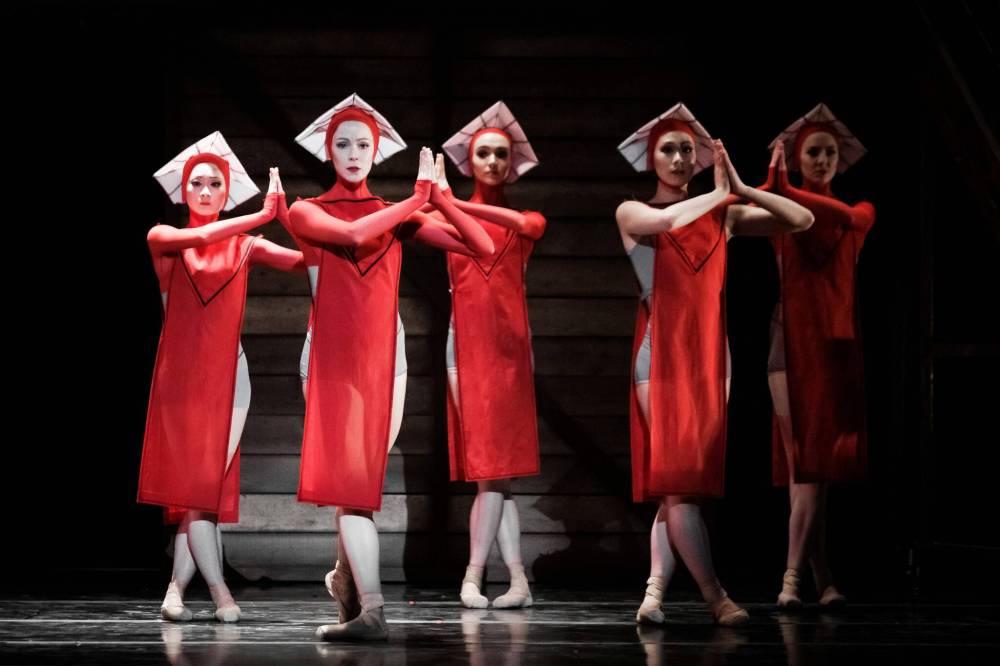
Daniel Crump photo
Royal Winnipeg Ballet last presented The Handmaid’s Tale in 2018.
Offred is a uniquely challenging character because, unlike in the novel or the TV show, the audience doesn’t have access to Offred’s interior life, and her inner monologue is often the only voice she has.
“Offred is voiceless, but how do you convey that to an audience in a visual art form?” Lamont says. “Everything is done in a pas de deux for Offred — it’s not until the very end of the ballet that I actually have my own solo, which is very unusual for a lead. And so, a lot of the time what I’m portraying as Offred in these pas de deux isn’t how she truly feels. I have to think how she would be thinking so that it actually reads. Otherwise, it just looks like she’s going along for the ride.”
Offred stands in contrast to the strong-willed Moira, who is doggedly determined to break free.
“She’s a badass — that’s the best way I can describe her,” says Bonnell with a laugh. Without revealing too much, Bonnell has relished being able to sink her teeth into Moira’s story, and the highs and lows her character goes through. “It’s heartbreaking to see her go from a high point with this really meaty, athletic solo to basically being drugged out of her mind and just tossed around.”
In addition to being a departure for the story ballet, The Handmaid’s Tale offers a chance for the dancers to take their own bold risks.
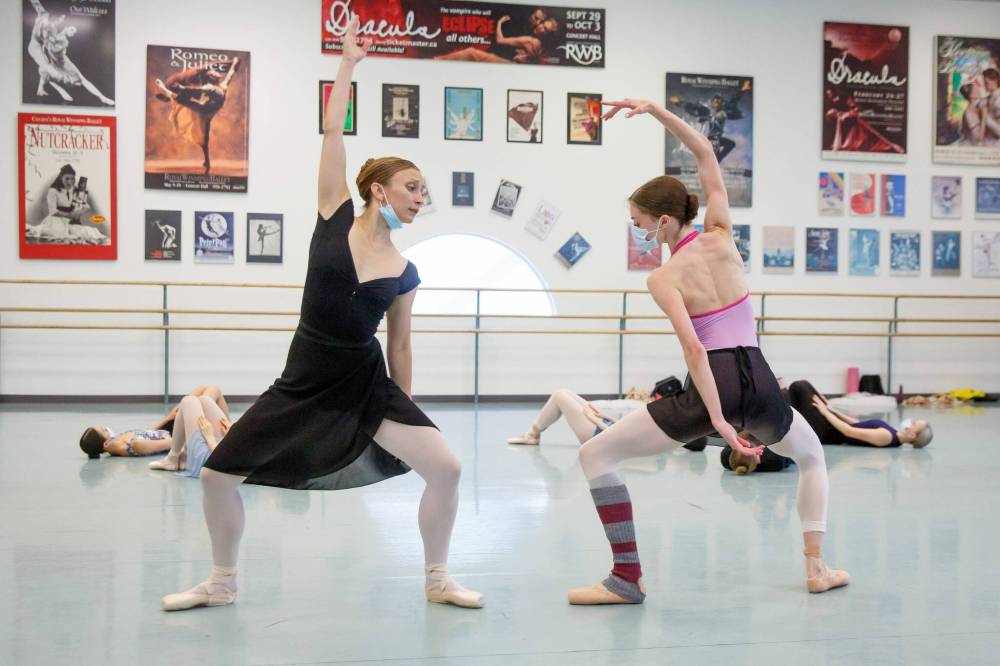
MIKE DEAL / WINNIPEG FREE PRESS
Amanda Solheim (right) and Alanna McAdie rehearse for the upcoming RWB presentation of The Handmaid’s Tale.
“It’s fun, too,” Bonnell says. “We’re not only being challenged physically with the dance steps, but because the characters are so brutal and mean and strong, you’re getting a lot of people that are being pushed from a character standpoint and an acting standpoint.”
“Female ballet dancers are almost never asked to be aggressive, strong, nasty — they’re almost never asked for those qualities,” choreographer York says. “But they’re doing it, and they’re doing it well.” In fact, having observed the company via Zoom for two weeks of rehearsals, York says the show has never looked this strong.
For the dancers, The Handmaid’s Tale, and its themes of strength, resilience and resistance, speak to the art’s ability to make a powerful statement.

“I like that it’s relevant — like, pointedly relevant right now with everything that’s going on with Roe v. Wade and women’s rights to their own bodies,” Bonnell says of the ballet. “And I think we have a platform to present these issues and make people feel a different way.”
Lamont would agree. “By us performing this crazy, Canadian, amazing piece of art work, it is a statement — and we can’t shy away from that because you have to give your women in the company a voice too,” she says, mentioning that The Handmaid’s Tale is often a banned and burned book — a point Atwood herself responded to earlier this year by taking a flame thrower to a fireproof copy.
“The fact we’re allowed to tell this story means a lot.”
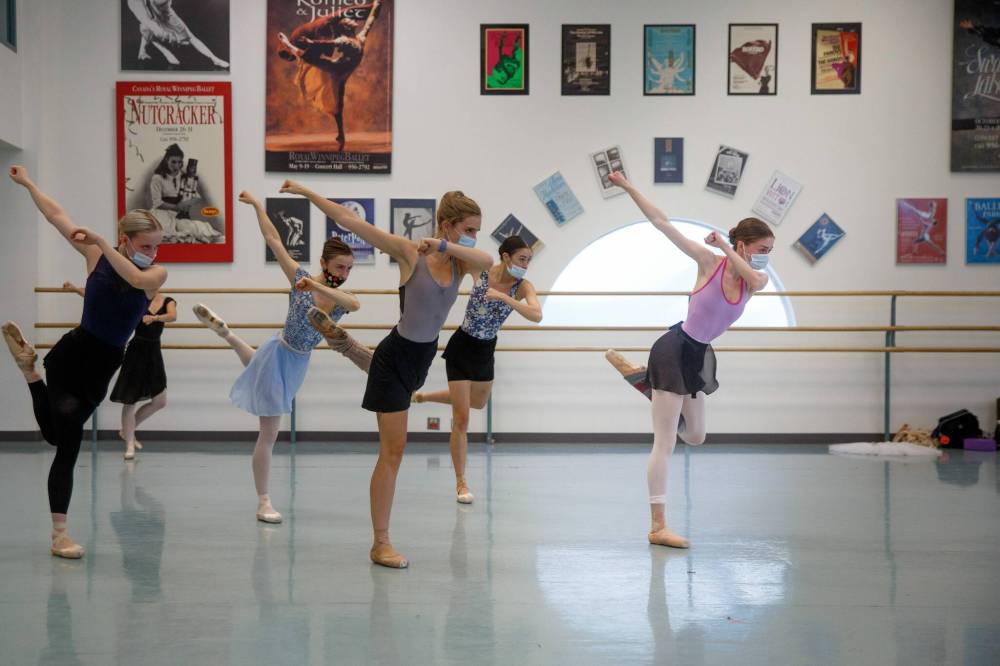
MIKE DEAL / WINNIPEG FREE PRESS
Corps de ballet member Amanda Solheim (right) says dancing the role of Moira requires emotional endurance.
jen.zoratti@winnipegfreepress.com
Twitter: @JenZoratti
Jen Zoratti is a columnist and feature writer working in the Arts & Life department, as well as the author of the weekly newsletter NEXT. A National Newspaper Award finalist for arts and entertainment writing, Jen is a graduate of the Creative Communications program at RRC Polytech and was a music writer before joining the Free Press in 2013. Read more about Jen.
Every piece of reporting Jen produces is reviewed by an editing team before it is posted online or published in print – part of the Free Press‘s tradition, since 1872, of producing reliable independent journalism. Read more about Free Press’s history and mandate, and learn how our newsroom operates.
Our newsroom depends on a growing audience of readers to power our journalism. If you are not a paid reader, please consider becoming a subscriber.
Our newsroom depends on its audience of readers to power our journalism. Thank you for your support.
Dance preview
The Handmaid’s Tale
Royal Winnipeg Ballet
● Wednesday to Sunday, 7:30 p.m. (2 p.m. matinée on Sunday)
● Centennial Concert Hall
● Tickets $39.04-$133.04 at rwb.org
Jen Zoratti is a columnist and feature writer working in the Arts & Life department, as well as the author of the weekly newsletter NEXT. A National Newspaper Award finalist for arts and entertainment writing, Jen is a graduate of the Creative Communications program at RRC Polytech and was a music writer before joining the Free Press in 2013. Read more about Jen.
Every piece of reporting Jen produces is reviewed by an editing team before it is posted online or published in print – part of the Free Press‘s tradition, since 1872, of producing reliable independent journalism. Read more about Free Press’s history and mandate, and learn how our newsroom operates.
Our newsroom depends on a growing audience of readers to power our journalism. If you are not a paid reader, please consider becoming a subscriber.
Our newsroom depends on its audience of readers to power our journalism. Thank you for your support.
Related Articles
Atwood’s grim story brought to life in dystopian dance
Advertisement Advertise With Us
Advertisement Advertise With Us