Smashing success: NASA asteroid strike results in big nudge

Advertisement

Advertise with us

CAPE CANAVERAL, Fla. (AP) — A spacecraft that plowed into a small, harmless asteroid millions of miles away succeeded in shifting its orbit, NASA said Tuesday in announcing the results of its save-the-world test.

Read this article for free:


or

Already have an account? Log in here »

To continue reading, please subscribe:

Subscribe and receive a limited-edition Free Press branded hat or tote.

Digital Subscription

One year of digital access for only $205*

  • Enjoy unlimited reading on winnipegfreepress.com
  • Read the E-Edition, our digital replica newspaper
  • Access News Break, our award-winning app
  • Play interactive puzzles

*First annual payment billed as $205.00 + GST for one year. This annual subscription will automatically renew at $233.00 + GST every 52 weeks (10% off the regular annual price of $259.35). Offer available to new and qualified returning subscribers only. Cancel any time.

To continue reading, please subscribe:

Add Free Press access to your Brandon Sun subscription for only an additional

$1 for the first 4 weeks*

  • Enjoy unlimited reading on winnipegfreepress.com
  • Read the E-Edition, our digital replica newspaper
  • Access News Break, our award-winning app
  • Play interactive puzzles
Start now

*Your next Brandon Sun subscription payment will increase by $1.00 and you will be charged $17.95 plus GST for four weeks. After four weeks, your payment will increase to $24.95 plus GST every four weeks.

Hey there, time traveller!
This article was published 11/10/2022 (1437 days ago), so information in it may no longer be current.

CAPE CANAVERAL, Fla. (AP) — A spacecraft that plowed into a small, harmless asteroid millions of miles away succeeded in shifting its orbit, NASA said Tuesday in announcing the results of its save-the-world test.

The space agency attempted the test two weeks ago to see if in the future a killer rock could be nudged out of Earth’s way.

“This mission shows that NASA is trying to be ready for whatever the universe throws at us,” NASA Administrator Bill Nelson said during a briefing at the space agency’s headquarters in Washington.

The Dart spacecraft carved a crater into the asteroid Dimorphos on Sept. 26, hurling debris out into space and creating a cometlike trail of dust and rubble stretching several thousand miles (kilometers). It took consecutive nights of telescope observations from Chile and South Africa to determine how much the impact altered the path of the 525-foot (160-meter) asteroid around its companion, a much bigger space rock.

Before the impact, the moonlet took 11 hours and 55 minutes to circle its parent asteroid. Scientists had anticipated shaving off 10 minutes, but Nelson said the impact shortened the asteroid’s orbit by 32 minutes.

“Let’s all just kind of take a moment to soak this in … for the first time ever, humanity has changed the orbit” of a celestial body, noted Lori Glaze, NASA’s director of planetary science.

Apollo astronaut Rusty Schweickart, a co-founder of the nonprofit B612 Foundation, dedicated to protecting Earth from asteroid strikes, said he’s “clearly delighted, no question about that” by the results and the attention the mission has brought to asteroid deflection.

The team’s scientists said the amount of debris apparently played a role in the outcome. The impact may also have left Dimorphos wobbling a bit, said NASA program scientist Tom Statler. That may affect the orbit, but it will never go back to its original location, he noted.

The two bodies originally were already less than a mile (1.2 kilometers) apart. Now they’re tens of yards (meters) closer.
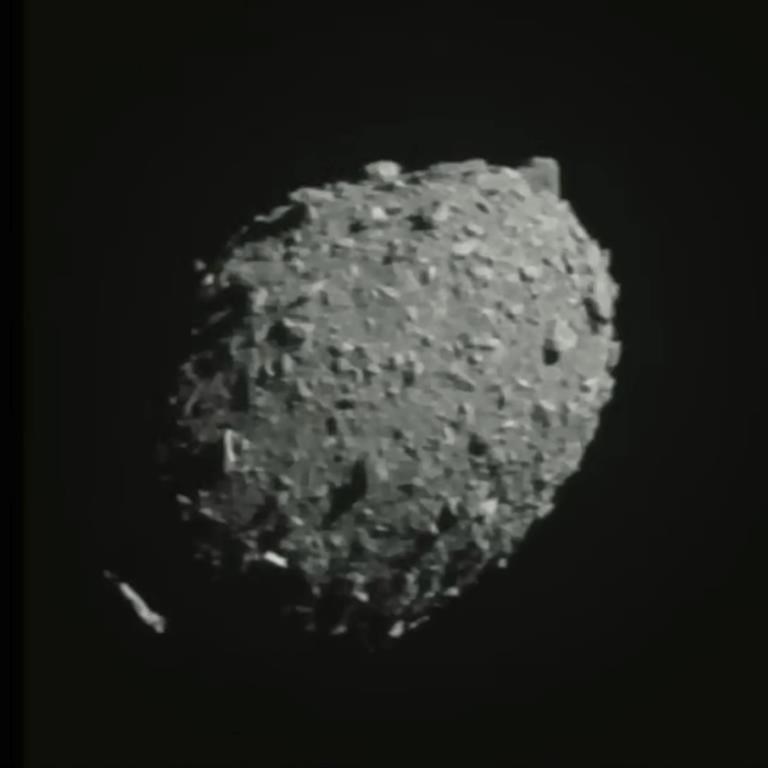
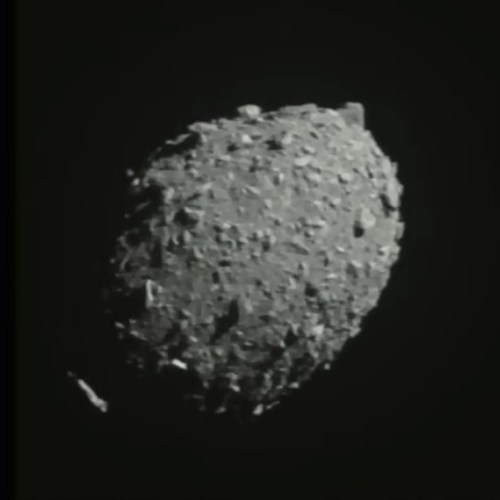
In this image made from a NASA livestream and taken from the Double Asteroid Redirection Test spacecraft, asteroid Dimorphos is seen as the spacecraft flies toward it, Monday, Sept. 26, 2022. (ASI/NASA via AP)

Neither asteroid posed a threat to Earth — and still don’t as they continue their journey around the sun. That’s why scientists picked the pair for this all-important dress rehearsal.

Planetary defense experts prefer nudging a threatening asteroid or comet out of the way, given years or even decades of lead time, rather than blowing it up and creating multiple pieces that could rain down on Earth.

“We really need to also have that warning time for a technique like this to be effective,” said mission leader Nancy Chabot of Johns Hopkins University’s Applied Physics Laboratory, which built the spacecraft and managed the $325 million mission.

“You’ve got to know they’re coming,” added Glaze.

Launched last year, the vending machine-size Dart — short for Double Asteroid Redirection Test — was destroyed when it slammed into the asteroid 7 million miles (11 million kilometers) away at 14,000 mph (22,500 kph).
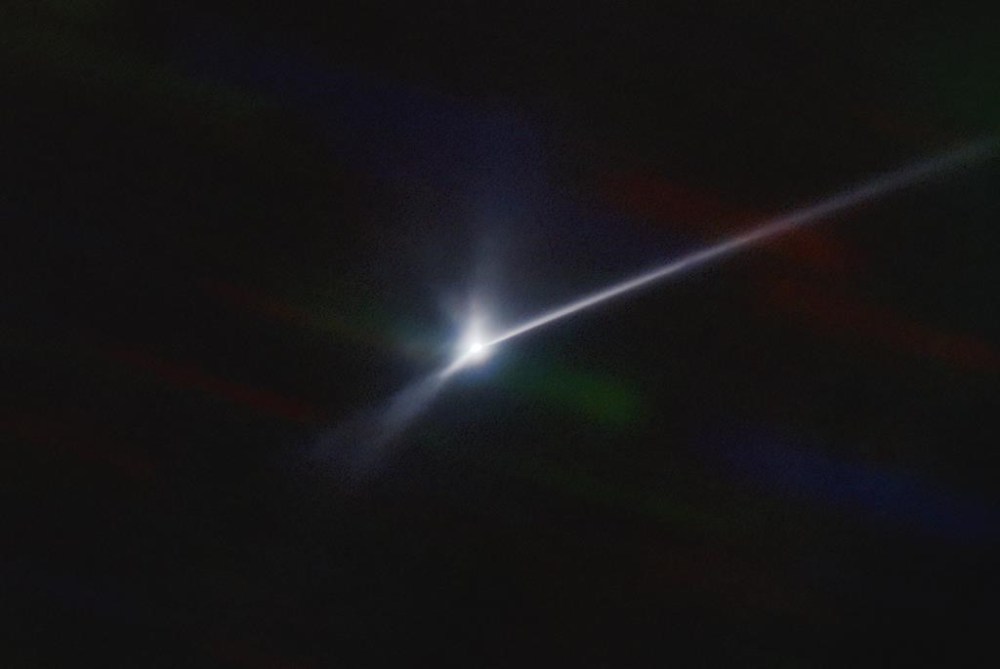
This image made available by NOIRLab shows a plume of dust and debris blasted from the surface of the asteroid Dimorphos by NASA's DART spacecraft after it impacted on Sept. 26, 2022, captured by the U.S. National Science Foundation's NOIRLab's SOAR telescope in Chile. The expanding, comet-like tail is more than 6,000 miles (10,000 kilometers) long. (Teddy Kareta, Matthew Knight/NOIRLab via AP)

“This is huge feat, not only in achieving the first step in possibly being able to protect ourselves from future asteroid impacts,” but also for the amount of images and data collected internationally, Daniel Brown, an astronomer at Nottingham Trent University in England, said via email.

Brown also said that it’s “particularly exciting” that the debris tail can be seen by amateur skygazers with medium-size telescopes.

Team scientists cautioned more work is needed to not only identify more of the countless space rocks out there, but to ascertain their makeup — some are solid, while others are rubble piles. Scouting missions might be needed, for instance, before launching impactors to deflect the orbits.

“We should not be too eager to say one test on one asteroid tells us exactly how every other asteroid would behave in a similar situation,” Statler said.

Nonetheless, he and others are rejoicing over this first effort.

”We’ve been imagining this for years and to have it finally be real is really quite a thrill,” he said.
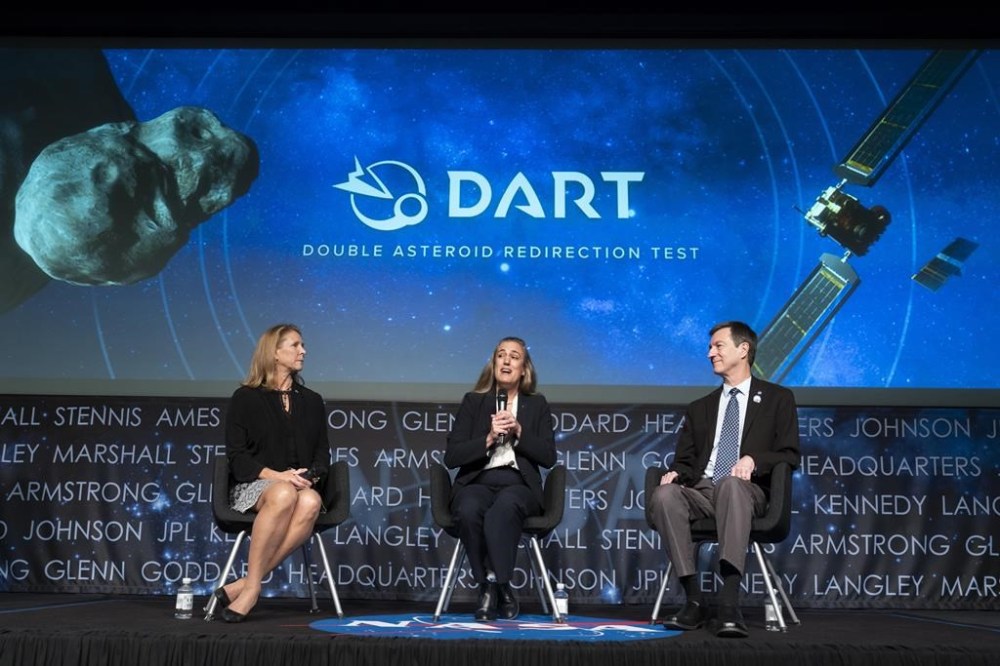
NASA Planetary Science Division director Lori Glaze, left, John Hopkins Applied Physics Laboratory DART coordination lead Nancy Chabot, and DART program scientist Tom Statler speak during a media briefing about the agency's recently completed Double Asteroid Redirection Test (DART), at NASA headquarters Tuesday, Oct. 11, 2022, in Washington. The DART mission saw the spacecraft collide with the asteroid Dimorphos in an attempt to test whether the resulting kinetic force could redirect an asteroid's course to protect Earth against potential impacts. (AP Photo/Alex Brandon)

___

The Associated Press Health and Science Department receives support from the Howard Hughes Medical Institute’s Department of Science Education. The AP is solely responsible for all content.


Report Error Submit a Tip

More Stories

Man gets 18 year sentence for sex assault that impregnated teen girl

Tessa Adamski 4 minute read Yesterday at 2:01 AM CDT

BRANDON — A 29-year-old man has been sentenced to 18 years in prison for sexually abusing and impregnating a 14-year-old girl in 2024.

“Sexual abuse of a child is inherently a grave violation of the child’s bodily integrity, dignity, and security, and in this case, the consequences were compounded by the victim’s pregnancy and the need to undergo a termination,” Brandon provincial court Judge Patrick Sullivan said on Tuesday.

The accused had pleaded guilty to two counts of sexual interference and two counts of breaching a court order banning him from contacting anyone under 18.

A publication ban prohibits the publication of information that could identify the 14-year-old, who is from a western Manitoba First Nation, and two other minors with whom he communicated.

A community brought the Trident Press home

Stephen Borys 6 minute read Preview

A community brought the Trident Press home

Stephen Borys 6 minute read 2:00 AM CDT

A truck pulled up outside Oseredok a few weeks ago carrying more than an exhibition.

Inside were the panels of Ukrainian Voice: A Legacy Mosaic, a monumental artwork built from the printing blocks once used to reproduce the photographs and illustrations in one of Canada’s longest-running Ukrainian newspapers.

A dozen people gathered to unload it. Some were longtime members of Winnipeg’s Ukrainian community; others were newcomers who had arrived since Russia’s full-scale invasion of Ukraine. Together, they lifted, unpacked and carried the panels through Oseredok’s doors.

It was an ordinary act of volunteer labour, but also a fitting final stage in an extraordinary journey. More than a century ago, Ukrainian newcomers created the newspaper whose printing blocks form the mosaic. Now another generation of newcomers was helping bring that history home.

Read
2:00 AM CDT

Online fundraiser for ‘polite, modest farmer’ facing firearms charges sending message, neighbour says

Nicole Buffie 4 minute read Preview

Online fundraiser for ‘polite, modest farmer’ facing firearms charges sending message, neighbour says

Nicole Buffie 4 minute read Yesterday at 5:45 PM CDT

Thousands of dollars have been raised to help cover the legal fees of a Manitoba man charged after he allegedly fired a gun at thieves during a theft on his farm in August.

Read
Yesterday at 5:45 PM CDT

Smashing success: NASA asteroid strike results in big nudge

Marcia Dunn, The Associated Press 5 minute read Preview

Smashing success: NASA asteroid strike results in big nudge

Marcia Dunn, The Associated Press 5 minute read Tuesday, Oct. 11, 2022

CAPE CANAVERAL, Fla. (AP) — A spacecraft that plowed into a small, harmless asteroid millions of miles away succeeded in shifting its orbit, NASA said Tuesday in announcing the results of its save-the-world test.

The space agency attempted the test two weeks ago to see if in the future a killer rock could be nudged out of Earth’s way.

“This mission shows that NASA is trying to be ready for whatever the universe throws at us,” NASA Administrator Bill Nelson said during a briefing at the space agency's headquarters in Washington.

The Dart spacecraft carved a crater into the asteroid Dimorphos on Sept. 26, hurling debris out into space and creating a cometlike trail of dust and rubble stretching several thousand miles (kilometers). It took consecutive nights of telescope observations from Chile and South Africa to determine how much the impact altered the path of the 525-foot (160-meter) asteroid around its companion, a much bigger space rock.

Read
Tuesday, Oct. 11, 2022

Gas turbine peaker plants are a mistake

Don Scott 7 minute read 2:00 AM CDT

Technology respecting electricity generation, storage and grid management is rapidly advancing and displacing gas-fired peaker plants. New battery storage systems are more efficient and less costly, smooth grid flow and are non-polluting. Texas, California and Australia are replacing gas turbine peaker plants with more effective storage batteries.

Solar and wind energy generation combined with battery storage at both the grid and home/business level is the most efficient way to meet peak demand. Building expensive, outdated, polluting American gas turbines, as Manitoba Hydro is proposing, is not in Manitoba’s interest.

Premier Wab Kinew noted that a final decision to build a new turbine power plant in Brandon has not been made. I hope he’s correct, for if Manitoba Hydro already made the decision and entered binding financial obligations with GE Vernova, the PUB’s role was superfluous.

In 2025/26 Nova Scotia Power installed 3 x 50 MW Lithium-ion grid batteries with the storage capacity of over 600 MWh. Installed by Kitchener/Waterloo based Canadian Solar’s subsidiary e-Storage who have operations around the world, they accomplished this in less than two years from the approval date in June 2024. Two were operational within 18 months, the third in 24. The cost was $237 million. At Nova Scotia’s cost per MW, a 750 MW battery peaker facility would cost Hydro $1.185 billion, just 40 per cent of the proposed $3 billion gas peaker plant.

A distant island and a European border

Editorial 4 minute read Preview

A distant island and a European border

Editorial 4 minute read 2:00 AM CDT

It’s at roughly 80°49′35″ North latitude and 66°27′30″West longitude.

Or, you might also know it as being in the Kennedy Channel of the Nares Strait in the high Arctic.

It’s Hans Island, an island that’s split between the Kingdom of Denmark and Canada.

The border was a bone of contention between the two nations for years, but not one that sired threats of annexation. Each simply claimed it as their own.

Read
2:00 AM CDT