

Feds inject $17M to make it easier to ship goods
New actions aim to streamline regulations, cut red tape across supply chains

Advertisement
Read this article for free:
or
Already have an account? Log in here »
To continue reading, please subscribe:

Digital Subscription
One year of digital access for only $205*
- Enjoy unlimited reading on winnipegfreepress.com
- Read the E-Edition, our digital replica newspaper
- Access News Break, our award-winning app
- Play interactive puzzles
*First annual payment billed as $205.00 + GST for one year. This annual subscription will automatically renew at $233.00 + GST every 52 weeks (10% off the regular annual price of $259.35). Offer available to new and qualified returning subscribers only. Cancel any time.
To continue reading, please subscribe:
Add Free Press access to your Brandon Sun subscription for only an additional
$1 for the first 4 weeks*
- Enjoy unlimited reading on winnipegfreepress.com
- Read the E-Edition, our digital replica newspaper
- Access News Break, our award-winning app
- Play interactive puzzles
*Your next Brandon Sun subscription payment will increase by $1.00 and you will be charged $17.95 plus GST for four weeks. After four weeks, your payment will increase to $24.95 plus GST every four weeks.
Read unlimited articles for free today:
or
Already have an account? Log in here »
Hey there, time traveller!
This article was published 14/10/2022 (1434 days ago), so information in it may no longer be current.
Winnipeg’s airport was the launchpad of a $17 million funding announcement aimed at improving supply chains.
Federal Transport Minister Omar Alghabra touted “investments that keep our supply chains moving and easing congestion” Thursday.
The $17 million, which Ottawa committed to in its latest budget, will be spread across five years and streamline operations between train, plane and sea in Canada, Alghabra said.
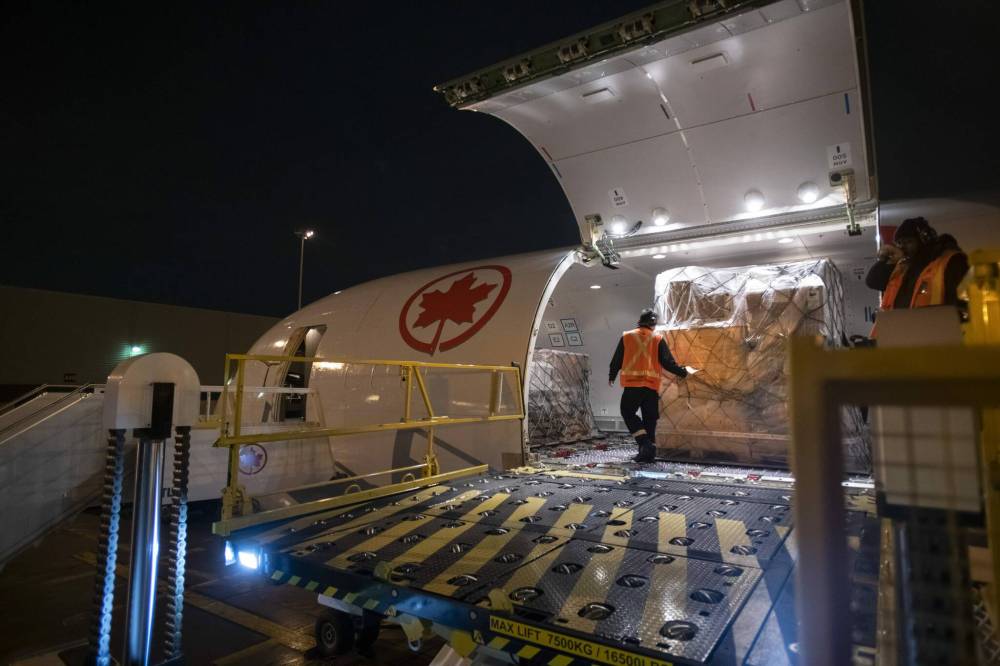
Fred Lum/The Globe and Mail.
Freight crews offload goods from an Air Canada 767.
When asked how much would be allocated specifically to Manitoba, his office did not respond by print deadline.
The $17 million will be put towards, in part, shifting from physical paper to the use of electronic shipping documents when transporting dangerous goods; launching a system to improve air cargo security; and creating a uniform system for digital information regarding ships in Maritime ports.
Ottawa has already amended the Canada Transport Act so Transport Canada can offer digital services, Alghabra noted.
Alghabra’s announcement comes on the heels of a National Supply Chain Task Force report, released earlier this month. The task force made 21 recommendations on how to improve Canada’s supply networks.
“Is this a good move? Absolutely, it’s a good move. Is it the only thing needed to make our supply chains more efficient? No, and (the government) will understand that,” said Diane Gray, CentrePort Canada’s president, who is leaving the helm of North America’s largest trimodal inland port next week.
Supply chain backlogs still persist, but it depends on what you’re ordering, she said, noting there are still shortages of vehicle parts and overhead doors are taking longer to arrive than before the pandemic.
Tackling infrastructure, labour shortages and regulatory challenges are crucial, she said, adding she would like to see streamlined shipping procedures across provinces.
Labour is the top issue affecting Manitoba’s trucking industry, said Aaron Dolyniuk, executive director of the Manitoba Trucking Association.
He applauded the task force recommendations, namely, those focused on recruiting and training workers.
“That’s music to our ears,” he said.
A 2021 Manitoba Labour report stated 5,000 truck driver positions would be opening over a five-year period.
“I don’t believe we are anywhere near that number (of new recruits) now,” Dolyniuk said.
He responded positively to Alghabra’s announcement to digitalize dangerous goods documents. He also pointed to the Canada-U.S. border, where trucks have been lining up in excess of two kilometres to cross.
More border security officials are needed to keep things moving, he said.
“If you speed up the ability for people to move things because the paperwork (is) a lot easier, then by default, you’re going to see products be able to come quicker,” said Rick Reid, executive director of Supply Chain Canada’s Manitoba branch.

Patrick Doyle / The Canadian Press
Transport Minister Omar Alghabra makes an announcement on ending vaccine mandates for domestic travellers, transportation workers, and federal employees.
He questioned whether there would be enough border officials to meet demand.
Committing money to transportation infrastructure is crucial, Reid added.
Most parcels from Asia come through Vancouver, so if the port is in crisis, as it was during last year’s atmospheric storm, numerous organizations’ supply chains are affected, he said.
The national task force addresses infrastructure in its report, including changes to major roads.
Alghabra said he plans to make further announcements in line with the recommendations, though he didn’t specify dates on Thursday.
The task force report recommends waiving 50 per cent of airports’ rent in the short term so they can focus on infrastructure.

“If we can build that out, it’s only going to strengthen the supply chain for our country,” said Tyler MacAfee, the Winnipeg Airports Authority’s vice-president of external affairs.
Money would go towards building the airport’s new cargo plane facility, MacAfee said.
Cargo planes have accounted for about 18 per cent of the airport’s total landings this year.
Federal Industry Minister François-Philippe Champagne is looking at attracting investment back to Canada for more homegrown manufacturing, Alghabra said.
gabrielle.piche@winnipegfreepress.com
Gabrielle Piché reports on business for the Free Press. She interned at the Free Press and worked for its sister outlet, Canstar Community News, before entering the business beat in 2021. Read more about Gabrielle.
Every piece of reporting Gabrielle produces is reviewed by an editing team before it is posted online or published in print — part of the Free Press‘s tradition, since 1872, of producing reliable independent journalism. Read more about Free Press’s history and mandate, and learn how our newsroom operates.
Our newsroom depends on a growing audience of readers to power our journalism. If you are not a paid reader, please consider becoming a subscriber.
Our newsroom depends on its audience of readers to power our journalism. Thank you for your support.
Gabrielle Piché reports on business for the Free Press. She interned at the Free Press and worked for its sister outlet, Canstar Community News, before entering the business beat in 2021. Read more about Gabrielle.
Every piece of reporting Gabrielle produces is reviewed by an editing team before it is posted online or published in print — part of the Free Press‘s tradition, since 1872, of producing reliable independent journalism. Read more about Free Press’s history and mandate, and learn how our newsroom operates.
Our newsroom depends on a growing audience of readers to power our journalism. If you are not a paid reader, please consider becoming a subscriber.
Our newsroom depends on its audience of readers to power our journalism. Thank you for your support.
Advertisement Advertise With Us
Advertisement Advertise With Us
History
Updated on Friday, October 14, 2022 4:39 PM CDT: Story edit