

Partners in progress
Deal puts Indigenous training centre on path to offering certificates in insurance, glass and industrial painting
Advertisement
Read this article for free:
or
Already have an account? Log in here »
To continue reading, please subscribe:
Monthly Digital Subscription
$1 per week for 24 weeks*
- Enjoy unlimited reading on winnipegfreepress.com
- Read the E-Edition, our digital replica newspaper
- Access News Break, our award-winning app
- Play interactive puzzles
*Billed as $4.00 plus GST every four weeks. After 24 weeks, price increases to the regular rate of $19.95 plus GST every four weeks. Offer available to new and qualified returning subscribers only. Cancel any time.
Monthly Digital Subscription
$4.99/week*
- Enjoy unlimited reading on winnipegfreepress.com
- Read the E-Edition, our digital replica newspaper
- Access News Break, our award-winning app
- Play interactive puzzles
*Billed as $19.95 plus GST every four weeks. Cancel any time.
To continue reading, please subscribe:
Add Free Press access to your Brandon Sun subscription for only an additional
$1 for the first 4 weeks*
*Your next subscription payment will increase by $1.00 and you will be charged $16.99 plus GST for four weeks. After four weeks, your payment will increase to $23.99 plus GST every four weeks.
Read unlimited articles for free today:
or
Already have an account? Log in here »
Hey there, time traveller!
This article was published 20/10/2022 (1281 days ago), so information in it may no longer be current.
Neeginan College of Applied Technology, the urban Indigenous education and training organization based in the old CP Rail station on Higgins Avenue, has been working with Manitoba Institute of Trades and Technology (MITT) for many years.
On Wednesday, the two schools signed an official partnership agreement that could lead to the development of new course curriculum as well as MITT providing accreditation for courses that Neeginan delivers.
Although Neeginan has been around for about 30 years, it does not have the status to allow it to grant certificates or diplomas or degrees on its own.
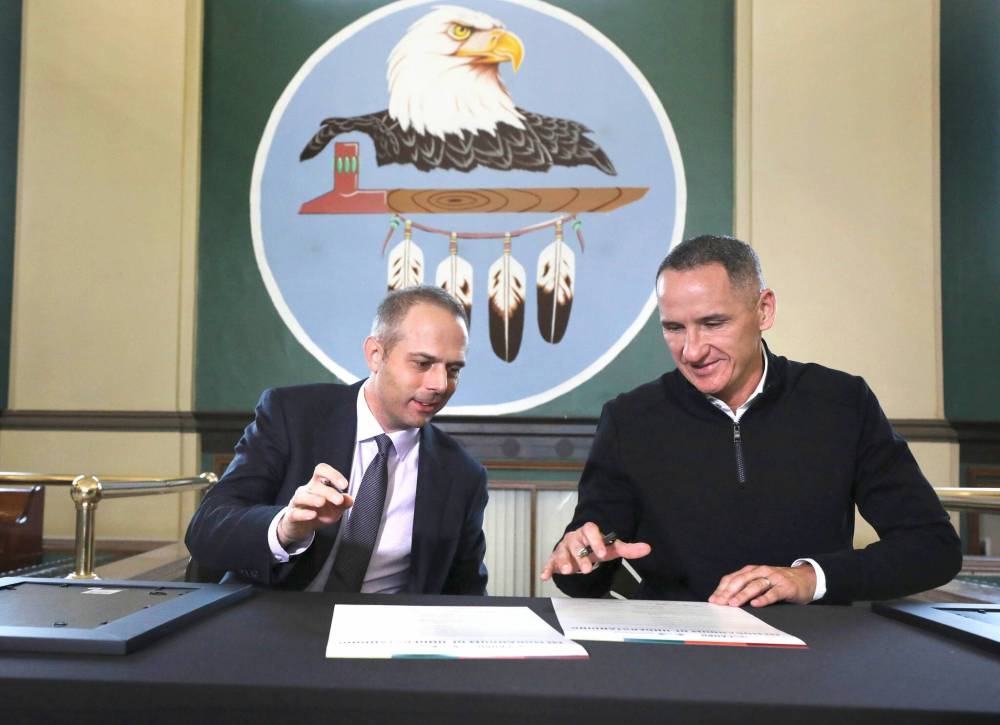
RUTH BONNEVILLE / WINNIPEG FREE PRESS
Ray Karasevich, president of the Manitoba Institute of Trades and Technology, and Kevin Chief, chairman of the Centre for Aboriginal Human Resource Development, sign a deal that opens the door to training more Indigenous people for well-paying jobs in industrial painting, glass work and insurance.
However, through partnerships such as the one it has had with MITT, it can deliver certain training programs and provide provincially recognized certification for graduating students. It also had similar partnerships with other degree-granting institutions.
It has already done just that successfully with MITT on courses that Neeginan has offered in early childhood education and building operations technicians.
In both cases either MITT developed the curriculum or the schools did it on a joint basis.
The two training organizations are now in the early stages of developing training courses in industrial painting, glazier (tradesmen that cut, install and remove glass and glass substitutes) and insurance industry workers.
Both Ray Karasevich, the CEO of MITT, and Heather McCormick, director of education at Neeginan College, said that industry has told them that there is a shortage of workers in those fields right now.
Karasevich said MITT sees these partnerships as a form of reconciliation in education.
“MITT will add value when it can,” he said. “Neeginan delivers training directly to people in inner city in a really effective way that creates better outcomes like getting good jobs and further opportunities.”
Neeginan is part of the Centre for Aboriginal Human Resource Development Inc. (CAHRD) which provides wrap-around support for students including day care and housing as part of its mandate to overcome the barriers many urban Indigenous people still face in Winnipeg to achieve self-sufficiency.
McCormick said Neeginan is not interested in providing training that would only lead to minimum wage positions.
“Our students are often older and they need to be able to support their families,” she said. “We also like to look at training that is relatively short for our clients so we can get them in, provide solid training and get them out to good paying jobs. We are talking about jobs that provide a living wage.”
The experience with the early childhood education program has been gratifying for both sides. Neeginan first took MITT’s curriculum and then made adjustments to address some Indigenous realities and now it provides its own provincially recognized certificate for that program.
Neeginan has graduated about 15 people in the two programs all of whom are now in the workforce.
Marileen Bartlett, the longtime executive director at CAHRD, said enrolment is currently down about 25 per cent as a result of pandemic disruptions.
Neeginan still had a mask mandate in place in the facility. Bartlett said there are still many people among its clientele who are not vaccinated and the organization is about to set up another mini vaccination clinic.
She is also in process of seeking additional capital to fund an expansion. More space is required before it would be able to offer an industrial painting training program, for instance.
But it does not need more space to deliver an insurance brokers program. That industry currently has about 500 positions that need filling in the province, said Kevin Chief, the former NDP cabinet minister and chairman of CAHRD’s board.
“We know that’s a big industry and there is a lot of demand right now,” he said.
He recognizes it is an industry that traditionally doesn’t hire a lot of Indigenous people.

“When you think about industrial painting it is self-evident and it makes sense,” he said. “The other end of the spectrum is the insurance industry. But that is how we have to think about opportunities. We need to get Indigenous people represented in all the different sectors.”
Chief believes it is irresponsible to encourage Indigenous youth to pursue certain careers when they have no role models to look up to.
“If you don’t know anyone in your family or peer group in the insurance industry, for example, you would never think it is a plausible job,” he said.
But Chief said the fact the Indigenous population is younger and growing faster than the non-Indigenous population in Winnipeg means it only makes sense for industry and the community at large to tap into that growing demographic.
martin.cash@freepress.mb.ca
History
Updated on Thursday, October 20, 2022 9:01 AM CDT: Adds web headline