A hub for helping
Being headquartered on the Prairies contributes to unique character of aid organizations

Advertisement
Read this article for free:
or
Already have an account? Log in here »
To continue reading, please subscribe:

Digital Subscription
One year of digital access for only $205*
- Enjoy unlimited reading on winnipegfreepress.com
- Read the E-Edition, our digital replica newspaper
- Access News Break, our award-winning app
- Play interactive puzzles
*First annual payment billed as $205.00 + GST for one year. This annual subscription will automatically renew at $233.00 + GST every 52 weeks (10% off the regular annual price of $259.35). Offer available to new and qualified returning subscribers only. Cancel any time.
To continue reading, please subscribe:
Add Free Press access to your Brandon Sun subscription for only an additional
$1 for the first 4 weeks*
- Enjoy unlimited reading on winnipegfreepress.com
- Read the E-Edition, our digital replica newspaper
- Access News Break, our award-winning app
- Play interactive puzzles
*Your next Brandon Sun subscription payment will increase by $1.00 and you will be charged $17.95 plus GST for four weeks. After four weeks, your payment will increase to $24.95 plus GST every four weeks.
Read unlimited articles for free today:
or
Already have an account? Log in here »
Hey there, time traveller!
This article was published 10/12/2022 (1404 days ago), so information in it may no longer be current.
Winnipeg is known for being home to leading companies in the areas of agribusiness, insurance, manufacturing and aerospace, among others
But it’s also known across Canada for being home to three of the country’s leading international relief and development organizations — Mennonite Central Committee Canada (MCC), Canadian Lutheran World Relief (CLWR) and Canadian Foodgrains Bank (CFGB).
Together, the three provided over $150 million of assistance to more than 1.6 million people in the developing world last year — encompassing food, water, shelter, health, education and other forms of aid.
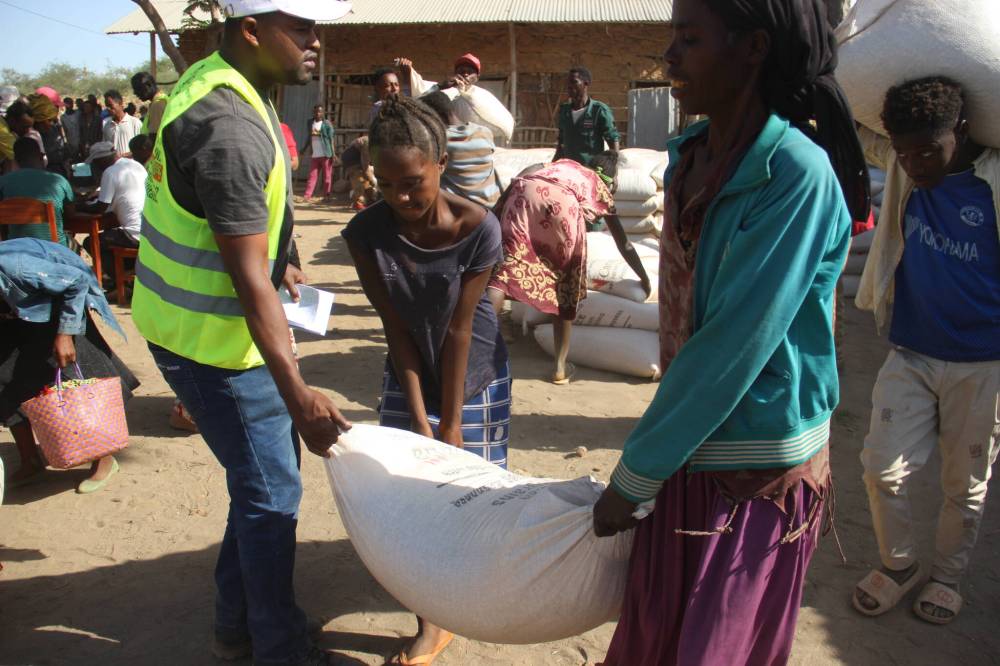
CLWR
Food assistance is provided by a Foodgrains Bank member.
Most of their funding came as donations from people across Canada, including from Manitoba.
MCC received $78 million in donations last year, with $13 million coming from Manitoba. The CFGB received $18.6 million, $4.1 million of which came from this province. And CLWR raised $4.9 million, getting over $700,000 from Manitobans.
The three organizations also received a total of $37 million in grants from the Government of Canada, with the bulk of it — $31 million — going to the CFGB, including an annual $25 million matching grant.
For all three, being headquartered in Manitoba contributes to their unique character.
“Many Mennonites who came to Manitoba once were hungry, victims of war and refugees themselves,” said MCC executive director Rick Cober Bauman. “That has helped shaped the way we respond.”
One of MCC’s most successful fundraising programs — the thrift shop movement, now with 85 shops — started in Altona in 1972, Cober Bauman noted.
“It grew out of a southern Manitoba sense of generosity and hospitality,” he said, noting the shops have provided over $300 million to MCC since that time.
A connection to rural people and farmers is also important. “The Prairies helped shaped MCC,” he said.
Andy Harrington, executive director of Canadian Foodgrains Bank feels the same way about that organization.
He noted the CFGB was born when Manitoba farmers came together in the 1970s to donate surplus grain to help feed hungry people in the developing world.
“With our roots on the Prairies, Winnipeg is a logical home base,” said Harrington. “It keeps us close to our farming roots.”
For Karin Achtelstetter, executive director of CLWR, “it makes absolute sense for us to be here.”
Formed in 1946 to help refugees in postwar Europe, CLWR brought 22,000 German Lutherans to Canada. Many of them found new homes in Winnipeg.
“In any Lutheran congregation in Winnipeg, there will be people whose parents or grandparents came here from Europe with help from CLWR,” Achtelstetter said.
As well, the two church denominations that support CLWR — the Evangelical Lutheran Church In Canada and Lutheran Church Canada — are also headquartered here.
“We have strong connections with both denominations,” she said, adding it is “good to be halfway between the east and west.”
Generous Manitobans
The heads of all three organizations noted that being in Manitoba is also beneficial since it is home to some of the most generous people in Canada.
According to the Fraser Institute, in 2021 the province had the highest percentage of Canadian tax filers that donated to charity — 21.9 per cent. Manitobans also donated the highest percentage of their income to charity (0.74 per cent).
Charitable Impact, an organization that encourages giving, reported that Winnipeg was the seventh-most generous city in Canada last year, while Steinbach and Winkler are second and third when it comes to places that have the most residents claiming charitable tax receipts when filing tax returns.
“Manitoba is known for its generosity, with southern Manitoba communities in the top for generosity every year,” said Bruce Guenther, who directs disaster response for MCC.
Government connections
Since all three groups work closely with the federal government in providing aid, being located in Winnipeg sometimes makes it difficult to stay connected with civil servants and politicians. That’s why MCC and the CFGB have offices in Ottawa; CLWR is considering opening one there.
But being so far from Ottawa isn’t always a disadvantage, said Louis Belanger, who directed communications in the office of the minister of development under the Liberals for five years.
Since almost all of Canada’s other international relief and development organizations are headquartered in Toronto, Ottawa or Montreal, it’s politically important for the federal government to be seen to be supporting western Canadian aid groups, he observed.
“It was always good to show diversity in funding,” he said, adding “they were seen and heard by the government and known for the high level of engagement by their supporters. That impressed people in government.”
Belanger added the three organizations are also seen as reliable partners with the government that “could be counted on to work with us to respond to a crisis.”
MCC, CLWR and the CFGB also make a valuable contribution to the larger Canadian relief and development sector, said Richard Morgan, executive director of the Humanitarian Coalition.
The three frequently lead the way when it comes to fundraising for the Coalition, which is comprised of 12 of Canada’s leading aid agencies including the CFGB and CLWR. MCC is part of the Coalition through its membership in the CFGB.
“They are very good at mobilizing their supporters,” said Morgan, adding they are also strong advocates for meeting the needs of people who aren’t getting much media attention.
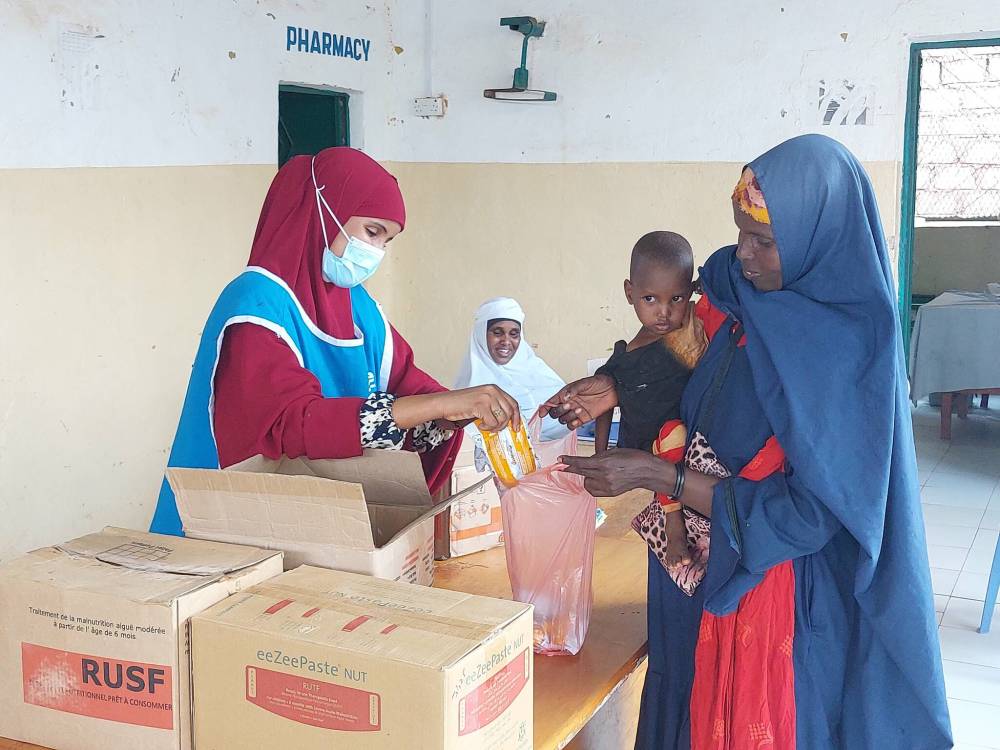
CLWR
A Somali woman picks up food for her child at the Dollow Referral Hospital.
“MCC, CLWR and CFGB keep saying we must do something, even if it isn’t in the media, because it’s the right thing to do,” he said.
Their faith perspective is also important, he said. “It enables the Coalition to have a deeper reach through their church partners in the developing world and it helps us connect with Canadians through their churches across the country,” he said.
That’s really important, Morgan added, since it enables the Coalition to “leverage donations through faith communities.”
Their presence also helps the Coalition when appealing to the government, media and corporations for support for needs in the developing world. “These groups anchor our presence in the West and help us make a stronger case for support,” he said.
Stretched by the world’s needs
All three groups are stretched as they respond to the many needs around the world.
This includes the global hunger crisis, “which is not widely enough known,” said Harrington, noting the number of people who are hungry in the developing world has increased from 690 million people in 2019 to 828 million now.
“After years of decreasing, it’s increasing again due to conflict and climate change,” he said, noting that conflict is a big driver of hunger. “Projections are that next year could be worse.”
Climate change is also a factor, said Stefan Epp-Koop, who directs humanitarian aid programs at the CFGB.
“Climate change is causing more extreme shocks for vulnerable people,” he said, noting places especially hard-hit include the northern part of Kenya, Somalia, South Sudan and Pakistan.
“People are dying,” he said. “Even if the rains come, their livelihoods are so damaged now.”
Together with strained supply chains and the rising cost of food, the CFGB “is stretched,” Epp-Koop said. “There is so much need. We are running pretty hard these days.”
When asked about needs today, Akililu Hunqe, who directs programs and partnerships for CLWR, said “there are so many — where to start?”
Hunger is a big problem in parts of Africa, where conflict has caused many to go without food. “Our food is just beginning to arrive in Ethiopia,” he said, adding that climate change is also a huge issue.
For MCC, Ukraine — where the organization began in 1920 — is a major response.
“Our partners there are working very hard under extremely challenging circumstances,” said Guenther, adding MCC is sending quilts to that country to help people cope with the cold.
At the same time, the organization doesn’t want people to forget about other needs such as in Cuba, which was hit hard by hurricane Ian, and in places like South Sudan and the Democratic Republic of Congo, where conflict is displacing many people.
People in need ‘not forgotten’
While major needs like Ukraine make the news, all three groups are responding to needs getting little or no media attention.
“We see how quickly the media focus shifts,” said Achtelstetter of how disasters are quickly replaced by other news.
When reporters move on, “we are still there,” she said. “We want to send a strong message to people in need that they are not forgotten.”

That’s something Harrington often hears when he visits people in the developing world.
People often say they feel overlooked, he said. “We want to prove to them that isn’t true, that the church in Canada has remembered them. Through our work we want to show that God cares about the poor.”
MCC also wants its supporters to remember those who may be overlooked at their time of need, said Cober Bauman.
“At our best we are a thin membrane between the needs of the world and donors in Canada,” he said. “We want them to touch and be touched by the needs of the world.”
faith@freepress.mb.ca
The Free Press is committed to covering faith in Manitoba through our Religion in the News project. This reporting continues because readers like you step forward to fund it.
Donate now to support our reporting on religion.
Your donation is eligible for a charitable tax receipt.
BECOME A FAITH JOURNALISM SUPPORTER
Our newsroom depends on a growing audience of readers to power our journalism. If you are not a paid reader, please consider becoming a subscriber.
Our newsroom depends on its audience of readers to power our journalism. Thank you for your support.
Aid organizations based in Winnipeg
Canadian Foodgrains Bank
Rated a top-10 impact charity by Charity Intelligence
Mission: A Christian response to hunger
Founded in 1983, the Foodgrains Bank is an association of 15 church-related aid groups, including MCC and CLWR, that work together to end global hunger.
foodgrainsbank.ca
Canadian Lutheran World Relief
Rated a four-star (out of five) impact charity by Charity Intelligence
Mission: Inspired by God’s love for humanity, CLWR challenges the causes and responds to the consequences of human suffering and poverty.
Founded in 1946, CLWR has offices in Ontario and B.C.
clwr.org
Mennonite Central Committee Canada
Rated a top-100 impact charity by Charity Intelligence
Mission: Relief, development and peace in the name of Christ
Founded in 1920, MCC has provincial offices in B.C., Alberta, Saskatchewan, Manitoba, Ontario and Atlantic Canada, and also responds to needs in those provinces.
mcccanada.ca
The Free Press is committed to covering faith in Manitoba through our Religion in the News project. This reporting continues because readers like you step forward to fund it.
Donate now to support our reporting on religion.
Your donation is eligible for a charitable tax receipt.
BECOME A FAITH JOURNALISM SUPPORTER
Our newsroom depends on a growing audience of readers to power our journalism. If you are not a paid reader, please consider becoming a subscriber.
Our newsroom depends on its audience of readers to power our journalism. Thank you for your support.
Advertisement Advertise With Us
Advertisement Advertise With Us
The Free Press acknowledges the financial support it receives from members of the city’s faith community, which makes our coverage of religion possible.