Strong performances buoy drama’s heavy subject matter

Advertisement
Read this article for free:
or
Already have an account? Log in here »
To continue reading, please subscribe:

Digital Subscription
One year of digital access for only $205*
- Enjoy unlimited reading on winnipegfreepress.com
- Read the E-Edition, our digital replica newspaper
- Access News Break, our award-winning app
- Play interactive puzzles
*First annual payment billed as $205.00 + GST for one year. This annual subscription will automatically renew at $233.00 + GST every 52 weeks (10% off the regular annual price of $259.35). Offer available to new and qualified returning subscribers only. Cancel any time.
To continue reading, please subscribe:
Add Free Press access to your Brandon Sun subscription for only an additional
$1 for the first 4 weeks*
- Enjoy unlimited reading on winnipegfreepress.com
- Read the E-Edition, our digital replica newspaper
- Access News Break, our award-winning app
- Play interactive puzzles
*Your next Brandon Sun subscription payment will increase by $1.00 and you will be charged $17.95 plus GST for four weeks. After four weeks, your payment will increase to $24.95 plus GST every four weeks.
Read unlimited articles for free today:
or
Already have an account? Log in here »
Hey there, time traveller!
This article was published 22/12/2022 (1359 days ago), so information in it may no longer be current.
Director Darren Aronofsky has demonstrated a penchant for grandiose metaphysical statements in past films, such as The Fountain, Black Swan and Mother!, but he is back down to earth in his new film, The Whale.
Probably his stagiest film (based on the play of the same name by Samuel D. Hunter), it falls into the other category of Aronofsky films, portraits of outcasts caught in an inexorable death spiral (The Wrestler, Requiem for a Dream).
Its focus is Charlie (Brendan Fraser), an English teacher who teaches online classes (pre-pandemic Charlie is ahead of the teaching curve, since the movie takes place in 2016, as evidenced by TV news reporting on that year’s Republican primaries).
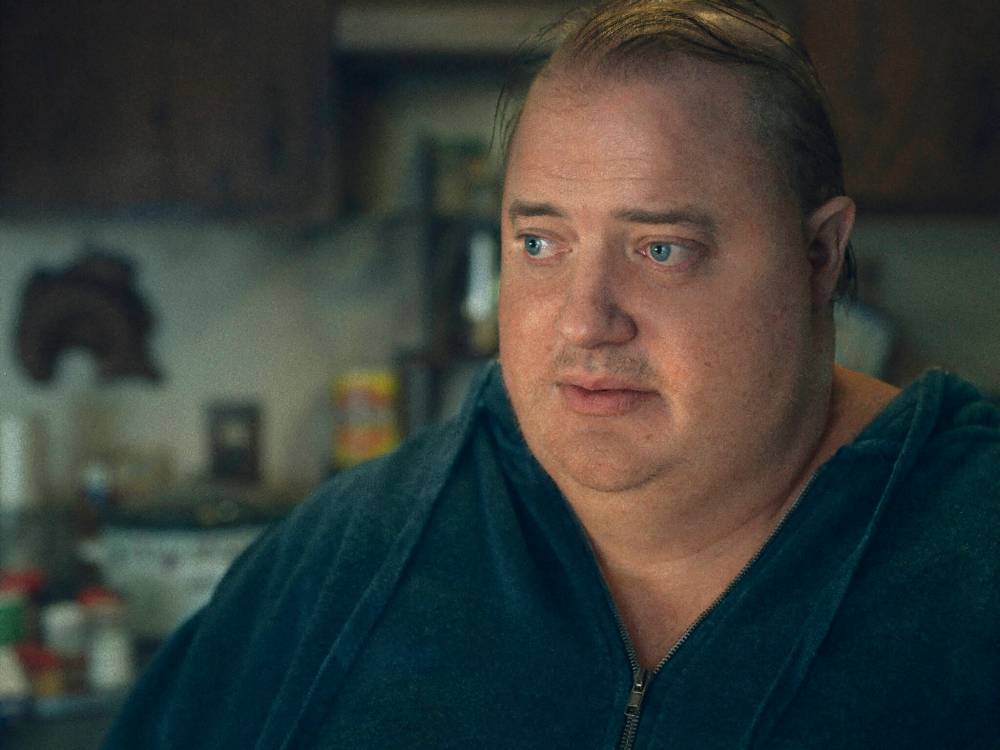
Charlie’s reasons for doing so are not pandemic-related. He is housebound in his Idaho apartment due to his crippling obesity. He keeps his own laptop camera off during his classes so his students are none the wiser about his physical condition.
The film opens with an uncomfortable scene in which Charlie is caught enjoying online gay porn. He comes close to suffering a heart attack when he is interrupted by a young evangelist at his door.
Thomas (Ty Simpkins) comes from an evangelical church whose promise is right there in its name: New Life. The kid is a zealot, but Charlie is not receptive. It turns out Charlie’s deceased lover was also a member of that evangelical sect, and the church’s influence only paid off in tragedy for the couple.
We learn the details through Charlie’s visiting nurse, Liz (Hong Chau), herself on a mission to save Charlie from his self-destructive eating disorder. It is Liz who breaks the news to Charlie that if he doesn’t get to a hospital, he will surely die.
But Charlie has some unsettled business with his teen daughter Ellie (Sadie Sink of Stranger Things), who comes to Charlie’s two-bedroom apartment filled with righteous rage, given that Charlie left her when she was eight years old and hasn’t seen her since.
Ellie’s embittered mother Mary (Samantha Morton) was somewhat responsible for his exile. (The film will even-handedly give her side.)
Amid the domestic drama, the film presents a mystery early on in the form of an English essay about Moby-Dick that Charlie reads when he is in crisis, like an asthma sufferer ingesting the medicine in an inhaler. It turns out to be a beautiful solve, though it would seem to contradict some characters’ assertion that nobody can really save anybody.
The Whale is on one level about the damage that religion can wreak on the outsiders. That’s one of the reasons for the 2016 timeline, when America’s evangelicals are on the verge of unleashing their own political plague on the world: licence to hate “the other.”

That theme has personal resonance for screenwriter Hunter. Like his protagonist, the Idaho-born playwright had food issues as a result of the self-loathing he experienced as a gay kid living in a Christian fundamentalist community.
For Aronofsky, it really does feel like his most grounded work since The Wrestler, which was also centred on a strained father-daughter relationship. And like that film, it leans heavily on strong, invested performances.
Fraser very much holds the centre of the movie like a sun in a solar system. His deeply sympathetic performance should elegantly counter accusations of fat exploitation that have been thrown the movie’s way. He makes Charlie such a beautifully realized character, it shouldn’t occur to anyone but the most shallow among us to find him repulsive.
Being in his orbit apparently brings out the best in his fellow actors, especially Chau, whose frazzled caregiver rings especially true and heroic in these pandemic times.
randall.king.arts@gmail.com
Our newsroom depends on a growing audience of readers to power our journalism. If you are not a paid reader, please consider becoming a subscriber.
Our newsroom depends on its audience of readers to power our journalism. Thank you for your support.
Movie Review
The Whale
Starring Brendan Fraser, Hong Chau and Sadie Sink
Grant Park
PG
117 minutes
★★★★ out of five
Other voices
The Whale is messy and compromised, but finds its honesty in the emotional core of its lead performance. See it for Fraser, try and drown out the rest.
— Adam Graham, Detroit News
A murky-looking, claustrophobic exercise in emotionalism at its most trite and ostentatiously maudlin.
— Ann Hornaday, Washington Post
A searing, moving experience.
— Soren Andersen, Seattle Times
In every scene, every moment, practically, Fraser strives for and often succeeds in finding something more than cheap pathos.
— Michael Phillips, Chicago Tribune
Stagy and sometimes overwrought, but it really is a heartbreaking, emotional journey.
— Claudia Puig, FilmWeek
Two hours of contrived miserablism posturing as an exercise in radical empathy.
— Isaac Feldberg, Above the Line
Most of The Whale simply isn’t as good as Brendan Fraser’s performance. For what he brings off, though, it deserves to be seen.
— Owen Gleiberman, Variety
The Whale is meant to be a poignant consideration of guilt, sexuality, religion, remorse. We really only know that, though, because the movie shouts it at us.
— Richard Lawson, Vanity Fair
The Whale may not be as honest as Charlie demands, but Fraser is, and that is the film’s saving grace.
— Katie Walsh, Tribune News Service
This is a film that stays with you and changes you. It is heavy, indeed.
— Mark Kennedy, Associated Press
Our newsroom depends on a growing audience of readers to power our journalism. If you are not a paid reader, please consider becoming a subscriber.
Our newsroom depends on its audience of readers to power our journalism. Thank you for your support.
Advertisement Advertise With Us
Advertisement Advertise With Us