

Pele’s legacy will live forever
World Cup triumph solidifies Messi as heir to crown
Advertisement
Read this article for free:
or
Already have an account? Log in here »
To continue reading, please subscribe:

Digital Subscription
One year of digital access for only $205*
- Enjoy unlimited reading on winnipegfreepress.com
- Read the E-Edition, our digital replica newspaper
- Access News Break, our award-winning app
- Play interactive puzzles
*First annual payment billed as $205.00 + GST for one year. This annual subscription will automatically renew at $233.00 + GST every 52 weeks (10% off the regular annual price of $259.35). Offer available to new and qualified returning subscribers only. Cancel any time.
To continue reading, please subscribe:
Add Free Press access to your Brandon Sun subscription for only an additional
$1 for the first 4 weeks*
- Enjoy unlimited reading on winnipegfreepress.com
- Read the E-Edition, our digital replica newspaper
- Access News Break, our award-winning app
- Play interactive puzzles
*Your next Brandon Sun subscription payment will increase by $1.00 and you will be charged $17.95 plus GST for four weeks. After four weeks, your payment will increase to $24.95 plus GST every four weeks.
Read unlimited articles for free today:
or
Already have an account? Log in here »
Hey there, time traveller!
This article was published 30/12/2022 (1348 days ago), so information in it may no longer be current.
There are times when it seems history weighs especially heavy, when a number of transformative events happen quickly one after the other, or when something so significant takes place that it becomes a point of demarcation. Or both.
The passing of Edson Arantes do Nascimento is every bit the latter. There was football before Pelé; there is now football after him. The death of O Rei, The King, as he was anointed upon winning the first of three World Cups as a 17-year-old in 1958, is also most poetic when placed alongside another consequential moment — Lionel Messi’s triumph of 11 days prior.
One could even suggest Messi requiring a World Cup to seal his own legacy was essential precisely because of Pelé’s achievements of the previous century.
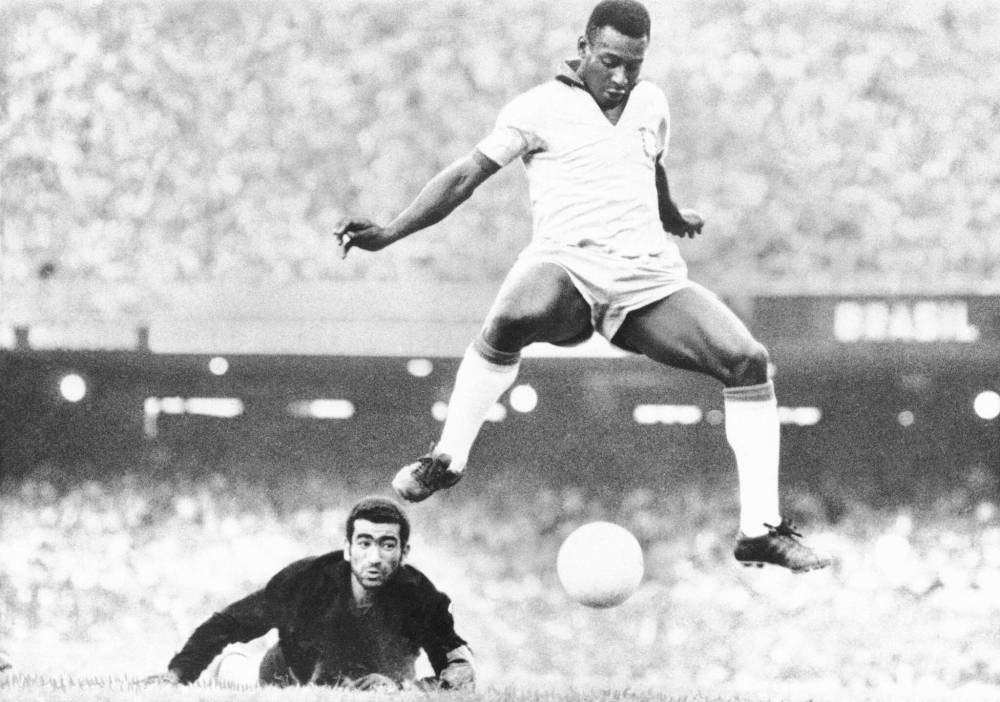
The Associated Press files
Pele scores against Venezuela keeper Fabrizio Fasano in Rio de Janeiro, Brazil, in 1969.
Already in 1970 with that unprecedented third championship, and certainly upon his retirement seven years later, the Brazilian was rightfully heralded as the consensus best footballer to ever play.
By then, Maradona had completed his first professional campaign, and like Pelé he secured his spot in the pantheon by lifting the World Cup.
When Maradona hung up his boots, Messi was filling the nets for Newell’s Old Boys’ youth team. A childhood supporter of the Rosario club, he’d even been at the stadium to watch the Argentina icon’s Newell’s debut in 1993.
Despite a mesmerizing, record-smashing career, which continues at Paris Saint-Germain, Messi’s pursuit of that elusive World Cup was made urgent because of Maradona’s victory, which itself elevated El Diego to Pelé’s platform.
What marks Pelé out as extraordinary, even among such peers, is that he, and the way he played, was germane to football as we know it.
He invented o jogo bonito, ‘The Beautiful Game,’ or in Brazil, futebol-arte.
That granular footage from Sweden more than six decades ago essentially begins the reel of football’s collective memory.
There is Pelé, chesting the ball with his back to goal and juggling it on his knee while pivoting for the shot, his delicate strike the difference in Brazil’s quarter-final win over Wales. In the semi-final with France, there is Pelé, again controlling the ball with his knee and blasting it past Claude Abbes to complete his hat-trick.
Then, in the World Cup final against the hosts, there is Pelé, scoring one of the most famous goals of all time. Having nestled an arcing cross against his body, he allows the ball a single bounce before a sky-high chip over the defender, and now, in the space he’s made for himself, he hits a precise finish that proves the winner.
Modern football begins in those few seconds.
Still a teenager, Pelé emerged from that tournament as the first global superstar of the television age. What’s especially remarkable is the fact that, beyond his 14 World Cup matches, few people outside Brazil actually saw him play.
Yes, there were those Intercontinental Cups that helped cement his reputation.
In the first, against Eusébio’s Benfica, he scored twice at the Maracanã and three times in Lisbon, that 5-2 Santos victory considered one of the best club matches ever played. In the second, he bagged a brace at San Siro, home to European champions AC Milan and the likes of Cesare Maldini, Gianni Rivera and Giovanni Trapattoni.
There were also the frequent global excursions arranged by Santos to give far-flung supporters an opportunity to see The King in person.
Most famously, there’s the story of the Nigerian-Biafran War being halted for two days in early 1969 so Pelé could play a friendly in Lagos. While there’s no evidence of an actual ceasefire — in fact, it’s more likely that Santos were used for sportswashing — there are accounts of white flags and posters in the capital calling for peace ahead of the match.
In any event, that African tour only added to Pelé’s lore. He was bigger than football, yet at the same time a figure perceived in film grain — part myth, part rumour, part legend. Part of what made him great is that, while playing, he remained elusive to the vast majority of fans.
Messi’s experience has been exactly the opposite.
Since at least the 2005 World Youth Championship, the seven-time Ballon d’Or winner has existed in the public eye like few athletes before him.
We’ve watched as he’s rewritten the Primera Division record book: most goals, most assists, most Pichichi awards, most MVPs. We’ve marvelled at how a Barcelona team built around him revolutionized the sport.
It’s been an eye test that hasn’t lied, and even without the World Cup the Argentine maestro would have eventually retired as the greatest footballer in history. But he won that, too.

As if in death a coronation would see a new sovereign crowned, Messi’s last game before Pelé’s passing was the 2022 World Cup final.
The thing is, while Edson Arantes do Nascimento died on Thursday, Pelé did not. Because Pelé is an idea, an ideal, the very essence of The Beautiful Game. And that lives on.
The King is dead. Long live The King.
jerradpeters@gmail.com
Twitter @JerradPeters
Our newsroom depends on a growing audience of readers to power our journalism. If you are not a paid reader, please consider becoming a subscriber.
Our newsroom depends on its audience of readers to power our journalism. Thank you for your support.
Our newsroom depends on a growing audience of readers to power our journalism. If you are not a paid reader, please consider becoming a subscriber.
Our newsroom depends on its audience of readers to power our journalism. Thank you for your support.
Related Articles
Tottenham upset by resurgent Villa; Chelsea held at Forest







Advertisement Advertise With Us
Advertisement Advertise With Us