

Fired Marsch not given chance to see Leeds overhaul through
Advertisement
Read this article for free:
or
Already have an account? Log in here »
To continue reading, please subscribe:
Digital Subscription
One year of digital access for only $1.44 a week*
- Enjoy unlimited reading on winnipegfreepress.com
- Read the E-Edition, our digital replica newspaper
- Access News Break, our award-winning app
- Play interactive puzzles
*Billed as $5.77 plus GST every four weeks. After 52 weeks, price increases to the regular rate of $19.95 plus GST every four weeks. Offer available to new and qualified returning subscribers only. Cancel any time.
To continue reading, please subscribe:
Add Free Press access to your Brandon Sun subscription for only an additional
$1 for the first 4 weeks*
- Enjoy unlimited reading on winnipegfreepress.com
- Read the E-Edition, our digital replica newspaper
- Access News Break, our award-winning app
- Play interactive puzzles
*Your next Brandon Sun subscription payment will increase by $1.00 and you will be charged $17.95 plus GST for four weeks. After four weeks, your payment will increase to $24.95 plus GST every four weeks.
Read unlimited articles for free today:
or
Already have an account? Log in here »
Hey there, time traveller!
This article was published 07/02/2023 (1352 days ago), so information in it may no longer be current.
Jesse Marsch must have thought he had more time at Leeds.
After all, he had just been allowed to bring in a close friend and fellow American, Chris Armas, to work alongside him in the coaching staff.
He had also just overseen an outlay of around $45 million in the January transfer window on two players — Maximilian Wöber and Georginio Rutter — as well as the loan signing of another U.S. international, Weston McKennie, to complement an increasingly American midfield.
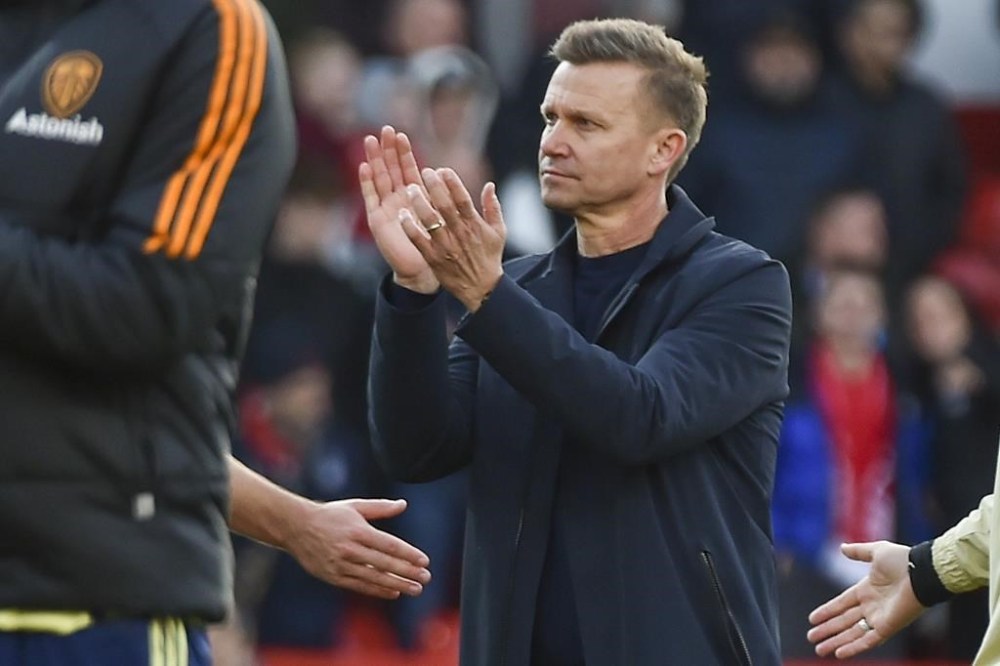
A structure of sorts was in place. Leeds, it appeared, was doubling down on an under-pressure manager who had heard the calls from frustrated fans for his dismissal and was determined to turn things around.
On Monday, Marsch was gone.
Effectively, he departs with Leeds in pretty much the same position as it was when he arrived: Battling against relegation heading into the final part of the season.
Having given Marsch almost a year to stamp his authority, the people in charge — majority owner Andrea Radrizzani and 49ers Enterprises, the investment arm of San Francisco 49ers in the NFL — seem to have decided nothing had really changed under the American.
Like under his predecessor, the popular Marcelo Bielsa, Leeds remained too easy to play through and score against, even if the team conceded fewer under Marsch.
Marsch’s problem — and he knew it — was Leeds’ inability to turn promising build-up play into goals. Indeed, what proved to be Marsch’s final two league games in charge saw Leeds fail to score despite dominating a 0-0 home draw with Brentford on Jan. 22 and then squander a slew of first-half chances in a 1-0 loss at Nottingham Forest on Sunday.
“We are struggling to turn performances into results,” Marsch said after the Forest game. “We have been in this place for a while.”
In the second half of the Forest game, the “Marsch out” chants returned in the away end and might have persuaded the ownership to act.
Marsch wasn’t helped by the fact that he inherited a squad of players so entrenched in Bielsa’s unique way of playing — intense pressing, hard-running, man-to-man marking — after 3 1/2 years under the Argentine. Maybe it was harsh to give him just a year to implement his own philosophy, even if it didn’t veer too much from Bielsa’s, but the specter of relegation can spook people at the top of a club.
Leeds is out of the bottom three only on goal difference and without a win in its past seven league games.
Also working against Marsch was his main striker, Patrick Bamford, being out injured for much of the past year and the reorganization required following the offseason departures of star midfielders Raphinha and Kalvin Phillips to Barcelona and Manchester City, respectively.
Marsch was the third American to coach a team in the Premier League after Bob Bradley, who lasted less than three months at Swansea in 2016, and David Wagner, who kept Huddersfield up in its first season back in the top-flight but was fired halfway through the next season (January 2019).

Marsch will leave with the memory of some high-profile wins — the 2-1 against Liverpool at Anfield in October stands out, as does the 3-0 home mauling of Chelsea in August — and keeping Leeds in the Premier League after a 2-1 victory at Brentford on the final day of last season.
“We have to build the roster and build the club in the right way,” Marsch said minutes after preserving the team’s top-flight status. “We have to continue to rely on the mentality of the club and the players but develop more and more, football-wise.”
He left without getting the chance to do that.
___
More AP soccer: https://apnews.com/hub/soccer and https://twitter.com/AP_Sports
Related Articles
Super League organizers set out 80-team competition idea









Advertisement Advertise With Us
Advertisement Advertise With Us