CMHR exhibit brings humanity to war

Advertisement

Advertise with us

So little said, so much emotion conveyed.

Read this article for free:


or

Already have an account? Log in here »

To continue reading, please subscribe:

Subscribe and receive a limited-edition Free Press branded hat or tote.

Digital Subscription

One year of digital access for only $205*

  • Enjoy unlimited reading on winnipegfreepress.com
  • Read the E-Edition, our digital replica newspaper
  • Access News Break, our award-winning app
  • Play interactive puzzles

*First annual payment billed as $205.00 + GST for one year. This annual subscription will automatically renew at $233.00 + GST every 52 weeks (10% off the regular annual price of $259.35). Offer available to new and qualified returning subscribers only. Cancel any time.

To continue reading, please subscribe:

Add Free Press access to your Brandon Sun subscription for only an additional

$1 for the first 4 weeks*

  • Enjoy unlimited reading on winnipegfreepress.com
  • Read the E-Edition, our digital replica newspaper
  • Access News Break, our award-winning app
  • Play interactive puzzles
Start now

*Your next Brandon Sun subscription payment will increase by $1.00 and you will be charged $17.95 plus GST for four weeks. After four weeks, your payment will increase to $24.95 plus GST every four weeks.

Hey there, time traveller!
This article was published 24/02/2023 (1295 days ago), so information in it may no longer be current.

So little said, so much emotion conveyed.

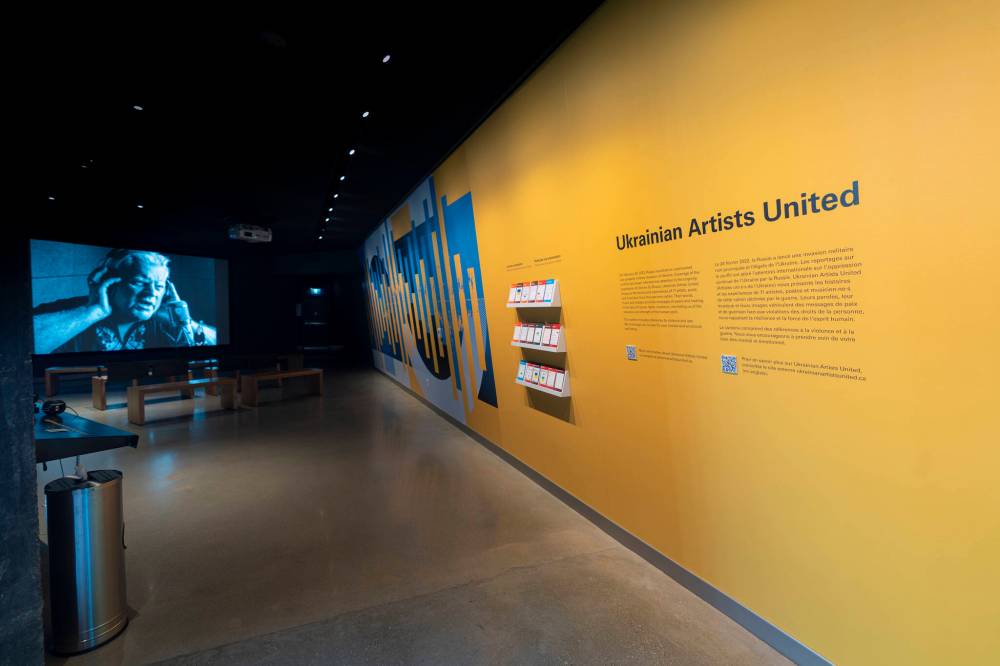
That’s an immediate reaction to Ukrainian Artists United, a new exhibition at the Canadian Museum for Human Rights that opens today, the one-year anniversary of Russia’s renewed invasion of Ukraine.

The opening coincides with a rally at the museum tonight at 6 p.m. hosted by the Ukrainian Canadian Congress.
Aaron Cohen / CMHR
                                Ukrainian Artists United, a new exhibition at the Canadian Museum for Human Rights, opens today.

Aaron Cohen / CMHR

Ukrainian Artists United, a new exhibition at the Canadian Museum for Human Rights, opens today.

The 25-minute film by Winnipeg artist and humanitarian Darcy Ataman and Los Angeles photographer Jason Wilheim shows vignettes of 11 artists from Lviv, western Ukraine’s major city, and their thoughts about how the conflict has changed their lives.

They each say only one or two sentences in their appearances but the message rings clear: Ukraine’s independence is worth fighting for and has a culture worth preserving.

“This old language is a grain for the future,” says poet Halyna Kruk in Ukrainian Artists United. She joins painters, a punk-rocker and player of the bandura, a traditional Ukrainian stringed instrument in the film, which includes a score performed by those on screen.

Ataman, who founded and leads the organization Make Music Matter that has helped more than 8,500 people in war zones using music therapy, was inducted into the Order of Manitoba in 2022.

He travelled to Lviv 10 months ago in the belief there were artists who wanted to share their feelings in the film.

Ukraine’s situation, with constant air-raid sirens and missile attacks by Russia that have killed thousands of civilians, is similar to the suffering he’s seen in Rwanda, the Democratic Republic of the Congo and Syria, except for one aspect.

“I saw that western media was paying attention to this war, and I thought it was a great opportunity to finally try my best as an artist to humanize conflict because it’s really hard to care about numbers,” Ataman says. “If you turn them into three-dimensional people that walk the earth, maybe we’ll care a bit more.”

Museum officials believe Ukrainian Artists United would be a timely addition for its Inspiring Change gallery, especially as the anniversary of Russia’s invasion approached. It remains on display until September and includes recordings at listening stations of musicians from other conflict zones.

“This fits so perfectly here for us because it is artists today engaging in a form of protest around what’s going on in Ukraine,” says Matthew Cutler, the museum’s vice-president of exhibitions. “Although this is the war that many of us are paying most attention to right now, these violations of human rights are happening around the world in other places.”

The human rights museum has become a venue for many protests and demonstrations in its history, and tonight’s event will likely be the one of the largest since the COVID-19 pandemic began three years ago.

It is offering free admission Friday night and the Hoosli Ukrainian Male Chorus will also perform.

“Whether it’s the protests, the commemoration and Darcy’s work, this is all the ecosystem of human rights,” Cutler says.

alan.small@freepress.mb.ca

Twitter: @AlanDSmall

Alan Small

Alan Small
Reporter

Alan Small was a journalist at the Free Press for more than 22 years in a variety of roles, the last being a reporter in the Arts and Life section.

Our newsroom depends on a growing audience of readers to power our journalism. If you are not a paid reader, please consider becoming a subscriber.

Our newsroom depends on its audience of readers to power our journalism. Thank you for your support.

Report Error Submit a Tip

More Stories

Lone Manitoba 9/11 victim's legacy lives on helping Inuit students become nurses

Melissa Martin 13 minute read Preview

Lone Manitoba 9/11 victim's legacy lives on helping Inuit students become nurses

Melissa Martin 13 minute read Yesterday at 5:24 PM CDT

On the night before the morning that everyone remembers, Ellen Judd spoke to her partner, Christine Egan, several times on the phone. Egan was in New York, where she’d gone to look after her nephews so her beloved brother, Michael, and his wife, Anna, could treat themselves to an anniversary vacation.

Usually, Judd would have been there, too. The couple had been together for more than 15 years, and loved sharing all the good parts of life. But at the time, she was an anthropology professor at the University of Manitoba, and the school year was just starting; she had classes the next day. Staying connected by phone would have to suffice.

In their calls that night, Judd remembers, Egan was happy. Christmas was the main topic. They were planning to spend the holiday with Judd’s family in Ontario, and talked about when to book flights. Egan was looking forward to that visit; Judd’s family “loved her to bits,” the now-retired professor says, and the affection was mutual.

The next day, Egan said, she planned to go into Manhattan with Michael. He was an executive at Aon, a global risk, retirement and health services corporation, and had an office on the 105th floor of the World Trade Centre’s South Tower.

Read
Yesterday at 5:24 PM CDT

Time to revamp Hydro’s water licence

Will Braun 5 minute read Preview

Time to revamp Hydro’s water licence

Will Braun 5 minute read 2:00 AM CDT

On Sept. 1, Manitoba Hydro’s 50-year licence to divert 85 per cent of the flow of the second largest river in the province and flood the fourth largest lake expired. How different will the next 50 years of the Churchill River Diversion look?

Read
2:00 AM CDT

Assisted living could alleviate ‘bed block’

Jesse Hajer and Tom Simms 5 minute read 2:00 AM CDT

There is a severe shortage of public and non-profit rent-geared-to-income/services-geared-to-income assisted-living housing for older adults in Manitoba. Seniors assisted living is a form of housing that includes rent, food, laundry and cleaning services.

Presently, the provincial government almost exclusively relies on the private market to provide assisted-living housing for seniors. Monthly private-market assisted-living housing rent for seniors ranges from $3,000 to $6,000 per month. The total income for an individual older adult receiving old age security (OAS) and guaranteed income supplement (GIS) pensions is less than $2,000 per month.

It is clear that low- and fixed-income seniors are not able to afford private-market assisted-living housing, resulting in the premature entry of these older adults into long-term care homes because seniors assisted-living housing is not publicly subsidized, whereas long-term care facilities do provide income-based subsidies.

Low- and fixed-income seniors are also experiencing a food affordability crisis which is negatively impacting their health and well-being. An enhanced assisted-living housing program that includes congregate meals would play an important role in addressing this growing affordability problem, along with reducing social isolation and loneliness.

Awareness is the first line of defence

Joseph Borsa 4 minute read Preview

Awareness is the first line of defence

Joseph Borsa 4 minute read Updated: 8:15 AM CDT

September is Prostate Cancer Awareness Month in Canada. This proclamation helps focus public attention on the very important protective role that such awareness can play in reducing the death and suffering associated with this disease.

The underlying reason for that is simple. In its beginning, prostate cancer, as is true for all cancers, starts and grows silently and stealthily, giving no indication through pain or other symptoms of its presence and of the developing pathology. Everything appears normal to the unsuspecting host until the cancer has grown to an extent that it interferes with normal function. There might then be pain, bleeding or some other manifestation of the growing tumour.

Unfortunately, by that time the disease may have reached an advanced stage, which is much more difficult to treat, and less likely to have a favourable outcome. It is a general truth in dealing with all types of cancer that the earlier it is discovered and treated, the better the likelihood of a favourable outcome. Awareness can be a major determinant of whether such early discovery happens or not.

Discovery of the cancer during its period of silent, surreptitious growth creates the opportunity for early treatment. Fortunately, in the case of prostate cancer such detection is favoured by two factors.

Read
Updated: 8:15 AM CDT

Theatre by the River’s latest production draws wisdom from Ovid

Ben Waldman 5 minute read Preview

Theatre by the River’s latest production draws wisdom from Ovid

Ben Waldman 5 minute read 6:00 AM CDT

The seed of Sap — the production debuting tonight by Winnipeg indie company Theatre by the River — was planted during the reign of Augustus Caesar.

Published four years ago by British playwright Rafaella Marcus, Sap is a fable that shines light on the epic first-century poetry of Ovid’s Metamorphoses, intertwining the story of Daphne — who wills herself to be transformed into a tree when pursued by an overzealous suitor — as a modern reminder of the universal need for peer-led queer sanctuary amid an increasingly violent political landscape for members of the LGBTTQ+ community.

When director Elio Zarrillo encountered the poetic script, it seemed an obvious match for Theatre by the River, a roving company founded in 2006 to produce work that builds compassion and respect for underserved narrative.

After getting initial interest, Zarrillo — a Winnipeg-raised playwright and performer who’s been onstage in recent years at Winnipeg Jewish Theatre (Narrow Bridge) and Prairie Theatre Exchange (The Outside Inn) — chose an appropriate location for a readthrough with Theatre by the River’s production team.

Read
6:00 AM CDT

Education minister’s reasons for revoking teacher’s licence ‘not good enough,’ judge decides

Maggie Macintosh 5 minute read Preview

Education minister’s reasons for revoking teacher’s licence ‘not good enough,’ judge decides

Maggie Macintosh 5 minute read Updated: 9:14 AM CDT

A Manitoba judge has rejected the education minister’s decision to end a teacher’s career because he repeatedly messaged with a 13-year-old girl on social media.

Read
Updated: 9:14 AM CDT