Repatriation and reconciliation
Liberal insider reflects on struggle to entrench Indigenous rights during the constitutional process of the early 1980s
Advertisement
Read this article for free:
or
Already have an account? Log in here »
To continue reading, please subscribe:
Digital Subscription
One year of digital access for only $1.44 a week*
- Enjoy unlimited reading on winnipegfreepress.com
- Read the E-Edition, our digital replica newspaper
- Access News Break, our award-winning app
- Play interactive puzzles
*Billed as $5.77 plus GST every four weeks. After 52 weeks, price increases to the regular rate of $19.95 plus GST every four weeks. Offer available to new and qualified returning subscribers only. Cancel any time.
To continue reading, please subscribe:
Add Free Press access to your Brandon Sun subscription for only an additional
$1 for the first 4 weeks*
- Enjoy unlimited reading on winnipegfreepress.com
- Read the E-Edition, our digital replica newspaper
- Access News Break, our award-winning app
- Play interactive puzzles
*Your next Brandon Sun subscription payment will increase by $1.00 and you will be charged $17.95 plus GST for four weeks. After four weeks, your payment will increase to $24.95 plus GST every four weeks.
Read unlimited articles for free today:
or
Already have an account? Log in here »
Hey there, time traveller!
This article was published 18/03/2023 (1312 days ago), so information in it may no longer be current.
The following is an abridged excerpt from Unlikely Insider: A West Coast Advocate in Ottawa, by Jack Austin, a former federal Liberal policy adviser, chief of staff to prime minister Pierre Trudeau and senator, with Edie Austin (McGill University Press, 2023).
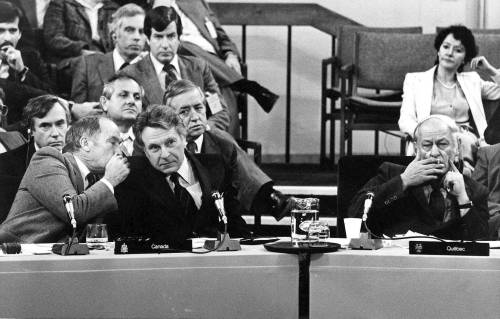
In 1980-81, I served as the Liberal whip of the Special Joint Committee of the Senate and of the House of Commons on the Constitution of Canada.
Patriation and all that flowed from it was prime minister Pierre Trudeau’s major policy initiative in his last electoral mandate. For me, the greatest achievement was section 35, giving clear constitutional recognition to the inherent rights of the Aboriginal peoples. It was a moment of triumph for common sense and decency, and a great step forward toward reconciliation, which cannot occur in the absence of recognition of Indigenous rights.

THE CANADIAN PRESS
Jack Austin, a former federal Liberal policy adviser, chief of staff to prime minister Pierre Trudeau and senator, speaks in the Canadian Senate in December 1981 arguing for Indigenous rights to be clearly entrenched in the Constitution as it was patriated from Britain.
It almost didn’t happen.
The original draft introduced by the federal government in the fall of 1980 — the one referred to the joint committee for study — did not include entrenchment of Aboriginal rights. There had been some resistance from the Progressive Conservative Party, but also on the Liberal side, with respect to including First Nations status and issues in the constitutional process. Trudeau and justice minister Jean Chrétien were loath to entrench Aboriginal rights before they were defined, and there was also considerable opposition from the provinces.
My own position was strongly in favour of embedding some kind of constitutional entitlement and recognition. I made my views known in caucus, where there were countless discussions, and in conversations with the prime minister, with Chrétien, and with Chrétien’s key adviser Eddie Goldenberg.
The joint committee received briefs and presentations from an array of prominent Indigenous leaders and representatives of Indigenous organizations who explained their perspectives eloquently and in some detail. They spoke of their painful history of dispossession and their continuing subjection to colonial rule and assimilationist policies. They expressed fear that patriation could infringe on their rights as nations to whom the Crown had an obligation, bringing further dispossession, and that equality provisions of the Charter could be turned against them to deprive them of their rights. They advocated strongly for a provision that would entrench Aboriginal rights in the Constitution.
They made their case not only before the committee but also before the people of Canada. In a precedent-setting move, the joint committee’s hearings were televised, and thousands of Canadians tuned in. This played a key role in winning public support for the entrenchment of Aboriginal rights. Canadians were moved by what they heard.
These presentations also made a big impact on members of our committee.
Meanwhile, some Indigenous representatives had travelled to London, where they were lobbying the British Parliament, either against patriation entirely or to ensure their rights were protected. While this lobbying yielded no direct result, it did add momentum to putting Indigenous concerns on the public agenda.
On Jan. 30, 1981, Chrétien appeared before the committee to propose an amendment that would entrench Aboriginal rights in the constitution, as well as define Aboriginal peoples as Indians, Métis and Inuit. This was an advance for the Métis in particular, who until that point were lacking recognition. The two provisions were labelled section 34 (1) and (2). For me, it was a profoundly important moment, and when it was my turn to speak, it was observed that there was emotion in my voice and there were tears in my eyes.
The committee hearings wrapped up the following month. Constitutional debates continued in Parliament and across the country. There was no agreement with the provinces. The federal government therefore was proceeding unilaterally. Meanwhile, among Indigenous people, opinion was divided about section 34 as it then stood. The Inuit maintained their support, but many First Nations rejected the proposed wording as inadequate.
In three provinces, the courts were asked to rule on whether the federal government could proceed with patriation unilaterally. The results varied, and the matter went before the Supreme Court of Canada. It ruled in September 1981 that while the federal government had the legal right to proceed unilaterally, doing so would violate convention. The decision gave new impetus to an effort to reach a federal-provincial accord.
One was indeed reached, on Nov. 5, 1981. But in the new text, the section entrenching Aboriginal rights was missing. With seven provinces opposing that provision, it had been sacrificed for the sake of reaching an accord on the Charter and patriation as a whole.
While I fully understood the realpolitik of the situation, I was bitterly disappointed. Speaking in Calgary at an Alberta Liberal convention held a few days later, I said that Ottawa and the premiers had made a serious mistake by leaving Aboriginal rights out of the constitution and I grieved at what had been done. By this point, I was a freshly minted cabinet minister. Behind the scenes I did what I could to get the provision restored. At the same time, many other voices were being raised, not least those of Indigenous people themselves.

McGill University Press
Unlikely Insider: A West Coast Advocate in Ottawa, by Jack Austin
In the face of considerable pressures, the negotiators returned to the table a couple of weeks later and restored section 34 (renumbered as section 35) with one change: the word “existing” was inserted to describe the rights that were being entrenched. The extent to which that word watered down the section was at that time a matter of some dispute, but it was necessary to make the section easier for the provinces to swallow. As I suggested at the time, and as later court decisions indicated, it did not in fact make much difference to the provision’s meaning.
While I like to think I did my part, other forces were also in motion.
Speaking in the Senate on Dec.7, 1981, I said that “public opinion, which had expressed itself through opinion polls as favouring the Charter of Rights and section 35, fell like a battering ram on the provinces, and they gave way. …
“Canada cannot be a caring, equitable and tolerant society and not address itself to the rights and problems of the Aboriginal peoples,” I said. “That is why it is so important, not only to the Aboriginal people, but also to all Canadians, that the idea of their having rights be clearly established as part of their entitlement as Canadians — that is, to give them the status in our Constitution and amongst Canadian citizens of equality as a community with all the other communities of our country and to begin from that fair base what will no doubt be a difficult and painful negotiation to establish specific terms of agreement between them and the greater Canadian society. I am not frightened of that process or of the pain of it, because it represents over time the reconciliation of old and difficult grievances, and the alternative would be unthinkable.”
In many parts of Canada today, it is common practice at public meetings to begin with a land acknowledgment. This reminder that there were people who were here for millennia before the settlers arrived indicates a very welcome attitude toward reconciliation. Still under way, however, is the process of fully accepting Indigenous Peoples as equal participants in Canadian society and as communities with rights, needs and wants, identities and cultures.
The positive role of section 35 of the Constitution in helping to change public attitudes should not be underestimated. It moved reconciliation to the courts from the legislatures, a by-product of which was to increase public respect for the results of the process, given that the public tends to have greater respect for judges than for politicians. In the courts, Indigenous Peoples have been able to apply section 35 in a way that they would never have been allowed to leverage their direct relationship with a British Crown largely indifferent to their situation. Eventually, this encouraged negotiation rather than litigation; First Nations could negotiate on the basis of Supreme Court-recognized rights, as affirmed in various court decisions. Moving reconciliation to the courts was also helpful for the political leadership: the public now understood governments had legal obligations to respect.
Various other factors softened public opinion and eroded old prejudices. I believe the work of the Royal Commission on Aboriginal Peoples, headed by Georges Erasmus and René Dussault, which held hearings in the early 1990s and then issued a multi-volume report in 1996, had a significant impact, albeit not one that could be measured right away. Twenty years later, the Truth and Reconciliation Commission, chaired by Murray Sinclair, further sensitized Canadians to the experiences and continuing suffering of Indigenous people.
Has Canadian society truly abandoned the assimilationist attitudes of the past? Such attitudes undeniably can still be found, but they no longer are driving federal policy.
Progress has been made in the recognition of the rights of Indigenous Peoples and toward reconciliation with Canada and other Canadians. I recognize that many problems remain unresolved, but am optimistic that a better future awaits.