Boy lost in outback forces town’s lot together

Advertisement

Advertise with us

Australian Fiona McFarlane’s debut novel The Night Guest was narrowly focused on the experiences and remembrances of Ruth, a 75-year-old widow. With her adult children far away and living alone in an isolated Australian beach house, Ruth is left alone to deal with both the existential threat of potential elder abuse and the psychological threat of becoming unmoored from her memories and history in the face of creeping dementia. All the while Ruth also explores anew memories of a missionary childhood in Fiji from six or seven decades prior.

Read this article for free:


or

Already have an account? Log in here »

To continue reading, please subscribe:

Subscribe and receive a limited-edition Free Press branded hat or tote.

Digital Subscription

One year of digital access for only $205*

  • Enjoy unlimited reading on winnipegfreepress.com
  • Read the E-Edition, our digital replica newspaper
  • Access News Break, our award-winning app
  • Play interactive puzzles

*First annual payment billed as $205.00 + GST for one year. This annual subscription will automatically renew at $233.00 + GST every 52 weeks (10% off the regular annual price of $259.35). Offer available to new and qualified returning subscribers only. Cancel any time.

To continue reading, please subscribe:

Add Free Press access to your Brandon Sun subscription for only an additional

$1 for the first 4 weeks*

  • Enjoy unlimited reading on winnipegfreepress.com
  • Read the E-Edition, our digital replica newspaper
  • Access News Break, our award-winning app
  • Play interactive puzzles
Start now

*Your next Brandon Sun subscription payment will increase by $1.00 and you will be charged $17.95 plus GST for four weeks. After four weeks, your payment will increase to $24.95 plus GST every four weeks.

Hey there, time traveller!
This article was published 08/04/2023 (1255 days ago), so information in it may no longer be current.

Australian Fiona McFarlane’s debut novel The Night Guest was narrowly focused on the experiences and remembrances of Ruth, a 75-year-old widow. With her adult children far away and living alone in an isolated Australian beach house, Ruth is left alone to deal with both the existential threat of potential elder abuse and the psychological threat of becoming unmoored from her memories and history in the face of creeping dementia. All the while Ruth also explores anew memories of a missionary childhood in Fiji from six or seven decades prior.

In this engaging sophomore novel, McFarlane casts even further back in time to a small-town outpost in 1883 colonial Australia. The precipitating event is the disappearance of a six-year-old boy, Denny Wallace, in the unforgiving outback after he gets turned around in a dust storm. It brings to mind Incident at Hawk’s Hill, the 1971 Canadian Prairies-set historical novel by Allan W. Eckert, in which another lost six-year-old is adopted by a mother badger who has lost her cubs and learns to live as a badger for months.

Like that novel, The Sun Walks Down has the potential to be an isolating tale, but not the way McFarlane tells it. The missing boy creates a situation whereby all sorts of people are forced to interact or cooperate when they might otherwise ignore each other socially. These include Indigenous trackers and European colonists, wealthy property owners and working men, an elderly German-born Lutheran woman with a certain sense of propriety and a whole host of others that fall short of her expectations.

The Sun Walks Down

The Sun Walks Down

The Wallace family includes Denny’s father, who spends most of the daylight hours planting parsnips, Denny’s hearing-impaired mother as well as five sisters, including Cissy. Second-eldest and inexplicably, adolescently angry, Cissy is also the natural leader in any crisis.

Other key characters include the local constable, whose wedding ceremony was interrupted by the same dust storm in which the boy was lost; Billy Rough, the Indigenous hired hand of the Wallace’s struggling farm; and a Swedish painter whose trek to paint the colours of the outback alternately intrigue or offend the townsfolk, but also puts him somewhere in the same wilderness that had swallowed Denny.

The boy himself appears only in brief spurts, and large portions of the novel leave the reader unaware if Denny is alive or dead, or whether he will even be found by the time the story is complete. His fate is important, but this is as much a story about small-town gossip, old rivalries and resentments and the unspoken power relationships that rest just below a surface layer that is less social fabric and more social veneer.

Parts of the novel could read almost like a comedy of manners, but McFarlane does not play these interactions and social negotiations to humourous effect. Instead, the narrative serves as a vehicle to an incisive and uncomfortable dissection of a racially and class-segmented society.

Almost a full century into Australia’s colonial era, there is a palpable tension sure to discomfit most contemporary readers. But at the centre of it all, still innocent, is one lost little boy and the hope that, despite it all, enough people can come together to save him.

Joel Boyce is a Winnipeg writer and educator.
Report Error Submit a Tip

More Stories

50 years ago, we thought we could change the world

Robert Milan and Miriam Cooley 8 minute read Preview

50 years ago, we thought we could change the world

Robert Milan and Miriam Cooley 8 minute read 2:00 AM CDT

Winnipeg, 50 years ago.

We began as a small loose unorganized group of teaching friends and educators who shared the same political and social convictions.

We defined ourselves as socialists, feminists and political activists. We were a cross section of educational minds — language arts and social studies teachers, an art teacher, an early childhood educator, a Winnipeg school trustee, a school principal — making our group quite representative of school culture at the time.

Our questions and discussions about politics, education and society arose from a diversity of backgrounds, yet reflected a progressive cohesiveness. The political climate in Manitoba helped bring us together. Sterling Lyon was premier and his Conservative government was pursuing policies that we strongly opposed. To us, his government represented a determined assault on many of the social and political values we believed in, particularly related to education. Eventually we decided that perhaps we should do more than talk. And so the Socialist Teachers Education Movement — STEM — was born.

Read
2:00 AM CDT

Treating the disease we simply won’t insure

Rafiq Andani 5 minute read 2:00 AM CDT

There is a condition affecting tens of thousands of Canadians.

In 2024, one national measure estimated that almost 120,000 people had the condition. The estimate captures only part of the problem.

The same data show its chronic form becoming more common. In 2017, an estimated 28,900 people met the definition for its chronic form. By 2024, there were 36,058, an increase of almost 25 per cent.

This condition carries an unfortunate prognosis.

Drug recovery centre opens office in ‘heart of the city’

Morgan Modjeski 4 minute read Preview

Drug recovery centre opens office in ‘heart of the city’

Morgan Modjeski 4 minute read Saturday, Sep. 12, 2026

Richard Halverson found his freedom from addiction through Adult & Teen Challenge and, six years later, he hopes a new Winnipeg location will bring hope to the city.

Dozens gathered Saturday morning to mark the grand opening of the recovery centre’s community services office on Main Street.

Located inside the former Wojcik funeral home, the bright-white building — which was also formerly a liquor store — will serve as an access point for people fighting drug addiction. That includes connecting them to addictions support, housing and training.

“For me, I always start with: ‘What’s your story?’” said Halverson, who now works for the faith-based organization.

Read
Saturday, Sep. 12, 2026

Tory health critic ‘disappointed’ after being rebuffed by health officials

Carol Sanders 4 minute read Preview

Tory health critic ‘disappointed’ after being rebuffed by health officials

Carol Sanders 4 minute read Saturday, Sep. 12, 2026

The health critic for the Progressive Conservative party says her ability to get information about the accelerated reopening of Dauphin’s emergency department was stymied by Prairie Mountain Health officials because they refused to meet with her.

“I wanted to meet with PMH staff to discuss the status of the facility and the challenges they’re facing and getting services back online,” Kathleen Cook said Friday.

“I was very disappointed that Prairie Mountain Health declined me that opportunity.”

Cook said she asked for a meeting a few days after the Sept. 7 reopening of a temporary ER at the hospital, that was severely damaged by flooding.

Read
Saturday, Sep. 12, 2026

Sunday-night auto aficionados work to steer away from unwelcome elements they say aren’t a part of their tradition

Zoe Pierce 12 minute read Preview

Sunday-night auto aficionados work to steer away from unwelcome elements they say aren’t a part of their tradition

Zoe Pierce 12 minute read Friday, Sep. 11, 2026

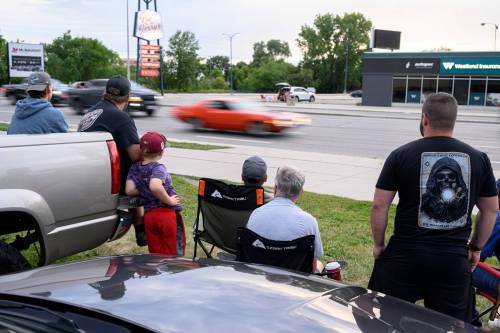
The red 1969 Dodge Coronet Super Bee out for a cruise on Portage Avenue draws admiring eyes from onlookers on a recent Sunday night, many of them seeing a specimen of the now-rare muscle car for the first time on a Winnipeg street. Or any other street, for that matter.

Longtime car enthusiast Bob Sudoma was behind the wheel, participating in the decades-old show-offy summer tradition.

The Sunday night cruise is built around a simple idea: proud car owners take their beloved vehicles for a spin to meet up with others of the same autophile ilk.

Less-fortunate appreciators, or just curious folks, also gather along the route to watch the highly-polished parade. Portage Avenue is one of cruise night’s best-known stretches.

Read
Friday, Sep. 11, 2026

Letters, Sept. 14

7 minute read 2:00 AM CDT

Transit troubles and passes

Re: Growing pains? Maybe, but it’s worth it, Think Tank, Sept. 10.

Worth it for who? Our transit system has been undergoing growing pains for the past year, ever since city staff completely messed up the system with their redesign.

The net result of those changes is reduced ridership, leading to a projected deficit of $18 million in revenues this year (not including the capital costs of those changes). Add that to the annual $126-million subsidy to operate Winnipeg Transit and that’s $144 million being paid annually by Winnipeg taxpayers.