Cloud seeding catching on amid Rocky Mountain drought
Advertisement
Read this article for free:
or
Already have an account? Log in here »
To continue reading, please subscribe:

Digital Subscription
One year of digital access for only $205*
- Enjoy unlimited reading on winnipegfreepress.com
- Read the E-Edition, our digital replica newspaper
- Access News Break, our award-winning app
- Play interactive puzzles
*First annual payment billed as $205.00 + GST for one year. This annual subscription will automatically renew at $233.00 + GST every 52 weeks (10% off the regular annual price of $259.35). Offer available to new and qualified returning subscribers only. Cancel any time.
To continue reading, please subscribe:
Add Free Press access to your Brandon Sun subscription for only an additional
$1 for the first 4 weeks*
- Enjoy unlimited reading on winnipegfreepress.com
- Read the E-Edition, our digital replica newspaper
- Access News Break, our award-winning app
- Play interactive puzzles
*Your next Brandon Sun subscription payment will increase by $1.00 and you will be charged $17.95 plus GST for four weeks. After four weeks, your payment will increase to $24.95 plus GST every four weeks.
Read unlimited articles for free today:
or
Already have an account? Log in here »
Hey there, time traveller!
This article was published 19/04/2023 (1242 days ago), so information in it may no longer be current.
LYONS, Colo. (AP) — Garrett Cammans and his brothers sometimes don’t talk about their toughest moments on the job in the cloud seeding business, like the time when one of them got stuck in deep mountain snow and had to hike out alone in the dark.
“They’re going out into some pretty remote and rural areas,” Cammans said. “And there have been a few close encounters with wildlife we don’t like to discuss at the family dinner table.”
But snow — as much as possible — is at the heart of the Cammans family business, Utah-based North American Weather Consultants, which holds cloud seeding contracts throughout the U.S. West, centered in the Rocky Mountains.
Lately, business is up. Amid two decades of drought, cloud seeding — using airplanes or ground equipment to waft rain-and-snow-making particles into clouds — is on the rise in the Rockies.
Colorado has added three new programs in the last five years. Wyoming, which began seeding in 2014, added an aerial program in 2018. Utah has steadily increased its fleet of cloud seeding equipment, and the state legislature just approved record funding to further expand programs and research.
No small part of the growth is due to intense pressure drought is placing on the Colorado River and its tributaries that supply water to millions of people from Wyoming to Los Angeles.
Not everybody believes cloud seeding is a worthwhile remedy. Some experts say conserving water is a better, more down-to-earth way to ensure enough water to go around. Juicing clouds to produce marginally more precipitation, they say, is an iffy alternative.
“It’s always easier to talk about how to get more water than to talk about how to use less,” said Kathryn Sorensen with the Kyl Center for Water Policy at Arizona State University in Tempe. “When you look at the problem of over-allocation on the Colorado River, the numbers are so large that really the solutions lie in using less, particularly in the agricultural sector. Politically that’s really painful to confront.”
But in the Rockies, cloud seeding these days has a full embrace from local and state officials eager for a not-too-expensive way to put more water in streams, rivers and especially the big Colorado River system reservoirs that hit record lows last year.
Their approach: shoot silver iodide into clouds, where moisture binds to the particles, forms ice and falls as snow. That snowpack high in the mountains serves as year-round cold storage for water that’s released as it melts.
In Wyoming, cloud seeding by plane attempts to increase snowpack on the west side of the Wind River Mountains, so snowmelt flows into the Green River and to communities downstream — eventually reaching the Colorado River and its reservoirs including Lake Powell and Lake Mead.
“Cloud seeding generates water that wouldn’t have been there before,” said Bryan Seppie, general manager of the Joint Powers Water Board providing water to southwestern Wyoming communities. “That’s just a benefit to the entire system.”
___
When the weather’s dry and water’s scarce in the West — where the saying goes that whisky’s for drinking and water is for fighting over — those with water rights established long ago get preference. And divvying up increasingly limited water has pitted states against each other.
Yet cloud seeding has emerged as a partial solution they can agree on.
Water providers in the Lower Colorado River Basin contribute about $1.5 million annually to cloud seeding in the Upper Basin, where snowmelt feeds the river. Recently, the federal government announced a $2.4 million contribution to the effort, a nod to the desperate times.
Despite the renewed attention, cloud seeding has been used around the world and in the Rockies for more than 50 years.
Cloud seeding in the U.S. got “oversold” and federal funding dried up in the 1990s and early 2000s, said Frank McDonough, a scientist at the Desert Research Institute in Reno, Nevada.
“Water folks at the local level knew it worked so they continued to fund it with states,” McDonnough said. “Now there’s new evidence that shows it does work.”
A study of Idaho aerial seeding in 2017 revealed a clear snowfall pattern on a radar that mirrored the seeding and offered evidence the method works.
Utah has calculated the amount of additional water cloud seeding created there. It added 186,000 acre-feet of water, or nearly a 12% increase, to the state’s supply in 2018, according to an analysis by the Division of Water Resources. The agency says the cost was $2.18 per acre-foot — a fraction of the $20 California farmers pay for that amount of water.
“That cost per acre-foot was so low, it’s kind of a no brainer,” said Jake Serago, water resources engineer with the division.
But Sarah Tessendorf of the National Center for Atmospheric Research said more research is needed to conclusively show how much additional water is created by cloud seeding.
“It’s really common for people to want to know what extra percent of precipitation formed,” said Tessendorf, a co-author of the Idaho cloud seeding study.
Silver iodide can have a minimal impact in some clouds and a high impact in others, so how much is created over an entire winter season is what matters most, she said. “We don’t have answers on that yet, but we hope to have them in the next few years with our new computer model results.”
___
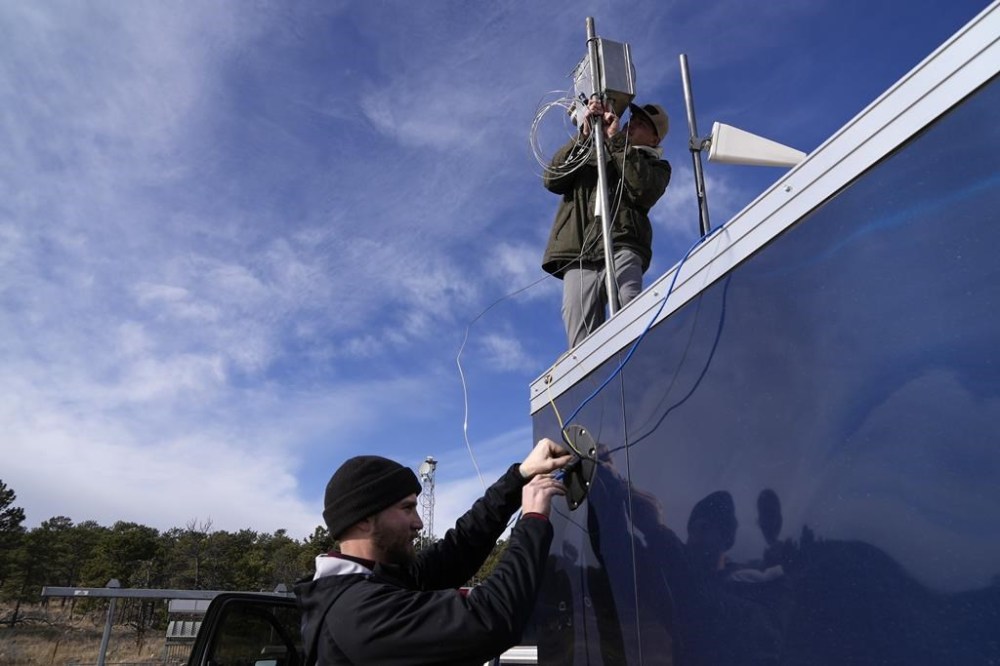
In foothills north of Boulder, the first cloud seeding project of the rapidly growing Rocky Mountain Front Range urban corridor north and south of Denver is underway. This winter, two ground-based generators have been pumping silver iodide into the air for the St. Vrain and Left Hand Water Conservancy District.
Each is a two-wheeled trailer containing a tank of silver iodide released by a roaring, propane-fueled flame atop a metal mast. There’s a communications antenna for signals to turn the generator on and off, depending on conditions.
The right conditions — wet weather headed upslope, from the east — have occurred a couple times a month, said Scott Griebling, a water resources engineer with the district.
Lately in the Rockies, the problem isn’t too little snow. Amid a wet spring, some cloud seeding generators have been shut down due to fears the heavy snowfall already is enough to cause flooding.
Among those idled are generators in southern Wyoming’s Sierra Madre Range, where snowpack is rivaling the deepest on record, said Jonathan Bowler with the Savery-Little Snake River Water Conservancy District that monitors runoff.
“You kind of live and die by the moisture here,” Bowler said. “Too dry is one extreme and too wet is another. But kind of regardless of what it’s going to give you, you just kind of have to make do.”
For the Wyoming Water Development Commission in charge of the state’s cloud seeding program, the long-term averages are what’s important, Chairman Ron Kailey Jr. said. “You have to take in the good years, the bad years and everything in between to determine how successful the program is,” said Kailey.
___
North American Weather Consultants has been cloud seeding for over 40 years. Cammans, who has a background in physics, chemistry and computer software, bought the company four years ago.
After expanding locations, including to the Colorado Front Range for the Boulder-area pilot program, North American Weather Consultants now has about 250 ground-based sites and two planes in use across the Western U.S. Cammans now has about 20 employees including meteorologists and his brothers.
“Once seedable conditions do occur, then we spring into operation,” he said. “We’ve got a pilot that will go up and fly if conditions are favorable for aerial seeding. We’ve got remotely operated equipment that meteorologists can operate from their home offices.”
Many of the company’s ground-based generators are turned on and off manually by about 150 paid contractors, some on their own land.
Cammans often reserves those toughest jobs for his brothers Parker and Carver, who drive trucks with knobby, 35-inch (1-meter) tires suited for snow and mud.
“They get to do some of our most exciting and more precarious work,” he said.
___
On Twitter follow Brittany Peterson: @BrittanyKPeters and Mead Gruver: @meadgruver
___
The Associated Press receives support from the Walton Family Foundation for coverage of water and environmental policy. The AP is solely responsible for all content. For all of AP’s environmental coverage, visit https://apnews.com/hub/climate-and-environment