Low tech makes cleaner water in Iowa; so what’s stopping it?
Advertisement
Read this article for free:
or
Already have an account? Log in here »
To continue reading, please subscribe:

Digital Subscription
One year of digital access for only $205*
- Enjoy unlimited reading on winnipegfreepress.com
- Read the E-Edition, our digital replica newspaper
- Access News Break, our award-winning app
- Play interactive puzzles
*First annual payment billed as $205.00 + GST for one year. This annual subscription will automatically renew at $233.00 + GST every 52 weeks (10% off the regular annual price of $259.35). Offer available to new and qualified returning subscribers only. Cancel any time.
To continue reading, please subscribe:
Add Free Press access to your Brandon Sun subscription for only an additional
$1 for the first 4 weeks*
- Enjoy unlimited reading on winnipegfreepress.com
- Read the E-Edition, our digital replica newspaper
- Access News Break, our award-winning app
- Play interactive puzzles
*Your next Brandon Sun subscription payment will increase by $1.00 and you will be charged $17.95 plus GST for four weeks. After four weeks, your payment will increase to $24.95 plus GST every four weeks.
Read unlimited articles for free today:
or
Already have an account? Log in here »
Hey there, time traveller!
This article was published 20/04/2023 (1247 days ago), so information in it may no longer be current.
SLATER, Iowa (AP) — Nick Helland’s central Iowa farm looks much like every other nearby farm on this chilly March day, with corn stubble stretching from a gravel road up over a low hill to the northern horizon.
But look closely, and you can see patches of muddy ground where a few months ago crews buried low-tech systems called bioreactors and streamside buffers that filter fertilizer-borne nitrates from water as it drains from Helland’s field into nearby Big Creek and eventually the Des Moines River.
The underground devices work. The question is whether one Iowa county’s promising new approach to an old problem can be expanded enough to finally address nitrate pollution that, for years, has endangered drinking water, made more than half the state’s waterways unfit for fish or humans, and fueled a giant dead zone nearly 1,000 miles away in the Gulf of Mexico.
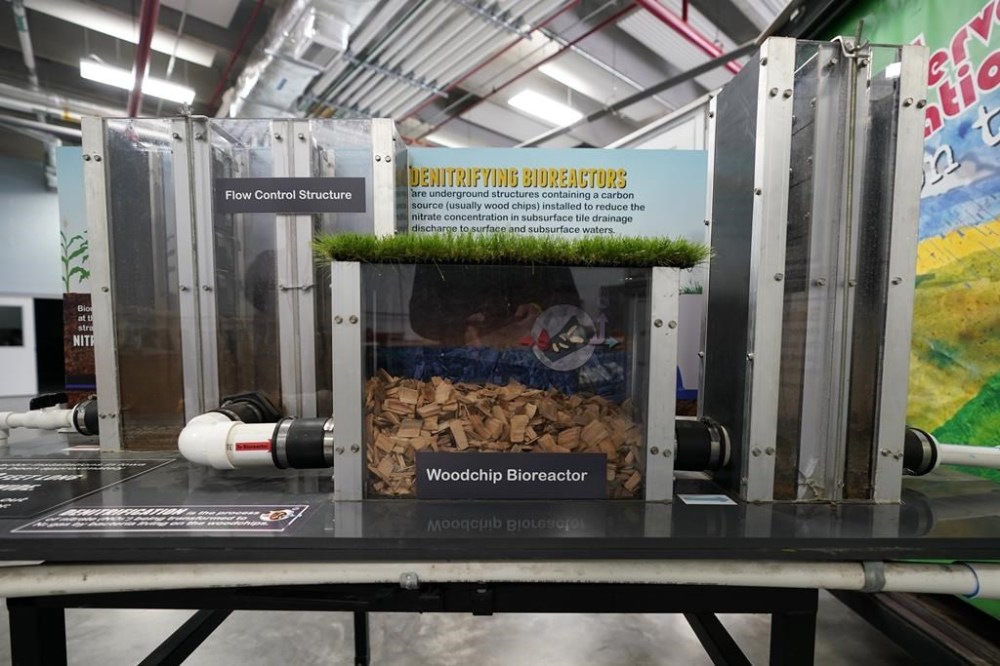
Polk County is doing it by making it painless for farmers — handling all the logistics and arrangements for the systems — and throwing in payments of $1,000 per site. Installations have exploded in the past two years, to 104, after only a handful were installed the eight years before that.
“They paid me and they paid the cost of all the installation,” Helland said. “That’s sort of a no-brainer to me that with very little lift, very little time, I can have this installed on my farm and it will ensure better water quality for everyone else downstream.”
The big challenge now is encouraging counties to launch and fund similar efforts to reduce runoff from Iowa’s 10 million acres of tile-drained farmland and combat the state’s multi-billion dollar problem with nitrogen pollution.
Nitrogen-based fertilizers and manure can lead to excessive nitrates in groundwater that can be toxic to livestock and humans. High levels have plagued waterways in Iowa and throughout the Midwest for decades from chemical fertilizers and animal manure sprayed on fields. Modern tractors let farmers assess their soil and apply only as much fertilizer as needed, but it’s still common to overspray.
It’s easy to see why. Yields of corn — the king crop in these parts, and planted on about 90 million acres nationwide — are at least doubled by fertilizer, and farmers want to be sure their crops have enough nutrients. Adding to the problem are the quick drainage systems that lie beneath so many fields — known as tiles, but actually plastic pipes — that whoosh excess water away and into streams.
Numerous studies have found the low-tech systems remove half the nitrate or more from runoff before it reaches waterways. In bioreactors, the water passes through a buried mound of wood chips that break down much of the nitrate. In the buffers, it moves through a grassy area parallel to a stream.
Too much nitrate and phosphorous in rivers and streams makes great food for algae and other plant growth that cuts oxygen in the water and blocks sunlight. Combined with industrial farming practices that have altered waterways by straightening streams and removing wetlands, that’s bad news for fish that need clear water and slower currents.
It hurts humans, too. Nitrate-contaminated drinking water can cause blue baby syndrome where an infant’s blood doesn’t have enough oxygen. More than half of Iowa’s rivers, streams and lakes are too polluted to properly support aquatic life or fishing and swimming, according to the state.
Iowa is among the largest contributors of nitrate runoff that flows to the Gulf, leading to the so-called dead zone by depleting oxygen necessary for marine life across several thousand square miles.
Pressure to reduce the dead zone led Iowa’s agriculture and natural resources departments to join in 2008 with Iowa State University for a strategy to address the problem. The effort has focused on voluntary actions; Iowa’s legislature has consistently rejected proposals to require farmers to reduce runoff.
Fifteen years into the program, Iowa hasn’t significantly reduced nitrogen runoff, according to a 2019 estimate. The problem in some ways has worsened as strong commodity prices encouraged farmers to plant corn and soybeans on more land. Meanwhile, Iowa’s giant hog industry has grown to about 24 million pigs — roughly triple the number in any other state — which means more manure gets spread over farmland.
In Polk County, exasperation with nitrate pollution came to a head in 2015, when the agency that provides drinking water to 600,000 people in the Des Moines area went to court over the millions of dollars it was being forced to spend to filter unsafe levels from drinking water taken from the Des Moines and Raccoon rivers. A judge ultimately dismissed the lawsuit against three northwest Iowa counties, ruling the issue was one for the Legislature to address.
Without hope of state mandates, local officials in Polk County sought to work cooperatively with agricultural groups. Part of that was studying why so few farmers were installing bioreactors and streamside buffers. They found an inefficient system for installation that made it expensive and bothersome for farmers, who had to arrange contractors and then seek reimbursement.
Polk County’s solution: Handle all the arrangements to make it easy for farmers, and group projects together for economies of scale. Even with the $1,000 inducement to get farmers to sign on, they found the new process was about 15% cheaper — less than $10,000 for a typical saturated buffer, and up to $15,000 for a bioreactor.
“Our success came from realizing we had been doing it wrong for like six years,” said John Swanson, Polk County’s water resources supervisor.
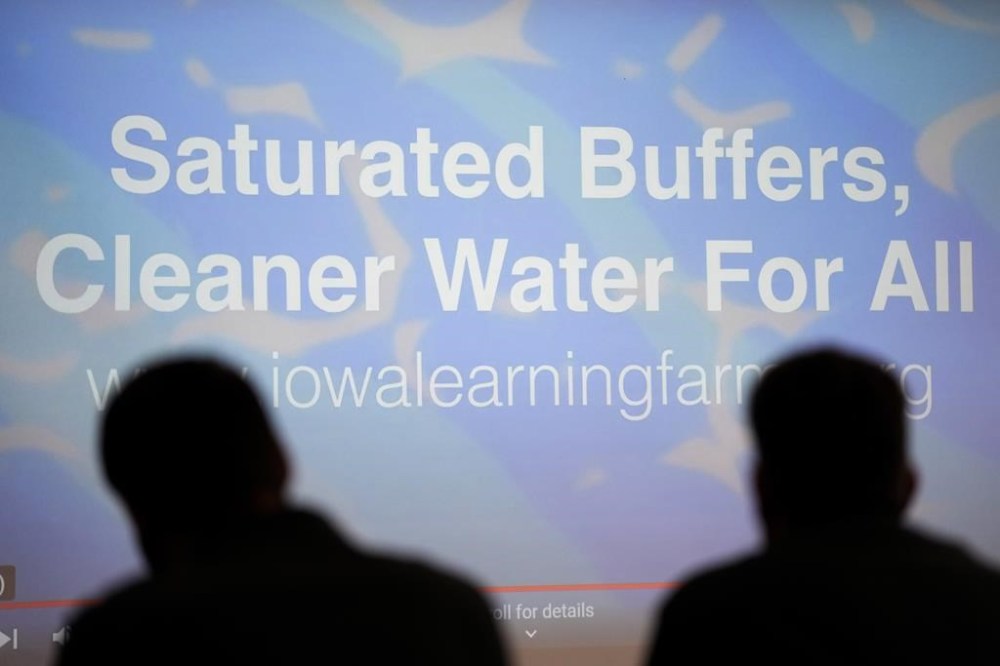
Iowa Agriculture Secretary Mike Naig, who has strongly opposed requiring farmers to filter runoff, has embraced Polk County’s effort and encouraged it elsewhere. In March, he promoted bioreactors and buffers at an event in Story County, north of Des Moines, where conservation officials have adopted the new program.
“We’re making it easy for a landowner to say yes, and then we bring the resources,” Naig said. “These are essentially 100% paid for. Either way, the work has to get done, and to have willing landowners and willing producers get involved, that will work much better.”
But clean water advocates note that Iowa needs thousands of the systems added each year, not hundreds, and question whether voluntary efforts can reach even a small percentage of the state’s farms — let alone those in other states.
“There’s a lot of people who are doing really good work,” said Alicia Vasto, the water program director at the Iowa Environmental Council. “The fact of the matter is that it’s just not at the pace and scale that’s necessary to fix the problem.”
The projected cost of scaling up is staggering. To significantly reduce nitrogen and phosphate runoff, a 2017 analysis found that upfront costs could be as high as $4 billion. That would include more than 100,000 bioreactors to deal with runoff on two-thirds of tile-drained farmland, as well as other solutions, like cover crops.
Swanson, the Polk County official, is now working with state officials to build more wetlands, which cost more and require more land but can filter much more runoff than the bioreactors and buffers. Helland wants such a wetland on his property and wants farmers to do more, but he thinks efforts should remain voluntary. Each farm is different, he said, and if governments try to require action, it could cause more problems and ultimately not be effective.
Jerry Hill, who has farmed for 52 years, attended the Story County meeting with other farmers and is leaning toward installing a bioreactor along a creek that borders his property. He liked the idea of filtering the water at little cost to his bottom line.
“We’re going to have to do a better job of keeping things clean,” Hill said. “From what I’ve heard, what they have going now is as good as it gets.”
___
Follow Scott McFetridge on Twitter: https://twitter.com/smcfetridge
___
The Associated Press receives support from the Walton Family Foundation for coverage of water and environmental policy. The AP is solely responsible for all content. For all of AP’s environmental coverage, visit https://apnews.com/hub/climate-and-environment