

TFSAs for a new era
Higher rates mean better returns on savings in these handy accounts, but as contribution room grows, higher growth strategies can generate much more sizable, tax-free income for retirement
Advertisement
Read this article for free:
or
Already have an account? Log in here »
To continue reading, please subscribe:

Digital Subscription
One year of digital access for only $205*
- Enjoy unlimited reading on winnipegfreepress.com
- Read the E-Edition, our digital replica newspaper
- Access News Break, our award-winning app
- Play interactive puzzles
*First annual payment billed as $205.00 + GST for one year. This annual subscription will automatically renew at $233.00 + GST every 52 weeks (10% off the regular annual price of $259.35). Offer available to new and qualified returning subscribers only. Cancel any time.
To continue reading, please subscribe:
Add Free Press access to your Brandon Sun subscription for only an additional
$1 for the first 4 weeks*
- Enjoy unlimited reading on winnipegfreepress.com
- Read the E-Edition, our digital replica newspaper
- Access News Break, our award-winning app
- Play interactive puzzles
*Your next Brandon Sun subscription payment will increase by $1.00 and you will be charged $17.95 plus GST for four weeks. After four weeks, your payment will increase to $24.95 plus GST every four weeks.
Read unlimited articles for free today:
or
Already have an account? Log in here »
Hey there, time traveller!
This article was published 29/04/2023 (1248 days ago), so information in it may no longer be current.
Chump change, it’s not.
The tax-free savings account (TFSA) has gradually transformed into an important financial tool for many Canadians since its inception years ago.
Starting with a $5,000 annual contribution in its inaugural year in 2009, the annual contribution limit has grown over the last 14 years—most recently to $6,500 for 2023.
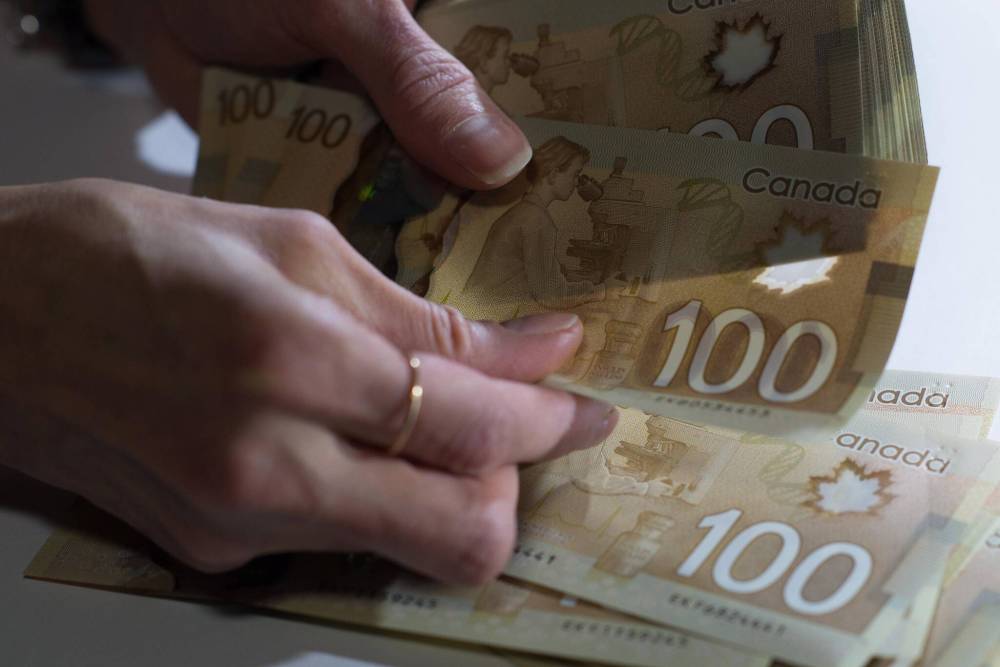
Graeme Roy / The Canadian Press files
The tax-free savings account is an increasingly powerful tool for retirement, or just about any other financial goal, but there are still a lot of misconceptions about their use.
In turn, if you were at least age 18 in 2009, you now have a lifetime maximum contribution limit of $88,000 that is growing with each passing year.
For a retired couple, that’s potentially $176,000 in tax-sheltered money today, plus growth, that can be withdrawn for any need, at any time and without tax consequences.
Given its contribution room heft—which will only grow in the future—the TFSA is an increasingly powerful tool for retirement, or just about any other goal.
Certainly, many Canadians are using it.
As of 2021, the latest federal data on TFSAs, more than 15 million Canadians had one, contributing collectively more than $71 billion.
Although many of these account holders are likely much happier with their returns in these accounts amid higher interest rates, they may not be seeing the bigger picture of TFSAs’ potential, says Jeanette Power, senior wealth adviser with CIBC Wood Gundy in Mississauga.
“There is still a lot of misconception about what TFSAs are and use.”
That key misunderstanding being many people use TFSAs as a savings account, as opposed to an investment account.
As such, a sizable chunk of TFSA holders put their contributions into guaranteed investment certificates (GICs) and high-interest savings accounts (HISAs).
Over the last 14 years, that strategy did not pay much. That said, it didn’t lose money either.
What’s more, Power is quick to add that regardless of investment choice, the TFSA is a handy tool particularly for retirees because withdrawals do not affect income-tested benefits like the guaranteed income supplement (GIS) for low-income seniors, or trigger clawbacks of Old Age Security for higher income seniors.
As well, “parking money” in a GIC today potentially earning five per cent per year feels pretty sweet relative to even a year ago when GICs paid about two per cent, Power says.
(It’s the same with HISAs, now earning three per cent versus 1.5 per cent or less for several years.)
Bonds look better too, says portfolio manager Grant White with Endeavour Wealth Management/IA Private Wealth in Winnipeg.
“It’s an interesting time to discuss (TFSAS) because there is more temptation to use bond funds and probably get a four per cent return,” he says. “And it’s nice to have that interest income tax-free.”
Yet as a money manager, providing clients’ have the risk appetite, White suggests a more growth-oriented strategy for the TFSA, which can be a “sort of holy grail” for long-term growth.
“Over someone’s lifetime, TFSAs have the potential to be multi-million-dollar accounts by the time they reach retirement age, especially if they have a partner, when using an equity growth strategy.”
Consider if you purchased $5,000 worth of electric vehicle maker Tesla stock in 2009. Its stock price has since increased 9,625 per cent (as December 31, 2022).
That would mean your $5,000-investment would be worth more than $480,000 today — and all of that growth would be tax-free inside a TFSA.
Of course, Tesla was a highly speculative stock in 2009.
And it’s likely not the best strategy “to be picking lottery tickets” inside your TFSA, says portfolio manager Darren Coleman with Raymond James Ltd. in Toronto.
“People often think that because you have a long time-horizon that you should buy the aggressive stuff.”
The rub with the ‘aggressive stuff’ is, if those speculative investments—i.e., early-stage technology companies—go sideways, you can end up losing TFSA contribution room (and equally important, your money).
A better risk-adjusted growth strategy for a TFSA would be dividend-producing stocks.
“It’s amazing to see people who have massive dividend income because they bought shares in big companies like McDonald’s 20 to 30 years ago,” Coleman says.
“And over time, these companies have grown their share price and dividends significantly, but the catch is you need to plant those seeds early so they have the time to grow into money trees.”
Even for retirees, allocating a portion of their TFSA to dividend stocks has appeal.
On the one hand, the dividends can provide annual income. On the other hand, the share prices will grow over several decades turning the TFSA into a sizable source of non-taxable wealth for the estate.
Yet a balanced approach may be most appealing of all.
“You can buy a balanced mutual fund or exchange-traded fund, for example,” Power says about the strategy of splitting assets between stocks and bonds.

Yet, given that most people may need money from the account in the short-term — just in case — she suggests investing half the contributions in a dividend fund, and the other half in bonds, GICs or a high-interest savings account.
“Of course, it’s different for every investor,” she adds.
The big takeaway, however, is simply to use the TFSA to your advantage sooner than later, Power says.
“It’s not difficult to understand the TFSA’s value proposition—it’s tax-free savings after all.”
As such, conservative saver or aggressive stock investor, the TFSA is one handy tool indeed.