Dust to dust? New Mexicans fight to save old adobe churches
Advertisement
Read this article for free:
or
Already have an account? Log in here »
To continue reading, please subscribe:

Digital Subscription
One year of digital access for only $205*
- Enjoy unlimited reading on winnipegfreepress.com
- Read the E-Edition, our digital replica newspaper
- Access News Break, our award-winning app
- Play interactive puzzles
*First annual payment billed as $205.00 + GST for one year. This annual subscription will automatically renew at $233.00 + GST every 52 weeks (10% off the regular annual price of $259.35). Offer available to new and qualified returning subscribers only. Cancel any time.
To continue reading, please subscribe:
Add Free Press access to your Brandon Sun subscription for only an additional
$1 for the first 4 weeks*
- Enjoy unlimited reading on winnipegfreepress.com
- Read the E-Edition, our digital replica newspaper
- Access News Break, our award-winning app
- Play interactive puzzles
*Your next Brandon Sun subscription payment will increase by $1.00 and you will be charged $17.95 plus GST for four weeks. After four weeks, your payment will increase to $24.95 plus GST every four weeks.
Read unlimited articles for free today:
or
Already have an account? Log in here »
Hey there, time traveller!
This article was published 29/04/2023 (1221 days ago), so information in it may no longer be current.
CORDOVA, New Mexico (AP) — Ever since missionaries started building churches out of mud 400 years ago in what was the isolated frontier of the Spanish empire, tiny mountain communities like Cordova relied on their own resources to keep the faith going.
Thousands of miles from religious and lay seats of power, everything from priests to sculptors to paint pigments was hard to come by. Villagers instituted lay church caretakers called “mayordomos,” and filled chapels with elaborate altarpieces made of local wood and varnished with pine sap.
Today, threatened by depopulation, dwindling congregations and fading traditions, some of their descendants are fighting to save these historic adobe structures from literally crumbling back to the earth they were built with.
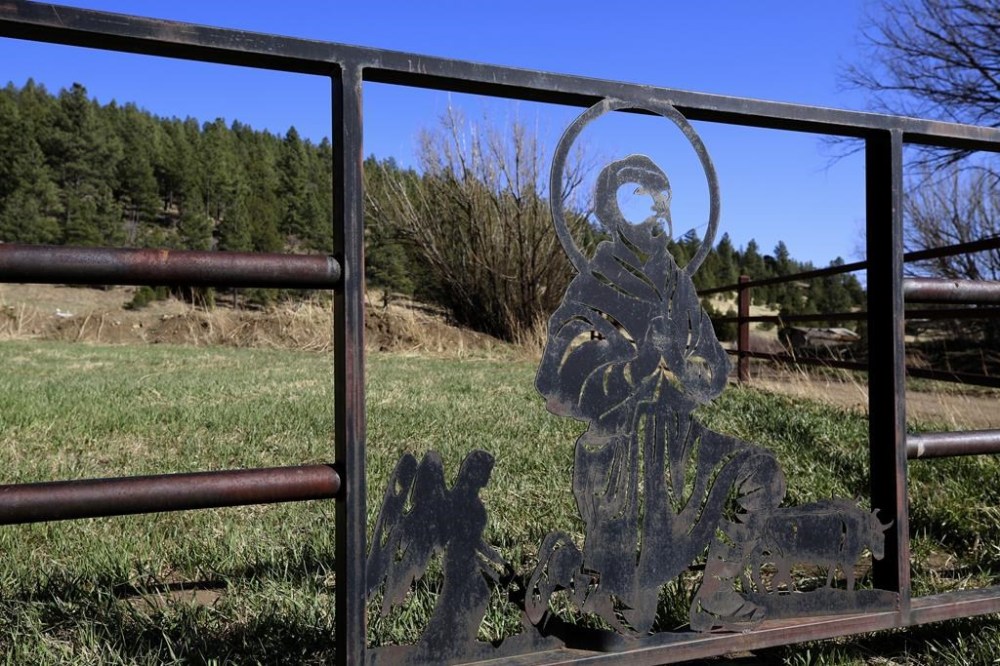
“Our ancestors put blood and sweat in this place for us to have Jesus present. This is the root of my faith,” said Angelo Sandoval on a chilly spring day inside the 1830s church of St. Anthony, where he serves as mayordomo in his native Cordova. “We’re not just a church, we’re not just a religion – we have roots.”
From the local dirt they’re made of to the generations of family memories they hold, these churches anchor a uniquely New Mexican way of life for their communities, many of which no longer have schools or stores, and struggle with chronic poverty and addiction.
An estimated 500 Catholic mission churches remain in northern New Mexico, where the Rocky Mountains taper off into desert mesas to the west and endless plains to the east.
It’s becoming increasingly difficult to find the necessary investment – hundreds of thousands of dollars, plus specialized conservation skills and families willing to serve as mayordomos – to preserve them, especially since most are used for only a few services each year.
“It’s truly a labor of love,” said the Rev. Rob Yaksich, pastor of Our Lady of Sorrows in Las Vegas, New Mexico, which oversees 23 rural churches, most in adobe, spread over a large territory. “When the faithful generation is gone, are they going to be a museum or serve their purpose? This old, deep-rooted Spanish Catholicism is experiencing serious disruption.”
Fidel Trujillo is mayordomo of the pink-stuccoed San José church in the hamlet of Ledoux where he grew up. With his wife and other family members, he keeps it spotless even though only two Masses per year are celebrated here regularly.
“Our ‘antepasados’ (ancestors) did a tremendous job in handing over the faith, and it’s our job now,” Trujillo said in the characteristic mix of Spanish and English that many speak in this region. While he’s also active in the main parish in the nearby town of Mora, he brings his children, 6 and 4, as often as he can to San José.
“This serves as a retreat and grounding for us,” he added. “I much prefer coming to these ‘capillas’ (chapels). It’s a compass that guides where your heart really belongs.”
Each mission church is devoted to a particular saint, for whom the community develops special veneration. When New Mexico’s largest wildfire last spring charred forests close to the San José church, and Trujillo was displaced for a month, he took the statue of St. Joseph with him.
In the small town of Bernalillo, Catholic faithful have kept a vow to St. Lawrence for more than 300 years that includes one family each year setting up an altar with his image in their home – and making it available 24/7 to anyone who wants to pray.
“They have knocked at my door at 2 a.m. and I’ve let them in,” said mayordoma Barbara Finley.
Her home is near the historic adobe Santuario de San Lorenzo, which the community fought to keep even though a larger church was built next door.
“Four hundred years ago, life was very difficult in this part of the world, the remote inland frontier of the Spanish empire,” explained Felix López, a master “santero” – the artists who sculpt, paint and conserve saint figures in New Mexico’s unique devotional style, born of historical isolation. “People needed these ‘santos.’ They were a source of comfort and refuge.”
In intervening centuries, most were stolen, sold or damaged, according to Bernadette Lucero, director, curator and archivist for the Archdiocese of Santa Fe, which has inventories of its hundreds of churches since the 1600s.
But how much these expressive sculptures and paintings still matter to local communities is evident where they survive in original form, as they do at the mission churches in Cordova, Truchas and Las Trampas on the mountain road from Santa Fe to Taos.
“Saints are the spiritual go-to; they can be highly powerful,” said Victor Goler, a master santero who just completed conserving the altarpieces, or “reredos,” in Las Trampas’ mid-18th century church. “It’s important for the community to have a connection. Their feeling is a lot deeper and that’s what keeps it going.”
On a recent Sunday at Truchas’ 1760s Holy Rosary church, López pointed out the rich decorative details that centuries of smoke and grime had hidden until he meticulously removed them with the absorbent inside of sourdough bread.
“I’m a devout Catholic, and I do this as meditation, as a form of prayer,” said López, who’s been a santero for five decades and whose family hails from this village perched on a ridge at 7,000 feet (2,100 meters).
A few miles down the valley in Cordova, Jerry Sandoval – another santero and the mayordomo’s uncle — says a prayer to each saint before starting to sculpt their image out of pine, cottonwood or aspen. He then paints them with natural pigments – purple is made of crushed bugs, for example – and varnishes them with the sap of piñon, the stocky pine tree that dots the countryside.
He also helped conserve the colorful, centuries-old reredos at the local church, where many children come back for traditional Christmas and Easter prayers – giving both Sandovals hope that the younger generations will learn to be attached to their church.
“They see all this,” Jerry Sandoval said in front of the richly decorated altarpieces from St. Anthony church. “Lots of people call it tradition, but we call it faith.”
For the Rev. Sebastian Lee, who as administrator of the popular Santuario de Chimayó complex a few miles away also oversees these mission churches, fostering local attachment is a daunting challenge as congregations shrink even faster since the COVID-19 pandemic.
“I want missions to be where people can taste culture and religiosity. They’re very healing, you’re soaked with people’s faith,” Lee said as pilgrims filed past his tiny adobe-walled office into the main sanctuary at Chimayó. “I wonder how to help them, because sooner or later one mission is not going to have enough people.”
The archdiocese’s Catholic Foundation provides small grants, and several organizations have been founded to help conservation efforts.
Frank Graziano hopes his non-profit Nuevo Mexico Profundo, which supported the Cordova conservation, can obtain the necessary permit from the archdiocese to restore the 1840s church of San Geronimo. Deep cracks break apart its adobe walls and bug nests buzz in a gaping hole by one of the windows.
The surrounding village, in a wide valley in the shadow of Hermit Peak, is almost entirely depopulated, making it unlikely that the community will step in for the necessary upkeep. Exposed to rain and snow, adobe needs a fresh replastering of dirt, sand and straw every couple of years lest it dissolve.
That makes local buy-in and some kind of ongoing activity, even just funerals, fundamental to long-term preservation, said Jake Barrow, program director at Cornerstones, which has worked on more than 300 churches and other structures.
When volunteers started fundraising for the mission in Truchas, the community suspected it would be turned into an art gallery, said mayordoma Aggie Vigil. They came around when she shared the dream to make the old adobe church, then unstable and infested with gophers, viable for Mass again.
But with fewer priests and fewer faithful, taking some rural missions off the church’s roster might be inevitable, said the Rev. Andy Pavlak, who serves on the archdiocese’s commission for preservation of historic churches.
“We have two choices: Either return to the community, or back to the earth they came from. We can’t save them all,” said Pavlak, who for nearly a decade ministered to 10 churches in Socorro County, the oldest from 1615. “The adobe is made from the earth. Adam and Eve were made from the earth. We’re all going to the earth. How do we do it with dignity?”
Running his hand over the smooth adobe walls he restored at the 1880s Santo Niño de Atocha chapel in Monte Aplanado, a hamlet nestled in a high mountain valley, Leo Paul Pacheco argued that the answer might hinge on the faith of lay people like him.
He and his son belong to one of the many brotherhoods, known as “penitentes” for their devotion to penance and prayer for souls in purgatory, that historians credit with fulfilling the church’s role of religious and social work when frontier dangers kept priests away.

The brothers still help set a model as their county struggles with unemployment and the drug crisis, Pacheco said. “We lift our community in prayer. What we do is to highlight and share aspects of community that bring bonds.”
Longer term, it will be up to future generations to leverage their faith to save these historic churches.
“They still have access to the same dirt,” Pacheco said as the adobe walls’ sand particles and straw sparkled in the sun. “They will provide.”
——
Associated Press religion coverage receives support through the AP’s collaboration with The Conversation US, with funding from Lilly Endowment Inc. The AP is solely responsible for this content.
The Free Press acknowledges the financial support it receives from members of the city’s faith community, which makes our coverage of religion possible.