Research monkey shortage undermines US readiness, panel says

Advertisement

Advertise with us

There’s a shortage of monkeys available for medical research and the U.S. should expand its breeding programs rather than rely on international suppliers to solve it, an influential scientific advisory panel said Thursday.

Read this article for free:


or

Already have an account? Log in here »

To continue reading, please subscribe:

Subscribe and receive a limited-edition Free Press branded hat or tote.

Digital Subscription

One year of digital access for only $205*

  • Enjoy unlimited reading on winnipegfreepress.com
  • Read the E-Edition, our digital replica newspaper
  • Access News Break, our award-winning app
  • Play interactive puzzles

*First annual payment billed as $205.00 + GST for one year. This annual subscription will automatically renew at $233.00 + GST every 52 weeks (10% off the regular annual price of $259.35). Offer available to new and qualified returning subscribers only. Cancel any time.

To continue reading, please subscribe:

Add Free Press access to your Brandon Sun subscription for only an additional

$1 for the first 4 weeks*

  • Enjoy unlimited reading on winnipegfreepress.com
  • Read the E-Edition, our digital replica newspaper
  • Access News Break, our award-winning app
  • Play interactive puzzles
Start now

*Your next Brandon Sun subscription payment will increase by $1.00 and you will be charged $17.95 plus GST for four weeks. After four weeks, your payment will increase to $24.95 plus GST every four weeks.

Hey there, time traveller!
This article was published 04/05/2023 (1228 days ago), so information in it may no longer be current.

There’s a shortage of monkeys available for medical research and the U.S. should expand its breeding programs rather than rely on international suppliers to solve it, an influential scientific advisory panel said Thursday.

Studies using nonhuman primates, especially monkeys, have been critical to lifesaving medical advances – including creating vaccines against COVID-19 – because of their similarities to people. The U.S. funds colonies at national primate centers but supplies were tight and more animals were regularly imported even before the pandemic.

Then China, once a leading supplier, ended exports of research monkeys in 2020, as scientists everywhere needed more for coronavirus studies. And last fall, the U.S. filed charges to stop a Cambodian smuggling ring accused of shipping endangered wild monkeys in place of those bred for research, further constraining supplies.
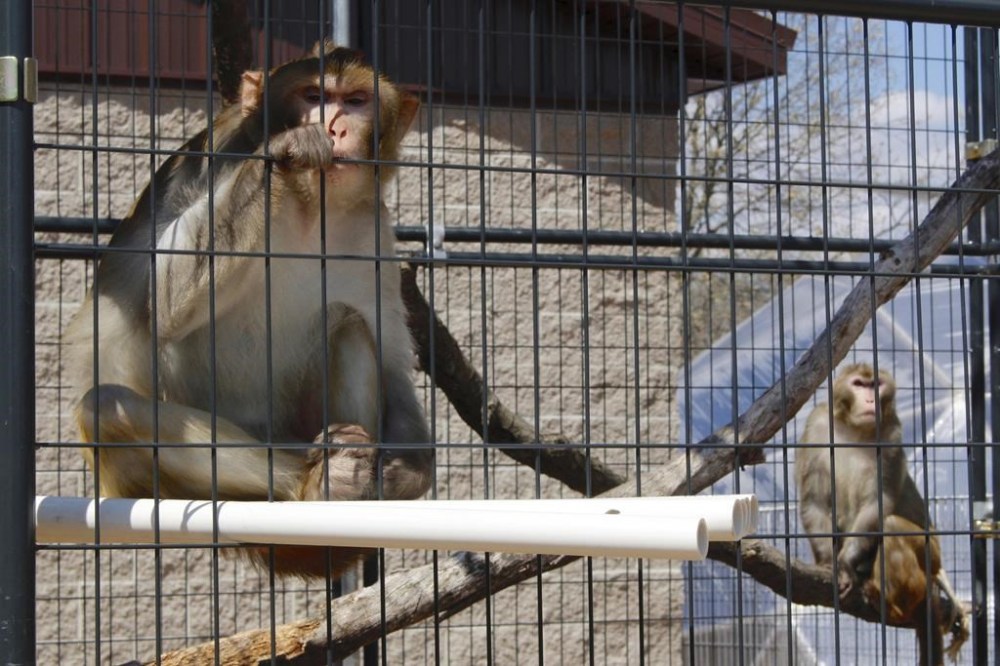
FILE - River, left, and Timon, both rhesus macaques who were previously used in medical research, sit in an outdoor enclosure at Primates Inc., in Westfield, Wis., on May 13, 2019. The sanctuary is a 17-acre rural compound where research animals can live their remaining years when their studies are done. A report released on Thursday, May 4, 2023, says a shortage of monkeys available for medical research undermines U.S. readiness to respond to public health emergencies. (AP Photo/Carrie Antlfinger, FILE)

Thursday’s report examined only research funded by the National Institutes of Health, deemed key to responding to public health emergencies — not drug company or other publicly or privately funded research with monkeys.

The nation’s preparedness is undermined by having to depend on imports of these animals, which are especially important for infectious disease research and neuroscience, said a panel of the National Academies of Sciences, Engineering and Medicine. Highlighting that vulnerability, the U.S. experienced a 20% drop in imports of one species, cynomolgus macaques, when China suddenly stopped shipping.

The panel also called for more development of alternatives to monkey testing — and in the meantime urged better scientific collaboration to make the best use of each research animal.

“If the U.S. is to produce high-impact biomedical research and have a research infrastructure capable of responding to the next public health crisis, now is the time to strengthen the systems we need for nonhuman primate research,” said committee chairman Dr. Kenneth Ramos of Texas A&M University.

Use of animals in biomedical research, especially nonhuman primates, is controversial. Under pressure, the NIH already retired chimpanzees, humans’ closest relatives, from invasive research but has maintained there’s still need for monkeys. Nonhuman primates represent 0.5% of all the animals used in biomedical research in the U.S., the report said.

In a survey of NIH-supported researchers, the National Academies panel found 64% reported challenges in getting nonhuman primates required for their work, including increased wait times and cost. In 2021, the National Primate Research Centers had such a shortage of monkeys never used in previous studies that it couldn’t meet two-thirds of researcher requests, the report said.

___

The Associated Press Health and Science Department receives support from the Howard Hughes Medical Institute’s Science and Educational Media Group. The AP is solely responsible for all content.

Report Error Submit a Tip

More Stories

Highway-safety upgrades in progress after tragic Interlake crash

Chris Kitching 5 minute read Preview

Highway-safety upgrades in progress after tragic Interlake crash

Chris Kitching 5 minute read Updated: Yesterday at 6:25 PM CDT

Provincial workers have started to update or install safety measures at a rural Interlake intersection where four teenage friends died in a crash on Labour Day weekend.

Pavement markings were repainted at Highway 8 and Provincial Road 229, just west of Winnipeg Beach, ahead of work to refresh worn-down rumble strips, starting Monday, and install flashing lights atop two stop signs, following an assessment earlier this week.

“They will also need to incorporate any information from the RCMP report that might be helpful if we were to consider any additional safety measures at this intersection,” Transportation and Infrastructure Minister Lisa Naylor said of department staff.

“The most important thing is safety, and any kinds of changes we make at any intersection actually have to make it safer.”

Read
Updated: Yesterday at 6:25 PM CDT

Tory health critic ‘disappointed’ after being rebuffed by health officials

Carol Sanders 4 minute read Preview

Tory health critic ‘disappointed’ after being rebuffed by health officials

Carol Sanders 4 minute read 11:53 AM CDT

The health critic for the Progressive Conservative party says her ability to get information about the accelerated reopening of Dauphin’s emergency department was stymied by Prairie Mountain Health officials because they refused to meet with her.

“I wanted to meet with PMH staff to discuss the status of the facility and the challenges they’re facing and getting services back online,” Kathleen Cook said Friday.

“I was very disappointed that Prairie Mountain Health declined me that opportunity.”

Cook said she asked for a meeting a few days after the Sept. 7 reopening of a temporary ER at the hospital, that was severely damaged by flooding.

Read
11:53 AM CDT

Education minister’s reasons for revoking teacher’s licence ‘not good enough,’ judge decides

Maggie Macintosh 5 minute read Preview

Education minister’s reasons for revoking teacher’s licence ‘not good enough,’ judge decides

Maggie Macintosh 5 minute read Updated: Yesterday at 9:14 AM CDT

A Manitoba judge has rejected the education minister’s decision to end a teacher’s career because he repeatedly messaged with a 13-year-old girl on social media.

Read
Updated: Yesterday at 9:14 AM CDT

Retired sportscaster Scott Oake determined as fundraising for women's addictions treatment facility enters home stretch

Melissa Martin 4 minute read Preview

Retired sportscaster Scott Oake determined as fundraising for women's addictions treatment facility enters home stretch

Melissa Martin 4 minute read Thursday, Sep. 10, 2026

For now, the patch of land just east of the Victoria Hospital doesn’t look like much: just a field of rocks, mounded dirt, and concrete piles driven into the earth. Yet when Scott Oake looks over the site, he can already imagine how it will look in just over a year’s time, when the new Anne Oake Family Recovery Centre is expected to open.

It’s easier to picture this time around. In 2020, when the recently-retired CBC sportscaster and his late wife, Anne, were building their first labour of intermingled grief and love, the Bruce Oake Recovery Centre for men, it was hard for him to wrap his mind around how a raw construction site could transform into a welcoming addictions treatment facility.

When that centre opened in 2021, Oake found it looked “almost identical” to the architect’s renderings. So it’s easy to hope the Anne Oake Centre will be the same. It will be the first facility of its kind, its founders believe, not only in Canada but in North America: a place where 50 to 70 women can pursue sobriety while staying with their children.

“At Bruce Oake there’s a culture of love, and most of all a culture of hope,” Oake said, speaking at the site Thursday after a media conference to announce the final push of the centre’s fundraising campaign. “I can feel it every time I walk into that building. And I know it will be the same here.”

Read
Thursday, Sep. 10, 2026

Goodness alive, well in N.L.-set musical

Jen Zoratti 4 minute read Preview

Goodness alive, well in N.L.-set musical

Jen Zoratti 4 minute read 2:01 AM CDT

I first saw Come From Away — the true-story musical about the incredible efforts of the residents of Gander, N.L. on Sept. 11, 2001, who welcomed nearly 7,000 travellers diverted to their remote town after the attacks on the World Trade Center and the Pentagon — in 2022, when Broadway Across Canada brought it to the Centennial Concert Hall.

I went in cold, but with blunted expectations; it seemed, on premise alone, like it could tilt too far into shmaltzy sentimentality, that it would be too earnest in its goodness.

So, when I wept until my face was as wet and salty as though it had been slapped by the waves of the North Atlantic, I was pleasantly surprised. I loved it. It’s emotional, yes. It’s sentimental, yes. But you can’t help but feel both buoyed — and, dare I say, patriotic — by the end of it.

Written by Canadians Irene Sankoff and David Hein, Come From Away seemed an unlikely hit when it opened on Broadway in 2017. But there was, by then, an appetite for it.

Read
2:01 AM CDT

Puzzles Palace

1 minute read Monday, Jul. 27, 2026

To solve our puzzles, please subscribe with this special offer: |