Metaverse to contribute at least $45.3B to Canada’s annual GDP by 2035 says Meta
Advertisement
Read this article for free:
or
Already have an account? Log in here »
To continue reading, please subscribe:

Digital Subscription
One year of digital access for only $205*
- Enjoy unlimited reading on winnipegfreepress.com
- Read the E-Edition, our digital replica newspaper
- Access News Break, our award-winning app
- Play interactive puzzles
*First annual payment billed as $205.00 + GST for one year. This annual subscription will automatically renew at $233.00 + GST every 52 weeks (10% off the regular annual price of $259.35). Offer available to new and qualified returning subscribers only. Cancel any time.
To continue reading, please subscribe:
Add Free Press access to your Brandon Sun subscription for only an additional
$1 for the first 4 weeks*
- Enjoy unlimited reading on winnipegfreepress.com
- Read the E-Edition, our digital replica newspaper
- Access News Break, our award-winning app
- Play interactive puzzles
*Your next Brandon Sun subscription payment will increase by $1.00 and you will be charged $17.95 plus GST for four weeks. After four weeks, your payment will increase to $24.95 plus GST every four weeks.
Read unlimited articles for free today:
or
Already have an account? Log in here »
Hey there, time traveller!
This article was published 09/05/2023 (1234 days ago), so information in it may no longer be current.
TORONTO – When Facebook chief executive Mark Zuckerberg changed his company’s name to Meta less than two years ago, he placed a multi-billion-dollar bet on a virtual but interactive realm where he believed people would work and play for generations to come.
Zuckerberg’s ultimate vision is still far from reality. The Quest headsets the company created to access the metaverse aren’t a fixture in most homes, businesses haven’t shifted operations to the digital space en masse and an abundance of questions remain about how safe the technology is and whether it’s really needed.
Media outlet Business Insider even wrote the technology’s obituary Monday, saying “RIP Metaverse, we hardly knew ye” and listing prominent companies including Disney, Microsoft and Walmart that have backed away from metaverse efforts.
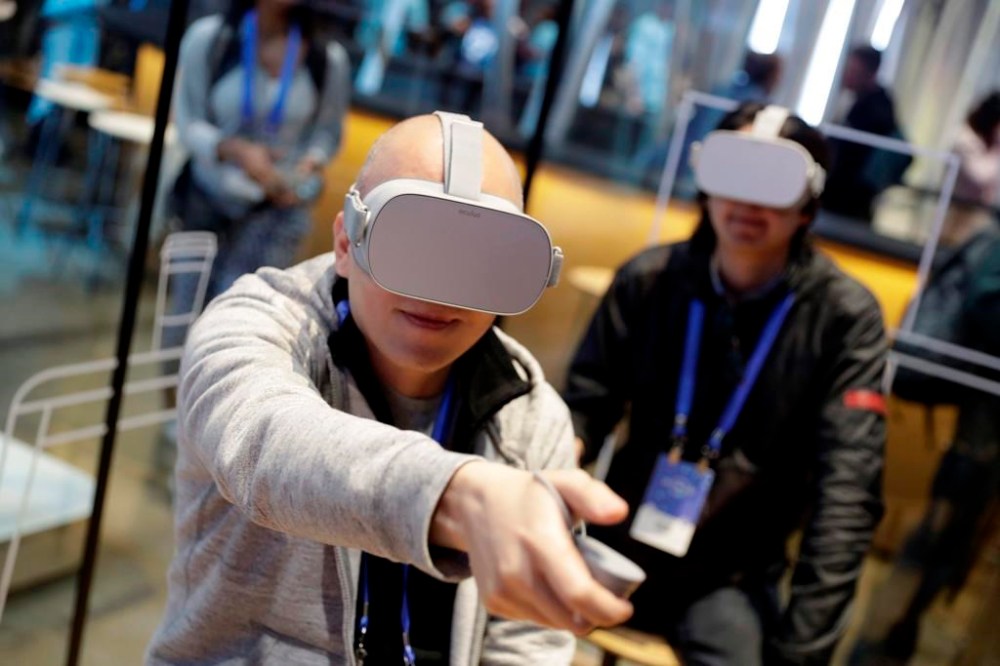
Yet Meta is still convinced that virtual spaces are the future — and it has added new Canadian data to bolster its prophecy.
A report released Tuesday by consulting firm Deloitte, which the tech giant commissioned last May, estimated the metaverse could contribute between $45.3 billion and $85.5 billion to Canada’s annual GDP by 2035, making up 1.3 per cent to 2.4 per cent of the country’s GDP.
Such stats are “not surprising,” said Kevin Chan, Meta’s global director of policy programs, in a media roundtable held in the metaverse Tuesday.
“There are a lot of interesting tech hubs in Canada, in Toronto, and a lot of gaming hubs traditionally in Quebec City and in Vancouver.”
As technology improves, companies are experimenting with ways to add digital components based around virtual, augmented or extended reality to software, smartphones and headsets.
Virtual reality (VR) helps create artificial environments, while augmented reality (AR) uses devices such as a headset to overlay sensory information like sounds or visuals on top of a user’s actual environment.
Extended reality (XR) is an umbrella term encompassing both VR and AR that is used to denote immersive digital worlds. The metaverse — a term coined in the 1992 science fiction novel Snow Crash — mostly uses VR but may eventually evolve to use all three types of technology.
Ottawa-headquartered e-commerce software company Shopify Inc. provides tools helping retailers launch AR versions of their products, while Toronto-based Xesto runs a smartphone application equipped with AR that allows consumers to scan their feet at home and receive a personalized shoe size.
At MetaVRse, a Toronto-based XR company, work is underway on The Mall, a 3D shopping centre where private investors and retailers can purchase spaces.
Georgian College in Barrie, Ont. is developing 12 VR learning programs in areas such as architecture, tourism and nursing, while Toronto-based Marion Surgical uses the technology in surgery for medical students.
But Chan still considers these the “very early stages of development of the metaverse.”
“It’s probably too early to be definitive about how it will fully develop by 2035,” he said.
Rob Sherman, Meta’s vice-president of policy, joined Chan at Tuesday’s metaverse briefing — held in a virtual space made to look like a sleek-wood-panelled conference room overlooking a lake — agreed, describing the metaverse as “a long-term project.”
“We’re looking at a 10 to 15-year time horizon before the kind of technology that we’ll be talking about today is really commonplace, but it is a part of people’s lives and people’s communities today, which is really, really exciting.”
But the metaverse needs to conquer one of its biggest challenges: adoption.
Despite Canadians being technology savvy (Meta and Deloitte’s report found 97 per cent of Canada’s population use the internet, 90 per cent have a smartphone and 80 per cent have a laptop or desktop computer), an Ipsos survey of 21,005 adults in 29 countries including Canada revealed Canadian consumers are less aware of the metaverse than consumers in other countries.
The online survey conducted in April and May last year concluded 74 per cent of Canadian adults were familiar with virtual reality, 43 per cent with augmented reality, 30 per cent with extended reality and 37 per cent with the metaverse.
Meta and Deloitte are projecting the market for AR and VR technologies will grow at a compound annual growth rate of 15.5 per cent between 2022 and 2027.
However, most Canadians don’t have positive feelings about the metaverse, Ipsos found.
While excitement around extended reality is high in China, India, Peru, Saudi Arabia and Columbia, where more than two thirds have positive feelings about the technology, less than one-third feel positive about it in Canada, Japan, Great British, Belgium, France and Germany.
The study didn’t investigate what weighed on positive feelings, but a December 2021 article from the New York Times said harassment, assaults, bullying and hate speech “already run rampant in virtual reality games, which are part of the metaverse, and there are few mechanisms to easily report the misbehaviour.”
Others are worried about data and privacy implications, which Sherman said, “are really critical to the future of this technology.”
“People won’t be comfortable using it either as a consumer or as a business, if they don’t have confidence that their information is protected and that it’s safe and secure.”
Meta, he said, is working to keep the metaverse safe by using “adversarial testing” to identify and mitigate threats “wherever we can.” It also has a bug bounty program, which allows third-party researchers to identify security gaps and report them in exchange for compensation.
Sherman also addressed whether Meta’s attention is being diverted way from the metaverse toward artificial intelligence.
Meta’s chief technology officer Andrew Bosworth said he along with Zuckerberg and chief product officer Chris Cox and are spending “most” of their time working on the company’s new artificial intelligence (AI) unit, in an April CNBC interview.

“I know there’s been this narrative that somehow we’re moving away from the metaverse and moving toward AI, so I just want to say upfront that that’s not accurate,” Sherman said.
He called AI “a foundational part of the metaverse work that we’re doing,” and “really critical actually to enabling the metaverse future that we’ve envisioned.”
This report by The Canadian Press was first published May 9, 2023.
—
Meta funds a limited number of fellowships that support emerging journalists at The Canadian Press.