Pipeline plot twist: where Line 5 threatens nature, now nature is a threat to Line 5
Advertisement
Read this article for free:
or
Already have an account? Log in here »
To continue reading, please subscribe:

Digital Subscription
One year of digital access for only $205*
- Enjoy unlimited reading on winnipegfreepress.com
- Read the E-Edition, our digital replica newspaper
- Access News Break, our award-winning app
- Play interactive puzzles
*First annual payment billed as $205.00 + GST for one year. This annual subscription will automatically renew at $233.00 + GST every 52 weeks (10% off the regular annual price of $259.35). Offer available to new and qualified returning subscribers only. Cancel any time.
To continue reading, please subscribe:
Add Free Press access to your Brandon Sun subscription for only an additional
$1 for the first 4 weeks*
- Enjoy unlimited reading on winnipegfreepress.com
- Read the E-Edition, our digital replica newspaper
- Access News Break, our award-winning app
- Play interactive puzzles
*Your next Brandon Sun subscription payment will increase by $1.00 and you will be charged $17.95 plus GST for four weeks. After four weeks, your payment will increase to $24.95 plus GST every four weeks.
Read unlimited articles for free today:
or
Already have an account? Log in here »
Hey there, time traveller!
This article was published 14/05/2023 (1248 days ago), so information in it may no longer be current.
WASHINGTON – The controversial Canada-U.S. oil and gas conduit known as Line 5 could be facing its toughest challenger yet: the very watershed the pipeline’s detractors are trying to protect.
Spring flooding has washed away significant portions of the riverbank where Line 5 intersects Wisconsin’s Bad River, a meandering, 120-kilometre course through Indigenous territory that feeds Lake Superior and a complex network of ecologically delicate wetlands.
The Bad River Band of the Lake Superior Chippewa has been in court with Alberta energy giant Enbridge Inc. since 2019 in an effort to compel the pipeline’s owner and operator to reroute Line 5 around its traditional territory.
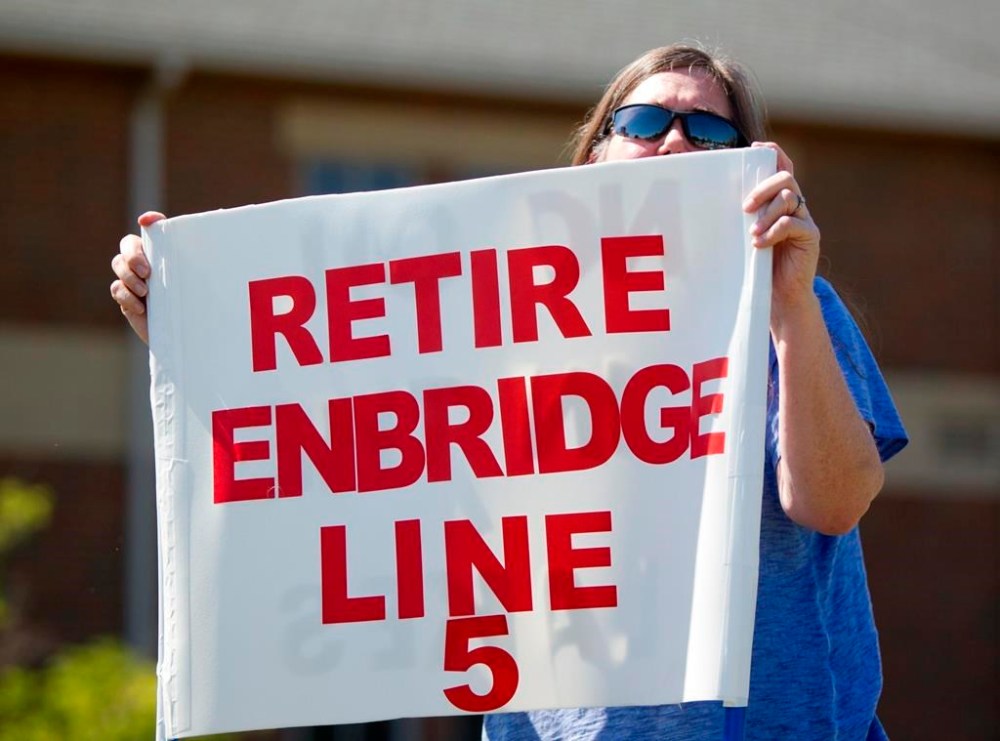
But last month, Mother Nature raised the stakes.
“There can be little doubt now that the small amount of remaining bank could be eroded and the pipeline undermined and breached in short order,” the band’s lawyers argued in an emergency motion filed last week.
“Very little margin for error remains.”
Line 5 meets the river on Indigenous territory just past a location the court has come to know as the “meander,” where the riverbed snakes back and forth multiple times, separated from itself only by several metres of forest and the pipeline itself.
At four locations, the river is less than 4.6 metres from the pipeline — just 3.4 metres in one particular spot — and the erosion has continued in recent days at an “alarming” rate, the motion says.
In one case, so-called “monuments” installed to measure the losses show that where there was more than 10 metres of riverbank in early April before the flooding began, only 3.7 metres remained as of last Tuesday.
“Significant erosion is continuing as of the filing of this motion, and the evidence strongly suggests that further bank loss could be substantial and result in exposure and rupture of the pipeline.”
Wisconsin district court Judge William Conley has scheduled a hearing for Thursday to hear oral arguments on the motion, which asks for an injunction that would require Enbridge to shut down the pipeline and purge its contents.
A response from the company is due by Tuesday — but a strongly worded statement Tuesday that described the motion as “truly outrageous” and “unnecessary” left little doubt about its position.
“There is no pipeline safety issue and certainly no cause for alarm,” the company said.
“To be clear, the band’s leadership seems determined to shut down this piece of critical North American energy infrastructure regardless of who will be impacted by their actions.”
Enbridge has offered “numerous plans” to reinforce the riverbank and install an additional emergency valve on the pipeline to further mitigate the risk — work that requires the band’s approval.
But the band insists no work can be done to reinforce the riverbank. “Nothing could be further from the truth,” Enbridge said.
Asked whether the company was putting contingency plans in place, “there are no existing alternatives” to Line 5, said spokesperson Juli Kellner.
“We will make the case, backed by expert testimony, that Line 5 is safe,” Kellner said. “Line 5 is not exposed; it’s buried under multiple feet of soil.”
Conley has already noted in court that the band, which Kellner said has already rejected more than a dozen Enbridge proposals to shore up the riverbank, “is uninterested in any kind of solution” other than shutting down the pipeline, she added.
It’s important to remember that neither side in the dispute wants to see the pipeline ruptured, said James Coleman, a specialist in energy law at Southern Methodist University’s Dedman School of Law in Dallas.
“Any kind of spill would be a catastrophe for all concerned, including Enbridge,” Coleman said. “Clearly, I think that the goal is, ‘Hey, let’s keep this in operation as long as we can do so safely until we have a reroute.'”
In a key decision last fall, Conley signalled clearly that he wasn’t interesting in ordering Line 5 shut down as a preventive measure, citing the likely economic and foreign-policy impacts of doing so.
The question now, Coleman said, is whether he is convinced that the erosion has changed the facts on the ground and does indeed pose an imminent threat to the Bad River watershed and to Lake Superior itself.
At this stage, however, neither the Bad River band nor the growing coalition of environmental groups on both sides of the Canada-U.S. border that are backing their challenge need any convincing.
“The interconnected waters flowing through the Mashkiiziibii — the Bad River — are inseparable from our people’s existence,” tribal chairman Mike Wiggins said in a statement.
“This is an imminent threat not just to our way of life, but to the clean waters that sustain all the residents and businesses throughout the Lake Superior basin. The court needs to take action to shut down and purge Line 5 before it’s too late.”
The dispute illustrates one of the major logistical difficulties of pipelines, where a problem in one spot impacts the entire operation, Coleman said — and it’s not going to go away any time soon, even if fossil fuels eventually do.

“This is a fundamental challenge of linear infrastructure,” he said.
Clean, renewable energy is still going to have to move around the continent via power lines, and hydrogen or newly captured carbon will also require pipeline and storage infrastructure in much the same way as oil and gas.
“Our clean energy sources are more dependent on linear infrastructure,” Coleman said.
“In the worst case, most of these liquids you can at least truck it in or ship it by rail. But for power or hydrogen or any of those things, they are entirely dependent on linear infrastructure.”
This report by The Canadian Press was first published May 14, 2023.