DEA’s failure to punish distributor blamed in opioid crisis raises revolving door questions

Advertisement

Advertise with us

SHREVEPORT, La. (AP) — The U.S. Drug Enforcement Administration has allowed one of the nation’s largest wholesale drug distributors to keep shipping highly addictive painkillers for nearly four years after a judge recommended it be stripped of its license for its “cavalier disregard” of thousands of suspicious orders fueling the opioid crisis.

Read this article for free:


By clicking the button above, an account will be created and you will begin to receive some of our recommended newsletters. You may opt out of any newsletter by visiting your Email and Communication Preferences page or by clicking "unsubscribe" at the bottom of any email.

or

Already have an account? Log in here »

To continue reading, please subscribe:

Digital Subscription

One year of digital access for only $1.44 a week*

  • Enjoy unlimited reading on winnipegfreepress.com
  • Read the E-Edition, our digital replica newspaper
  • Access News Break, our award-winning app
  • Play interactive puzzles

*Billed as $5.77 plus GST every four weeks. After 52 weeks, price increases to the regular rate of $19.95 plus GST every four weeks. Offer available to new and qualified returning subscribers only. Cancel any time.

To continue reading, please subscribe:

Add Free Press access to your Brandon Sun subscription for only an additional

$1 for the first 4 weeks*

  • Enjoy unlimited reading on winnipegfreepress.com
  • Read the E-Edition, our digital replica newspaper
  • Access News Break, our award-winning app
  • Play interactive puzzles
Start now

*Your next Brandon Sun subscription payment will increase by $1.00 and you will be charged $17.95 plus GST for four weeks. After four weeks, your payment will increase to $24.95 plus GST every four weeks.

Hey there, time traveller!
This article was published 24/05/2023 (1247 days ago), so information in it may no longer be current.

SHREVEPORT, La. (AP) — The U.S. Drug Enforcement Administration has allowed one of the nation’s largest wholesale drug distributors to keep shipping highly addictive painkillers for nearly four years after a judge recommended it be stripped of its license for its “cavalier disregard” of thousands of suspicious orders fueling the opioid crisis.

The DEA did not respond to repeated questions from The Associated Press about its handling of the case against Morris & Dickson Co. or the involvement of a high-profile consultant the company had hired to stave off punishment and who is now DEA Administrator Anne Milgram’s top deputy.

But the delay has raised concerns about how the revolving door between government and industry may be impacting the DEA’s mission to police drug companies blamed for tens of thousands of American overdose deaths.
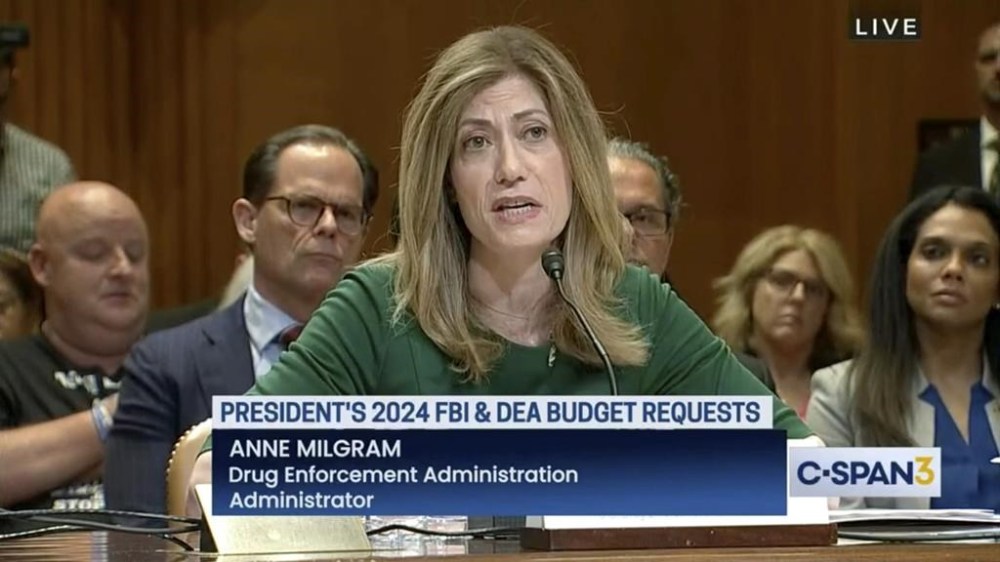
In this image from video provided by C-SPAN, U.S. Drug Enforcement Administration Administrator Anne Milgram speaks during a hearing before the Senate Appropriations Subcommittee on Commerce, Justice, and Science in Washington on May 10, 2023. At center left behind Milgram is Louis Milione. After temporarily leaving the DEA in 2017, like dozens of colleagues in the agency's powerful-but-little-known Office of Diversion Control, Milione immediately went to work as a consultant for some of the same companies he had been tasked with regulating, including Morris & Dickson. He was named deputy administrator in 2021. On another front, a federal watchdog is investigating whether Milgram improperly awarded millions of dollars in no-bid contracts to hire her past associates. (C-SPAN via AP)

“If the DEA had issued its order in a timely manner, one could then credibly believe that its second-in-command was not involved despite an obvious conflict of interest,” said Craig Holman, an ethics expert at the watchdog group Public Citizen in Washington. “The mere fact that its action has been delayed four years just raises red flags. It casts the entire process under grave suspicion.”

Last week, after the AP reached out to the DEA for comment, the agency broke its silence on the issue and abruptly notified Morris & Dickson that it has decided to revoke its registration to distribute controlled substances, according to two people familiar with the development who spoke on the condition of anonymity to discuss the exchange. However, no final order has yet been published. The company has described revocation as a “virtual death sentence” and is almost certain to challenge the decision in federal court.

Louis Milione, who was named DEA’s principal deputy administrator in 2021, did not respond to requests for comment. He retired from the DEA in 2017 after a storied 21-year career that included two years leading the division that controls the sale of highly addictive narcotics. Like dozens of colleagues in the DEA’s powerful-but-little-known Office of Diversion Control, he quickly went to work as a consultant for some of the same companies he had been tasked with regulating, including Morris & Dickson.

Milione was brought in by Morris & Dickson as part of a $3 million contract to save its registration to supply painkillers after the DEA accused the company in 2018 of failing to flag thousands of suspicious, high-volume orders.

Testifying in 2019 before federal Administrative Law Judge Charles W. Dorman, Milione argued that Morris & Dickson “spared no expense” to overhaul its compliance systems, cancel suspicious orders and send daily emails to the DEA spelling out its actions.

But those efforts were too little, too late, the judge wrote in a 159-page recommendation which has not been previously reported and was recently obtained by the AP. Anything less than the most severe punishment, he said, “would communicate to DEA registrants that despite their transgressions, no matter how egregious, they will get a mere slap on the wrist and a second chance so long as they acknowledge their sins and vow to sin no more.”

Accompanied by local law enforcement, U.S. Drug Enforcement Administration agents raid Wilkinson Family Pharmacy in Chalmette, La., Wednesday, April 19, 2017. Wilkinson purchased more than 4.5 million pills of oxycodone and hydrocodone from Morris & Dickson between 2014 and 2017, and federal prosecutors say during that time owner Keith Wilkinson laundered more than $345,000 from illegal opioid sales made with forged prescriptions or written by “pill mill” doctors. (Sophia Germer/The Advocate via AP)

“Acceptance of responsibility and evidence of remediation are not get-out-of-jail-free cards that erase the harm caused by years of cavalier disregard,” Dorman wrote. “Allowing the respondent to keep its registration would tell distributors that it is acceptable to take a relaxed approach to DEA regulations until they are caught, at which point they only need to throw millions of dollars at the problem to make the DEA go away.”

Shreveport, Louisiana-based Morris & Dickson, the nation’s fourth-largest wholesale drug distributor with $4 billion a year in revenue and nearly 600 employees, has said losing its license would effectively shut it down and have a “catastrophic” effect on patients in 29 states.

In a statement to AP, the company said it has invested millions of dollars in compliance systems, executives and advisors. “If DEA attempts to revoke our license for previous actions, the company will vigorously appeal and seek a stay in federal court,” it said. “We are confident we will achieve an outcome that safeguards the supply chain for all of our healthcare partners and the communities they serve.”

Neither Milgram nor two DEA administrators who preceded her have taken any enforcement action since Dorman’s 2019 recommendation, allowing Morris & Dickson to continue operating even as it pursued a potential settlement. Former DEA officials told AP a nearly four-year wait in such a case is highly unusual, noting it rarely takes the agency more than two years to issue a final order.

Milgram’s management of DEA since the Biden nominee came into office nearly two years ago has been called into question on another front. AP reported last month that a federal watchdog is investigating whether the agency improperly awarded millions of dollars in no-bid contracts to hire Milgram’s past associates.

As for Milione, federal ethics rules bar government employees from taking part in decisions that could benefit companies where they previously worked. DEA spokesperson Christina Pryor declined to comment, but a person familiar with Milione’s work said he recused himself from issues related to Morris & Dickson after returning to the DEA in 2021. The person spoke on condition of anonymity because they were not authorized to speak publicly about DEA officials’ recusals.

An automatic system drops pharmaceutical orders on a conveyor belt to be placed into boxes at Morris and Dickson Co., in Shreveport, Wednesday, July 13, 2016. The U.S. Drug Enforcement Administration has allowed one of the nation’s largest wholesale drug distributors to keep shipping opioid painkillers for nearly four years after a judge recommended in 2018 it lose its license for its “cavalier disregard” of thousands of suspicious orders fueling the opioid crisis. (Henrietta Wildsmith/The Shreveport Times via AP)

Milione, a lawyer and former bit Hollywood actor, impressed fellow DEA agents for his risk taking and toughness. Among his achievements was running the overseas sting that in 2008 nabbed Russia’s notorious arms trafficker Viktor Bout, aka “The Merchant of Death.”

But after taking over as the head of Diversion Control in 2015, he ended his predecessor’s refusal to meet with drug manufacturers and distributors and opened the DEA’s doors to the industry it was charged with regulating.

Among those Milione met with on at least two occasions was Paul Dickson Sr. — then-president of Morris & Dickson. That included a 2016 visit to the Louisiana headquarters with DEA investigators to discuss the company’s compliance program.

John Gray, the head of the Healthcare Distributors Alliance, a lobbying group that includes Morris & Dickson, recounted in a 2015 email how Milione, under orders from then-incoming DEA Administrator Chuck Rosenberg, wanted to “reset” relations with the drug industry. And Milione even delivered the keynote speech at the group’s annual meeting.

“Overall, he was engaging, exceedingly pleasant and seemed genuinely concerned that we had lost touch with each other,” Gray wrote. “It is a very different tone and approach than we have all seen in the past 8-10 years.”

Morris & Dickson had been punished for its mishandling of addictive drugs before. In 2019, before Dorman issued his recommendation, the company agreed to pay $22 million in civil penalties to resolve federal prosecutors’ claims that it violated the Controlled Substances Act by failing to report suspicious orders of hydrocodone and oxycodone. The company also agreed to multimillion-dollar upgrades of its compliance program to ensure it reports suspicious orders moving forward.

Pharmaceutical orders fall into boxes as workers make sure the orders are complete at Morris and Dickson Co., in Shreveport, Wednesday, July 13, 2016. The U.S. Drug Enforcement Administration has allowed one of the nation’s largest wholesale drug distributors to keep shipping opioid painkillers for nearly four years after a judge recommended in 2018 it lose its license for its “cavalier disregard” of thousands of suspicious orders fueling the opioid crisis. (Henrietta Wildsmith/The Shreveport Times via AP)

The case drew far less attention than the enforcement actions DEA took in recent years against Morris & Dickson’s larger competitors, a trio of pharmaceutical distributors who have agreed to pay the federal government more than $1 billion in fines and penalties for similar violations. Cardinal Health, AmerisourceBergen and McKesson also agreed to pay $21 billion over 18 years to resolve claims as part of a nationwide settlement.

Among the more than 12,000 suspicious orders that Dorman said Morris & Dickson should have reported to the DEA were 51 unusually large orders of opioids made by Wilkinson Family Pharmacy in suburban New Orleans.

Wilkinson purchased more than 4.5 million pills of oxycodone and hydrocodone from Morris & Dickson between 2014 and 2017, and federal prosecutors say during that time owner Keith Wilkinson laundered more than $345,000 from illegal sales made with forged prescriptions or written by “pill mill” doctors.

In one month, as many as 42% of all prescriptions filled by Wilkinson were for painkillers and 38% of those were paid for in cash. The DEA considers a pharmacy’s sales of controlled substances suspicious whenever they surpass 15% or cash transactions exceed 9%.

Yet Morris & Dickson never suspended any shipments to the pharmacy. Over three years, it filed just three suspicious order reports to the DEA – none of which resulted in shipments being suspended.

“Anybody with half a brain could’ve seen something wasn’t right,” said Dan Schneider, a retired pharmacist near New Orleans whose fight to hold drug companies accountable for the opioid epidemic was featured in a Netflix documentary series. “They were way out of line.”

FILE - DEA Administrator Anne Milgram, center, flanked by Attorney General Merrick Garland, left, and Deputy Attorney General Lisa Monaco, right, speaks during a news conference at the Justice Department in Washington, Friday, April 14, 2023. Prosecutors revealed in a recent indictment that while Sinaloa cartel boss Joaquín
FILE - DEA Administrator Anne Milgram, center, flanked by Attorney General Merrick Garland, left, and Deputy Attorney General Lisa Monaco, right, speaks during a news conference at the Justice Department in Washington, Friday, April 14, 2023. Prosecutors revealed in a recent indictment that while Sinaloa cartel boss Joaquín "El Chapo" Guzmán serves a life sentence, his sons have steered the family business into fentanyl, establishing a network of labs churning out massive quantities of the cheap, deadly drug that they smuggle into the U.S. (AP Photo/Susan Walsh, File)

_____

Goodman reported from Miami. Contact AP’s global investigative team at Investigative@ap.org.

Report Error Submit a Tip

More Stories

Living a lie takes a toll on whole family

Maureen Scurfield 5 minute read 2:00 AM CDT

DEAR MISS LONELYHEARTS: My wife is no longer my life partner! To my mind, she’s just the mother of my children. She still lives with us and does the major part of the child care.

This summer she discovered I had a girlfriend, but she didn’t want to “break up our family,” as I earn a lot of money. Now she’s treating me like garbage. She’s pleasant to the kids and our cleaning help, but she doesn’t speak much to me, and is disposed to giving me lists for groceries and medication pickups via email, so I pay for almost everything.

The kids seem fine so far, because we haven’t broken up our family and we haven’t changed how we treat each other in front of them. We’re polite and we never fight.

Then just last weekend, my wife finally let me know she’d recently met someone she’s “seeing privately.” It’s a guy we both know from a sports activity the kids enjoy. That just makes me sick — and is upsetting me far more than breaking up.

Winnipeg-shot biopic as daring as its subject

Randall King 4 minute read Preview

Winnipeg-shot biopic as daring as its subject

Randall King 4 minute read 2:01 AM CDT

Simultaneously huge in its biographical breadth and intimate in its scale, Patrick Wang’s film A. Rimbaud is a portrait of the 19th-century poet Arthur Rimbaud, a grand, 175-minute biopic that eschews the genre’s convention with the adventurous spirit Rimbaud applied to the written word.

For example, while we follow Rimbaud travelling the globe, the film was shot entirely on a Winnipeg soundstage.

Also, Rimbaud (portrayed by charismatic Australian actor Blake Draper) is always alone on camera. The voices of other characters are filled in by a series of musical instruments, inevitably recalling how the same technique was employed by Bill Melendez in Peanuts cartoons, wherein adult voices were portrayed by a muted trombone.

The film ended up being shot in Winnipeg thanks largely to producer Evan Johnson, a filmmaker in his own right with shared directing credits on various films with his brother Galen Johnson and Guy Maddin, including The Green Fog (2017) and Rumours (2024).

Read
2:01 AM CDT

Researchers: lights at Henderson crossing ‘long overdue’

Maggie Macintosh 6 minute read Preview

Researchers: lights at Henderson crossing ‘long overdue’

Maggie Macintosh 6 minute read 2:00 AM CDT

Six months after a fatal collision at a crosswalk on Henderson Highway, two traffic safety researchers question why the intersection remains an outlier that is missing key flashing lights.

The City of Winnipeg is being urged to install “backflashers” to better protect road users moving in all directions at the intersection where a 32-year-old father died in the spring.

“It’s these little, mundane, non-sexy engineering problems that can cause everything right up to fatality,” said Curt Pankratz, an associate professor at the University of Winnipeg who studies traffic engineering and policymaking.

On April 19, shortly before sunrise, Gabe Beardy was struck when he was crossing the six-lane thoroughfare at Neil Avenue.

Read
2:00 AM CDT

Police HQ report ‘outrageous’: Kinew

Joyanne Pursaga 6 minute read Preview

Police HQ report ‘outrageous’: Kinew

Joyanne Pursaga 6 minute read Tuesday, Oct. 20, 2026

Premier Wab Kinew says public inquiry findings that taxpayers were overcharged more than $40 million for the Winnipeg Police Service headquarters project and two city leaders broke the public trust are “outrageous.”

Inquiry commissioner Garth Smorang’s report, which was released Monday, concluded former mayor Sam Katz “violated the public trust” and council code of conduct, while the city’s former chief administrative officer Phil Sheegl suffered from a “complete lack of a moral compass.”

Smorang also found the city was overcharged $43.3 million for the project, with $42 million of that going to key contractor Caspian Projects.

“It’s outrageous that people who were elected betrayed the public here in the city. It’s outrageous that there were people in business who ripped you off, ripped me off — I was paying property taxes in Winnipeg at the time — and ripped all of us off to the tune of $43.3 million. That’s crazy,” said Kinew.

Read
Tuesday, Oct. 20, 2026

Can’t have our cake and eat it, too

Mel Marginet 6 minute read Preview

Can’t have our cake and eat it, too

Mel Marginet 6 minute read 2:00 AM CDT

Last month, the City of Winnipeg said it would soon begin to study ways to improve pedestrian and cyclist safety along Osborne Street, which runs between two of the city’s densest neighbourhoods, where residents walk and bike for many of their daily activities. As someone who lives in South Osborne and who has frequented the shops and restaurants of the Village since my university days over 20 years ago, these changes can’t come soon enough.

Imagine my frustration when I read that this study of the street between Broadway and the St. Vital Bridge will take place “over the next year” to find “quick” solutions. We’ve all been through the COVID-19 pandemic, during which cities around the world found rapid solutions to improve safety and encourage more walking, biking and transit. Entire manuals have been published on easy things our city could try, literally this weekend, to improve the safety of Osborne Street.

Perhaps the reason this project is going to take a year can be found in this quote from David Patman, the city’s manager of transportation: “Osborne Street is currently serving multiple, competing functions … It exists in a dense, pedestrian-oriented development area that is close to rapid transit, which is at odds with the high flow of motor vehicles that travel daily along the corridor.”

Mr. Patman has correctly identified Osborne Street as a “stroad”. A stroad is a dangerous, inefficient combination of a street and a road. Stroads try to be the best of both worlds, and they fail at both. Charles Marohn, author of Strong Towns, offers the best analogy — a stroad is like a futon, which is both a terrible couch and an uncomfortable bed. You try to save money on two functions, but neither is right.

Read
2:00 AM CDT

Dozens, if not hundreds, of wounds inflicted on man, murder trial told

Dean Pritchard 3 minute read Preview

Dozens, if not hundreds, of wounds inflicted on man, murder trial told

Dean Pritchard 3 minute read Tuesday, Oct. 20, 2026

The body of a Winnipeg man beaten to death in a North End drug house was outside a Flora Avenue church for nearly a week before it was discovered, a court has been told.

Read
Tuesday, Oct. 20, 2026