‘More connected’: Researchers looking at growing food under solar panels

Advertisement

Advertise with us

EDMONTON - Lawns, backyards and roofs could be used to produce both solar power and fresh vegetables, University of Alberta researchers say.

Read this article for free:


or

Already have an account? Log in here »

To continue reading, please subscribe:

Subscribe and receive a limited-edition Free Press branded hat or tote.

Digital Subscription

One year of digital access for only $205*

  • Enjoy unlimited reading on winnipegfreepress.com
  • Read the E-Edition, our digital replica newspaper
  • Access News Break, our award-winning app
  • Play interactive puzzles

*First annual payment billed as $205.00 + GST for one year. This annual subscription will automatically renew at $233.00 + GST every 52 weeks (10% off the regular annual price of $259.35). Offer available to new and qualified returning subscribers only. Cancel any time.

To continue reading, please subscribe:

Add Free Press access to your Brandon Sun subscription for only an additional

$1 for the first 4 weeks*

  • Enjoy unlimited reading on winnipegfreepress.com
  • Read the E-Edition, our digital replica newspaper
  • Access News Break, our award-winning app
  • Play interactive puzzles
Start now

*Your next Brandon Sun subscription payment will increase by $1.00 and you will be charged $17.95 plus GST for four weeks. After four weeks, your payment will increase to $24.95 plus GST every four weeks.

Hey there, time traveller!
This article was published 27/05/2023 (1234 days ago), so information in it may no longer be current.

EDMONTON – Lawns, backyards and roofs could be used to produce both solar power and fresh vegetables, University of Alberta researchers say.

Guillermo Hernandez, a soil scientist, and Camila Quiroz, a research intern from Peru, are looking into growing crops under solar panels to improve the use of space in cities and farms.

“We know how to generate electricity from sunlight. We also know how to grow crops,” says Hernandez. “But the question is, can we do the two things in the same space?”
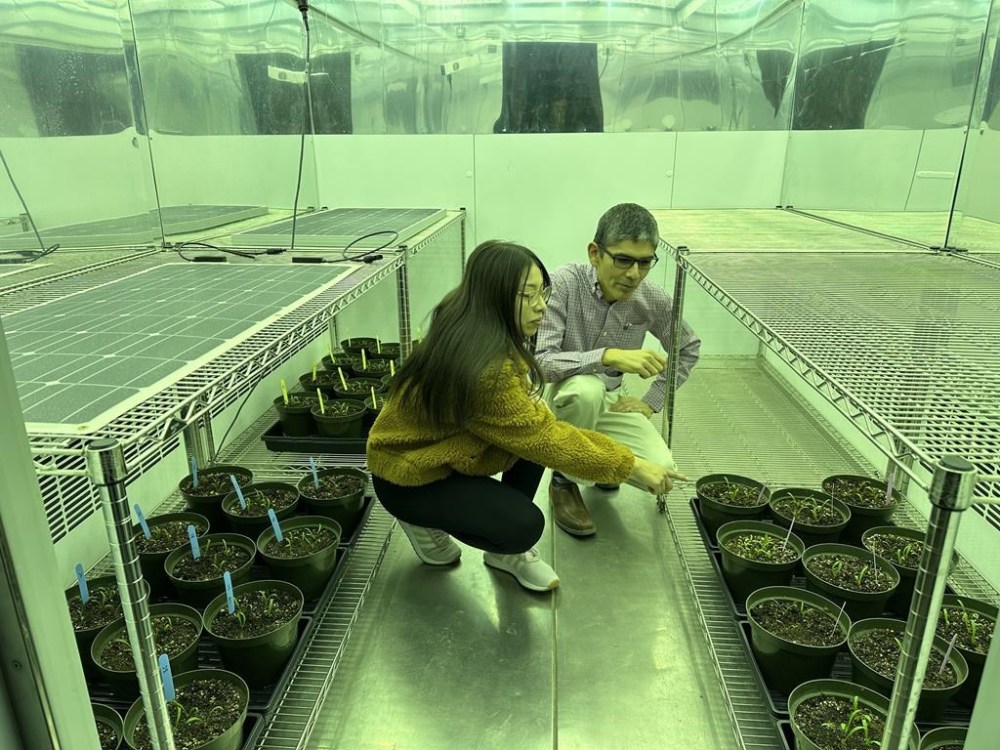
Guillermo Hernandez, right, a soil scientist, and Camila Quiroz, a research intern from Peru, look over their plants in a research room used to simulate sunlight at the University of Alberta in Edmonton in this undated handout photo. THE CANADIAN PRESS/HO, Guillermo Hernandez Ramirez, University of Alberta. *MANDATORY CREDIT*

Crop harvesting under solar panels is called agrivoltaics, a relatively new concept to improve land-use efficiency by producing energy and food in the same spot.

In a 25-day experiment, Hernandez and Quiroz grew batches of spinach under three systems — thick solar panels, thin solar panels and without solar panels.

The researchers used simulated sunlight in a small room at the university during the Alberta winter.

Quiroz, who is studying energy engineering in Peru, says there weren’t any significant differences in taste or nutrition between the spinach grown under solar panels and the batch grown under simulated sunlight.

“I ate some of the solar panel-grown spinach,” Quiroz says. “They were sweet. The taste was perfect.”

However, the solar panel-grown plants were smaller than the batch grown without the panels.

Quiroz says a “little more time” under the panel would help them mature better.

The researchers are conducting a lab analysis to determine the exact nutritional composition of the three batches, and will be publishing the results in the coming weeks.

Quiroz says agrivoltaics is about more than just optimizing land area.

Solar panels create a microclimate underneath them, shielding plants from direct sunlight and fostering the right temperatures. Greens, berries and broccoli are among the foods that grow well under solar panels.

Quiroz says solar panels could also contribute to higher crop production for certain foods and improve water efficiency.

“Another benefit is the increase the solar energy generation,” Quiroz says.

An International Energy Agency report this year said investors are increasingly gravitating towards solar-powered projects, outpacing the spending on fossil fuel projects for the first time.

Hernandez says even though the initial cost of installing solar panels could be high, agrivoltaics has the potential to become a part of the urban landscape in Canada.

“The connection with food is missing in some urban areas.”

He says agrivoltaic farming would teach people to grow fresh produce while harnessing solar energy on balconies, backyards and smaller areas.

“People will be able to witness growing their own food, and they will feel more connected to where their food is coming from.”

Some provincial governments have been giving rebates and grants to households and institutions for installing solar panels.

Other countries, including South Korea and France, are also experimenting with agrivoltaics.

Hernandez says the next step is to secure funding for research on other vegetables and explore how solar panels work outdoors and at differing heights and angles.

He is also working on a guide for agrivoltaic farming, which would include a list of crops that can be grown under solar panels.

This report by The Canadian Press was first published May 27, 2023.

—-

This story was produced with the financial assistance of the Meta and Canadian Press News Fellowship.


Report Error Submit a Tip

More Stories

News briefs for Monday, October 12, 2026

2 minute read Updated: 2:26 PM CDT

A collection of breaking news briefs filed on Monday, October 12, 2026

Gianmarco Soresi coming to Winnipeg

2:26 PM

Stand-up comedian and actor Gianmarco Soresi is set to perform at Club Regent Event Centre in the spring.

Piece of Winnipeg’s magic history disappears

Kelly-Anne Riess 5 minute read Preview

Piece of Winnipeg’s magic history disappears

Kelly-Anne Riess 5 minute read Saturday, Oct. 10, 2026

A piece of Winnipeg’s magic history has vanished, and internationally renowned escape artist Dean Gunnarson is offering a $500 reward to anyone who can make it reappear.

The plaque marked the birthplace of what has become the world’s largest organization of professional and amateur magicians, the International Brotherhood of Magicians, which was founded in Winnipeg more than a century ago.

Gunnarson said fellow magician and local magic historian Bruce Thompson discovered the disappearance Tuesday while on his way to work.

Thompson returned to inspect the site and found what appeared to be evidence it had been forcibly removed.

Read
Saturday, Oct. 10, 2026

Hurricane Simon pounds resorts and vulnerable towns along Mexico’s Pacific coast

Fernando Llano And Martin Silva, The Associated Press 5 minute read Preview

Hurricane Simon pounds resorts and vulnerable towns along Mexico’s Pacific coast

Fernando Llano And Martin Silva, The Associated Press 5 minute read Updated: 2:38 AM CDT

PUERTO VALLARTA, Mexico (AP) — Hurricane Simon pounded Mexico’s Pacific coast as a Category 3 storm on Sunday, its eye remaining just offshore as its most powerful winds and rain slammed people living between the Sierra Madre and the ocean.

The hurricane's center swirled parallel to the coast, closing in on the Puerto Vallarta area, where its most damaging winds and rain were expected to hit around midnight and continue through Monday morning. Its maximum sustained winds weakened late Sunday to 115 mph (185 kph), according to the U.S. National Hurricane Center in Miami, but it was still expected to remain a dangerous hurricane.

That’s not good news for people in and around Puerto Vallarta, a popular tourist destination in the state of Jalisco. Just inland and uphill from the resort areas, many Mexicans live in communities where housing might not stand up to the storm.

By late Sunday, Simon's eye was moving northwest about 45 miles (75 kilometers) south of Cabo Corrientes at about 5 mph (7 kph). A senior hurricane center specialist, Philippe Papin, said this westernmost tip of mainland Mexico is the area most likely to get a direct hit from the system. Cabo Corrientes is at the southern tip of Bahia de Banderas, the wide bay where Puerto Vallarta looks out to the Pacific.

Read
Updated: 2:38 AM CDT

A Life's Story: Writer built bridges with genuine curiosity, compassion for diversity of religious practices

Janine LeGal 6 minute read Preview

A Life's Story: Writer built bridges with genuine curiosity, compassion for diversity of religious practices

Janine LeGal 6 minute read Saturday, Oct. 10, 2026

Brenda Suderman knew how to make people feel comfortable. For a journalist, that character trait is a real strength, and it made people trust and appreciate her.

Whether covering musicals, worship spaces, the effects of pandemic shutdowns, death rituals and practices of different traditions, the discovery of the burial of 2,284 infants in unmarked graves, or any other of the countless topics she wrote about in her four- decade career, Suderman did it with genuine interest and care.

Born and raised in Winkler, Suderman grew up on a farm. Much of her childhood was spent in gardens and sugar beet fields.

Baptized at 16, she became a member of the Winkler Bergthaler Mennonite Church. The restrictions against women at the time contributed to planting the seeds of Suderman’s feminist perspective.

Read
Saturday, Oct. 10, 2026

Puzzles Palace

1 minute read Monday, Jul. 27, 2026

To solve our puzzles, please subscribe with this special offer: |

What's open, what's closed, what's up on Thanksgiving

Free Press staff 3 minute read Preview

What's open, what's closed, what's up on Thanksgiving

Free Press staff 3 minute read Friday, Oct. 9, 2026

Here's a round-up of things to do and hours of business for services on Thanksgiving Day 2026.

Read
Friday, Oct. 9, 2026