Early snowmelt in Western mountains means drier summers, more wildfire risk: study

Advertisement

Advertise with us

VANCOUVER - Leaner snowpack in Western Canada and United States mountain ranges is causing drier summers and increasing wildfire risk, says a new study from the University of Colorado Boulder.

Read this article for free:


or

Already have an account? Log in here »

To continue reading, please subscribe:

Subscribe and receive a limited-edition Free Press branded hat or tote.

Digital Subscription

One year of digital access for only $205*

  • Enjoy unlimited reading on winnipegfreepress.com
  • Read the E-Edition, our digital replica newspaper
  • Access News Break, our award-winning app
  • Play interactive puzzles

*First annual payment billed as $205.00 + GST for one year. This annual subscription will automatically renew at $233.00 + GST every 52 weeks (10% off the regular annual price of $259.35). Offer available to new and qualified returning subscribers only. Cancel any time.

To continue reading, please subscribe:

Add Free Press access to your Brandon Sun subscription for only an additional

$1 for the first 4 weeks*

  • Enjoy unlimited reading on winnipegfreepress.com
  • Read the E-Edition, our digital replica newspaper
  • Access News Break, our award-winning app
  • Play interactive puzzles
Start now

*Your next Brandon Sun subscription payment will increase by $1.00 and you will be charged $17.95 plus GST for four weeks. After four weeks, your payment will increase to $24.95 plus GST every four weeks.

Hey there, time traveller!
This article was published 28/05/2023 (1218 days ago), so information in it may no longer be current.

VANCOUVER – Leaner snowpack in Western Canada and United States mountain ranges is causing drier summers and increasing wildfire risk, says a new study from the University of Colorado Boulder.

Lead author Kate Hale said her team analyzed mountain snow data and found snowpack water storage decreased more than 25 per cent from 1950 to 2013. This, she said, can be attributed to earlier snowmelt, less snowfall and more rain.

“We actually saw some of the strongest signals up in the Canadian Rockies, by way of this decrease in snowfall and then earlier snowmelts and rainfall generation,” Hale said in an interview.
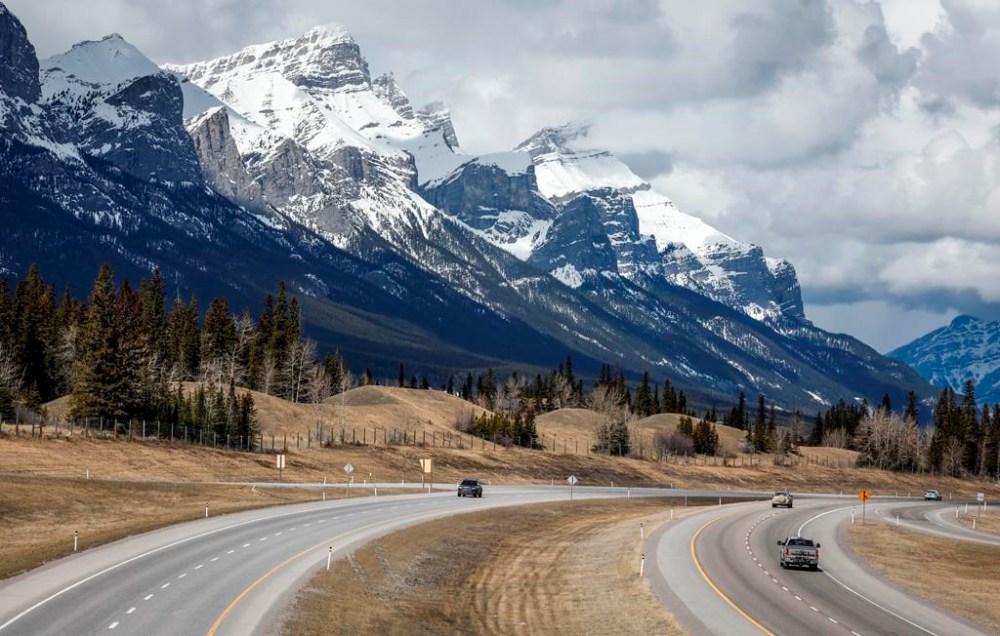
Traffic travels along the Trans Canada Highway past Mount Rundle of the Rocky Mountains near Canmore, Alta., on April 24, 2023. THE CANADIAN PRESS/Jeff McIntosh

Snowmelt serves as the primary water resource in western mountain regions, the study says. The ranges store snow throughout the winter, which then melts during spring and summer months when demand for water peaks.

Hale said snow in these regions typically wouldn’t start melting until late May or June, but has begun showing signs of snow thawing as early as March.

Such a shift in snowmelt may pose challenges for residents as much of the infrastructure in these regions were designed to adapt to when water becomes available, Hale said.

“The snowmelts are providing most of the downstream water resources, such that if there is more snowmelt occurring earlier in the year, that means there will be less available for later in the year,” she said.

Holly Chubb, a climate researcher at the University of British Columbia, agreed, saying a serious decline in the snowpack would cause “cascading issues” for energy security in B.C.

“We rely on hydroelectric power as a major source to power our businesses, our homes and our schools, and the hydroelectric power is generally fed from the glacier, which fills our reservoirs,” she said in an interview.

“We may have to really adjust our usage, our consumption, and think about actually how we are utilizing hydro power in B.C.”

She said changes in snowmelt may impact soil and lead to an increase in the size and duration of wildfires.

It could also disrupt wildlife, she added. For instance, she said early snowmelt could shift the volume and temperature of rivers, which could prevent fish from spawning and reduce the province’s salmon population.

“All of this information about the timing of snow melting is really, really essential to our cultural, economic and general energy security in British Columbia,” she said.

She suggested governments follow advice from Indigenous leaders.

“They have seen the changes in this landscape for thousands of years,” she said. “They have a deep knowledge and relationship with the land, with salmon, with bears that we do not have and that knowledge system is incredibly valuable.”

This report by The Canadian Press was first published May 28, 2023.

This story was produced with the financial assistance of the Meta and Canadian Press News Fellowship.

Report Error Submit a Tip

More Stories

Sequestered skivvies seem like last straw

Maureen Scurfield 5 minute read Yesterday at 2:00 AM CDT

DEAR MISS LONELYHEARTS: My husband, who earns a hefty income, stayed in the city most of the summer working, except for a few long weekends with the kids and me at the cottage. He has giant work projects that need daily tending.

I work hard, too, with our four kids, two dogs and a cat. But I have to tell you I got a shock last week after coming home to organize my family team for a thorough cleaning of our three-storey home.

You’ll never guess what they found up in the attic — hidden boxes of sexy women’s lingerie that all looks brand-new.

I’ve kept my mouth shut so far, but my mind is spinning.

Gordon Bell students relish — ‘of all things’ — new pickleball courts

Maggie Macintosh 4 minute read Preview

Gordon Bell students relish — ‘of all things’ — new pickleball courts

Maggie Macintosh 4 minute read 6:00 AM CDT

Manitoba’s newest public school sports facility is bringing the pickleball craze to an inner-city campus.

Gordon Bell High School unveiled four custom-made courts for the popular paddle sport this fall as part of a multi-faceted makeover.

Grade 12 student Matea Thiessen Unger called the courts “the cherry on top,” of a multi-year construction project that consumed much of her high school career.

“It was happening for so long — it felt like it was never going to end,” the 16-year-old said.

Read
6:00 AM CDT

Four Jets clear waivers to join Moose

Ken Wiebe 3 minute read Preview

Four Jets clear waivers to join Moose

Ken Wiebe 3 minute read 2:28 PM CDT

The Winnipeg Jets organizational depth has yet to take a hit on the waiver wire.

On Saturday afternoon, all four players exposed to waivers — defenceman Isaak Phillips and forwards Nikita Chibrikov, Noah Gregor and Parker Ford — cleared, which means they can be assigned to the Manitoba Moose of the American Hockey League.

Owing to injuries to captain Adam Lowry and winger Cole Perfetti, both Chibrikov and Ford started last season on the NHL roster but spent the bulk of last season with the Moose.

Chibrikov, chosen in the second round of the 2021 NHL Draft, has dealt with multiple lower-body injuries during the prior two seasons and is still working his way back to peak form.

Read
2:28 PM CDT

Nuit Blanche ready to wow in city’s core

Conrad Sweatman 5 minute read Preview

Nuit Blanche ready to wow in city’s core

Conrad Sweatman 5 minute read Yesterday at 6:33 PM CDT

For one night each September, downtown Winnipeg becomes an art gallery — an amusement park, even.

During Nuit Blanche, which takes place tonight, 3D projections spill across the Exchange District, The Forks and St. Boniface, and thousands flood the city core to take in live music, DJs and installations.

“There really isn’t anything like it. I know every promoter probably tells you that, but we are the only event that works at this scale in the fall,” says Nuit Blanche general manager Kurt Tittlemier.

“Culture Days Manitoba is run with the mission statement to make free, accessible artistic programming to all,” he adds, referring to the multi-week national festival, “and Nuit Blanche is our flagship event.”

Read
Yesterday at 6:33 PM CDT

‘In Normandy, we remember’

Aaron Epp 4 minute read Preview

‘In Normandy, we remember’

Aaron Epp 4 minute read 6:23 PM CDT

Travelling nearly 7,000 km from his home in France to Winnipeg gave Gabriel Zaranski a new perspective on warfare.

“It’s very different to speak about war in school (than) to speak with real people who (have fought) in a war,” he said. “We can feel the emotion when they speak … The testimony has more impact when it’s real soldiers.”

Zaranski is one of 14 Grade 12 students from Bayeux, a town in France’s Normandy region, in Winnipeg this week for a learning tour.

The students, who attend Lycée Arcisse de Caumont high school, met on Saturday with veterans from the Queen’s Own Cameron Highlanders of Canada, a local military regiment, to discuss their studies and the regiment’s role in the Second World War.

Read
6:23 PM CDT

Early snowmelt a trend in Western mountains: study

Nono Shen, The Canadian Press 3 minute read Preview

Early snowmelt a trend in Western mountains: study

Nono Shen, The Canadian Press 3 minute read Sunday, May. 28, 2023

VANCOUVER - Leaner snowpack in Western Canada and United States mountain ranges is causing drier summers and increasing wildfire risk, says a new study from the University of Colorado Boulder.

Lead author Kate Hale said her team analyzed mountain snow data and found snowpack water storage decreased more than 25 per cent from 1950 to 2013. This, she said, can be attributed to earlier snowmelt, less snowfall and more rain.

“We actually saw some of the strongest signals up in the Canadian Rockies, by way of this decrease in snowfall and then earlier snowmelts and rainfall generation,” Hale said in an interview.

Snowmelt serves as the primary water resource in western mountain regions, the study says. The ranges store snow throughout the winter, which then melts during spring and summer months when demand for water peaks.

Read
Sunday, May. 28, 2023