As rising oceans threaten NYC, study documents another risk: The city is sinking

Advertisement

Advertise with us

NEW YORK (AP) — If rising oceans aren’t worry enough, add this to the risks New York City faces: The metropolis is slowly sinking under the weight of its skyscrapers, homes, asphalt and humanity itself.

Read this article for free:


or

Already have an account? Log in here »

To continue reading, please subscribe:

Subscribe and receive a limited-edition Free Press branded hat or tote.

Digital Subscription

One year of digital access for only $205*

  • Enjoy unlimited reading on winnipegfreepress.com
  • Read the E-Edition, our digital replica newspaper
  • Access News Break, our award-winning app
  • Play interactive puzzles

*First annual payment billed as $205.00 + GST for one year. This annual subscription will automatically renew at $233.00 + GST every 52 weeks (10% off the regular annual price of $259.35). Offer available to new and qualified returning subscribers only. Cancel any time.

To continue reading, please subscribe:

Add Free Press access to your Brandon Sun subscription for only an additional

$1 for the first 4 weeks*

  • Enjoy unlimited reading on winnipegfreepress.com
  • Read the E-Edition, our digital replica newspaper
  • Access News Break, our award-winning app
  • Play interactive puzzles
Start now

*Your next Brandon Sun subscription payment will increase by $1.00 and you will be charged $17.95 plus GST for four weeks. After four weeks, your payment will increase to $24.95 plus GST every four weeks.

Hey there, time traveller!
This article was published 29/05/2023 (1167 days ago), so information in it may no longer be current.

NEW YORK (AP) — If rising oceans aren’t worry enough, add this to the risks New York City faces: The metropolis is slowly sinking under the weight of its skyscrapers, homes, asphalt and humanity itself.

New research estimates the city’s landmass is sinking at an average rate of 1 to 2 millimeters per year, something referred to as “subsidence.”

That natural process happens everywhere as ground is compressed, but the study published this month in the journal Earth’s Future sought to estimate how the massive weight of the city itself is hurrying things along.
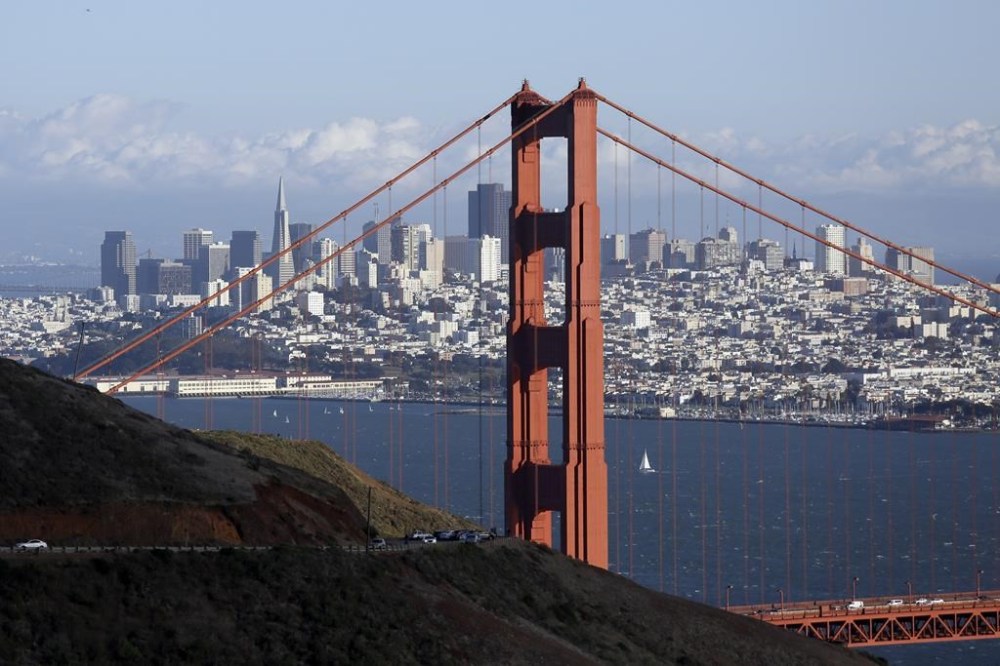
FILE — The Golden Gate Bridge and San Francisco skyline from the Marin Headlands above Sausalito, Calif. are shown in the photo, Oct. 28, 2015. New York City isn't the only place sinking. San Francisco is, too — putting considerable pressure on the ground and on active earthquake faults. (AP Photo/Eric Risberg, File)

More than 1 million buildings are spread across the city’s five boroughs. The research team calculated that all those structures add up to about 1.7 trillion tons (1.5 trillion metric tons) of concrete, metal and glass — about the mass of 4,700 Empire State buildings — pressing down on the Earth.

The rate of compression varies throughout the city. Midtown Manhattan’s skyscrapers are largely built on rock, which compresses very little, while some parts of Brooklyn, Queens and downtown Manhattan are on looser soil and sinking faster, the study revealed.

While the process is slow, lead researcher Tom Parsons of the U.S. Geological Survey said parts of the city will eventually be under water.

“It’s inevitable. The ground is going down, and the water’s coming up. At some point, those two levels will meet,” said Parsons, whose job is to forecast hazardous events from earthquakes and tsunamis to incremental shifts of the ground below us.

But no need to invest in life preservers just yet, Parsons assured.

The study merely notes buildings themselves are contributing, albeit incrementally, to the shifting landscape, he said. Parsons and his team of researchers reached their conclusions using satellite imaging, data modeling and a lot of mathematical assumptions.

It will take hundreds of years — precisely when is unclear — before New York becomes America’s version of Venice, which is famously sinking into the Adriatic Sea.

But parts of the city are more at risk.

“There’s a lot of weight there, a lot of people there,” Parsons said, referring specifically to Manhattan. “The average elevation in the southern part of the island is only 1 or 2 meters (3.2 or 6.5 feet) above sea level — it is very close to the waterline, and so it is a deep concern.”

Because the ocean is rising at a similar rate as the land is sinking, the Earth’s changing climate could accelerate the timeline for parts of the city to disappear under water.

“It doesn’t mean that we should stop building buildings. It doesn’t mean that the buildings are themselves the sole cause of this. There are a lot of factors,” Parsons said. “The purpose was to point this out in advance before it becomes a bigger problem.”

Already, New York City is at risk of flooding because of massive storms that can cause the ocean to swell inland or inundate neighborhoods with torrential rain.

The resulting flooding could have destructive and deadly consequences, as demonstrated by Superstorm Sandy a decade ago and the still-potent remnants of Hurricane Ida two years ago.

“From a scientific perspective, this is an important study,” said Andrew Kruczkiewicz, a senior researcher at Columbia University’s Climate School, who was not involved in the research.

Its findings could help inform policy makers as they draft ongoing plans to combat, or at least forestall, the rising tides.

“We can’t sit around and wait for a critical threshold of sea level rise to occur,” he said, “because waiting could mean we would be missing out on taking anticipatory action and preparedness measures.”

New Yorkers such as Tracy Miles can be incredulous at first.

“I think it’s a made-up story,” Miles said. He thought again while looking at sailboats bobbing in the water edging downtown Manhattan. “We do have an excessive amount of skyscrapers, apartment buildings, corporate offices and retail spaces.”

New York City isn’t the only place sinking. San Francisco also is putting considerable pressure on the ground and the region’s active earthquake faults. In Indonesia, the government is preparing for a possible retreat from Jakarta, which is sinking into the Java Sea, for a new capital being constructed on the higher ground of an entirely different island.

Report Error Submit a Tip

More Stories

City puts Osborne Village lot up for sale third time

Joyanne Pursaga 5 minute read Preview

City puts Osborne Village lot up for sale third time

Joyanne Pursaga 5 minute read Thursday, Aug. 6, 2026

The city is making a third attempt to sell a seemingly prime Osborne Street property, after an offer for the surface parking lot fell through earlier this year.

The 772-square-metre space at 145 Osborne St., which formerly operated as an official paid city parking lot, has been posted for sale once again.

It may puzzle some Winnipeggers to see the site in the heart of Osborne Village remain empty so long after the city declared it surplus in 2020.

However, a few different challenges may limit its appeal to potential buyers, alocal real estate agent said.

Read
Thursday, Aug. 6, 2026

Police resuming drug-enforcement crackdown, working with outreach community

Chris Kitching 7 minute read Preview

Police resuming drug-enforcement crackdown, working with outreach community

Chris Kitching 7 minute read Thursday, Aug. 6, 2026

Winnipeg police are relaunching a drug enforcement campaign in some neighbourhoods Friday after they say a 10-day sweep led to more than 100 arrests and a drop in reported crime earlier this summer.

Police said the renewed initiative, targeting open drug use and trafficking, will continue into November with an outreach-first approach and a partnership with a coalition of community groups in response to criticism of the initial campaign.

“While there was a great deal of support for the enforcement actions we undertook to address public safety issues, there was also criticism about the lack of collaboration,” Winnipeg Police Service Chief Gene Bowers told reporters.

“At that time, I acknowledged that community organizations should have been part of our efforts. Hence, we’re here today.”

Read
Thursday, Aug. 6, 2026

Sending the wrong message

Andrea Charron 4 minute read 2:01 AM CDT

The U.S. State Department has announced plans to close five overseas diplomatic posts approved by Congress: Douala, Cameroon (a branch office); St. George’s, Grenada (an embassy); Nagoya, Japan (a consulate); Medan, Indonesia (a consulate); and Winnipeg, Canada (a consulate).

All are located in countries that are partners or allies of the United States.

It is unusual for the United States to reduce its diplomatic footprint. With the exception of some retrenchment efforts during the Trump administration, Washington has generally viewed diplomacy as a force multiplier. Diplomacy is not simply a matter of authority and leverage. It requires sustained local engagement, relationships and presence.

Consulates and branch offices are not the same as embassies. They are smaller missions, headed by consuls or consuls general rather than ambassadors and often provide a more limited range of services. Yet they play a vital political, economic and cultural role, supporting both local populations and American citizens abroad.

Leon’s Getting Larger and their tours are getting longer

Tiago Resko 4 minute read Preview

Leon’s Getting Larger and their tours are getting longer

Tiago Resko 4 minute read Yesterday at 3:00 AM CDT

Emo music was never just a phase for Nikola Boticki.

“It was people just saying the things I was feeling,” says the 26-year-old vocalist and guitarist. “Growing up, it’s kind of like, ‘I feel that way but I’m not going to say that out loud,’ so it was nice to hear someone say it.”

Boticki got into the punk subgenre near the end of his angsty high school years and his appreciation only grew while in isolation during the COVID-19 pandemic.

The music inspired him to form his own emo band, Leon’s Getting Larger, with friends Luke Penner (vocals/drums) and Noah St Hilaire (bass).

Read
Yesterday at 3:00 AM CDT

Lac du Bonnet slowly healing from devastating fire

Nicole Buffie 6 minute read Preview

Lac du Bonnet slowly healing from devastating fire

Nicole Buffie 6 minute read Yesterday at 6:32 PM CDT

LAC DU BONNET — Fifteen months after devastating wildfires ripped through Lac du Bonnet, claiming two lives and destroying more than a dozen homes, residents are trying their best to build back better.

Along the winding gravel path that is Wendigo Road outside Lac du Bonnet, new timber peeks through patches of charred forest. Homes and cottages are beginning to take shape after fire raced through the neighbourhood at record speed and levelled at least 18 homes on the road.

Table saws and nail guns ring in the distance while Brian Curtis plots out where his new cottage will go. Curtis bought his previous cottage 19 years ago and had recently levelled the foundation.

He and his wife, Pam, had been thinking about long-term renovations when the May 13, 2025 fire swept away all their work and memories.

Read
Yesterday at 6:32 PM CDT

Local medical scrubs retailer feeling abandoned by U of M, RRC Polytech nursing programs

Maggie Macintosh 4 minute read Preview

Local medical scrubs retailer feeling abandoned by U of M, RRC Polytech nursing programs

Maggie Macintosh 4 minute read Thursday, Aug. 6, 2026

A Winnipeg uniform store is appealing to medical students to shop locally for scrubs this back-to-school season as it grapples with growing competition online and an apparent shutout by local campuses.

Unimor Healthwear has long ordered uniforms in bulk in navy blue, burgundy and pewter, as nurses-in-training are required to wear those colours based on where they’re enrolled in the province.

“It’s not like it used to be,” Evan Schwartz said about customer traffic to his store at 98 Sherbrook St.

The company’s director estimated he spent about $15,000 to stock up on scrubs in pewter in preparation for the launch of Red River College Polytechnic’s upcoming nursing intake.

Read
Thursday, Aug. 6, 2026