Small-brained ancient human cousins may have buried their dead, according to a surprising study

Advertisement

Advertise with us

NEW YORK (AP) — An ancient human cousin may have buried its dead and carved symbols into cave walls, surprising findings for a creature with a small brain.

Read this article for free:


or

Already have an account? Log in here »

To continue reading, please subscribe:

Subscribe and receive a limited-edition Free Press branded hat or tote.

Digital Subscription

One year of digital access for only $205*

  • Enjoy unlimited reading on winnipegfreepress.com
  • Read the E-Edition, our digital replica newspaper
  • Access News Break, our award-winning app
  • Play interactive puzzles

*First annual payment billed as $205.00 + GST for one year. This annual subscription will automatically renew at $233.00 + GST every 52 weeks (10% off the regular annual price of $259.35). Offer available to new and qualified returning subscribers only. Cancel any time.

To continue reading, please subscribe:

Add Free Press access to your Brandon Sun subscription for only an additional

$1 for the first 4 weeks*

  • Enjoy unlimited reading on winnipegfreepress.com
  • Read the E-Edition, our digital replica newspaper
  • Access News Break, our award-winning app
  • Play interactive puzzles
Start now

*Your next Brandon Sun subscription payment will increase by $1.00 and you will be charged $17.95 plus GST for four weeks. After four weeks, your payment will increase to $24.95 plus GST every four weeks.

Hey there, time traveller!
This article was published 05/06/2023 (1197 days ago), so information in it may no longer be current.

NEW YORK (AP) — An ancient human cousin may have buried its dead and carved symbols into cave walls, surprising findings for a creature with a small brain.

Fossil remains of the species — named Homo naledi — were uncovered in underground caves in South Africa a decade ago. Now, researchers say they’ve found evidence that the species was capable of complex behavior that so far has only been seen in those with bigger brains.

“We are facing a remarkable discovery here” for a species with brains one-third the size of humans, said anthropologist Lee Berger, who led the research funded by the National Geographic Society, where he now works.
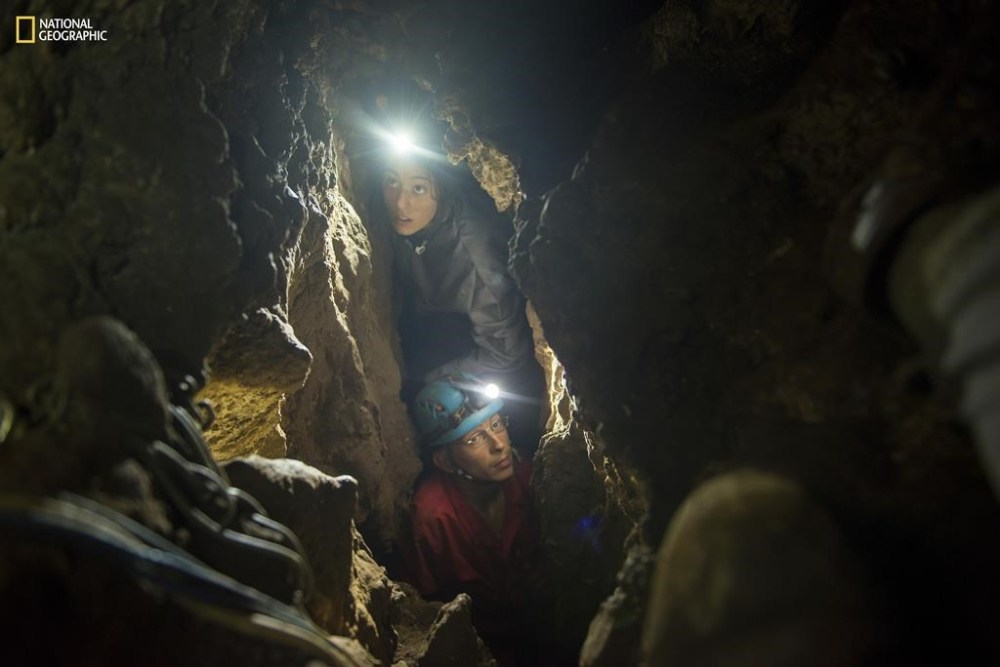
In this photo provided by National Geographic, National Geographic Explorer-in-Residence Lee Berger's daughter, Megan, and underground exploration team member Rick Hunter navigate the narrow chutes leading to the Dinaledi Chamber of the Rising Star Cave in South Africa in 2014, where fossil elements belonging to Homo naledi, a new species of human relative, were discovered. In research released on Monday, June 5, 2023, scientists say they've found evidence that the ancient human cousin buried its dead and carved symbols into cave walls, actions previously tied only to bigger-brained species. (Robert Clark/National Geographic via AP)

Berger and colleagues describe their findings in studies posted online Monday. The research has not been peer-reviewed yet and some outside scientists think more evidence is needed to challenge what we know about how humans evolved their complex thinking.

“There’s still a lot to uncover,” said Rick Potts, director of the Smithsonian’s Human Origins Program who was not involved in the research.

H. naledi is a pretty new addition to the family tree of hominins, which includes our direct ancestors and other extinct relatives who walked on two legs. Berger and his team announced the species in 2015, after a tip from local spelunkers led them to the Rising Star cave system near Johannesburg where they uncovered fossils from at least 15 individuals who lived around 300,000 years ago.

These creatures had some traits in common with modern humans, like legs made for walking upright and hands that could work with objects, said University of Wisconsin-Madison anthropologist John Hawks, a member of the research team. But other features looked more ancient, including their small brains.

In recent years, team members have ventured back into the caves, a tricky descent through tight underground spaces. What’s down there shows the species in a new light, they reported.

One of the new studies describes what researchers say were intentional burial sites. The team uncovered fossil remains of adults and children in shallow holes in the ground, their bodies in a fetal position.

Another study describes a series of marks carved into the cave walls, including geometric patterns and cross-hatched lines.

“This is something that takes a lot of time and effort to do,” said Berger, who led the initial research while at the University of the Witwatersrand in Johannesburg.

All of this behavior would be surprising for a creature whose brain was closer in size to an ape’s than a human’s, experts said.

Decades ago, we thought Homo sapiens were the only ones who could figure out how to use fire, bury their dead or create art, said Chris Stringer, a human evolution expert at London’s Natural History Museum who was not involved in the research.

Since then, we’ve learned that other groups like Neanderthals also lived complex lives. But those species still had big brains — unlike H. naledi, whose burials would raise further questions about human evolution, Stringer said.

Scientists haven’t yet been able to identify how old the engravings are. So Potts said the current evidence can’t say for sure whether H. naledi was truly the one to create the symbols, or if some other creature — maybe even H. sapiens — made its way down there at some point.

For study author Agustin Fuentes, an anthropologist at Princeton University, the H. naledi evidence takes the focus off brain size.

“Big brains are still important,” Fuentes said. “They just don’t explain what we thought they explained.”

___

The Associated Press Health and Science Department receives support from the Howard Hughes Medical Institute’s Science and Educational Media Group. The AP is solely responsible for all content.
Report Error Submit a Tip

More Stories

Pokemon thieves clear out collectibles shop

Scott Billeck 5 minute read Preview

Pokemon thieves clear out collectibles shop

Scott Billeck 5 minute read Friday, Sep. 11, 2026

Terri Settle loved watching children walk into her collectibles shop to hunt for their favourite Pokemon cards.

After the latest break in stripped her shelves of much of the inventory, she’s not sure she’ll get to see it again.

Thieves broke into Terri’s Trinkets and Toys on Tuesday evening, punching through a grate and then the store’s bathroom wall to reach the storefront.

They made off with about $6,000 worth of merchandise, including all of the store’s Pokemon cards — about 7,000 of them — along with toys, Lego, jewelry, video games, a debit machine and personal laptop. They even took her vacuum cleaner.

Read
Friday, Sep. 11, 2026

Puzzles Palace

1 minute read Monday, Jul. 27, 2026

To solve our puzzles, please subscribe with this special offer: |

Nifty neighbours also jonesing for geniality

Maureen Scurfield 4 minute read Yesterday at 2:01 AM CDT

DEAR MISS LONELYHEARTS: Recently, a new couple with no children moved onto our cul de sac, and everybody is taking notice! This attractive pair with no kids both drive amazing cars, work from home and leave their garage doors up a lot. Everybody on the street walks by to sneak a peek into the big garage at just about any time of day.

Lately, the man’s been out on his front lawn in a muscle shirt in the late afternoon, planting shrubs and putting up stylish fall-themed ornaments. At night they often leave the living-room curtains open. That makes for convenient viewing for curious neighbours like us!

A few days ago, my wife invited the new couple over for a barbecue and swim in our pool. They are really nice people, but mentioned that other people nearby have been pretty stand-offish. They wonder why. Should I tell them it’s probably just jealousy over their beautiful vehicles and enviable lifestyle, or should I just shut up?

—Wanting to Help, Sage Creek

Canadians loving Carney’s decision to stand tall against floundering U.S. bully

Tom Brodbeck 5 minute read Preview

Canadians loving Carney’s decision to stand tall against floundering U.S. bully

Tom Brodbeck 5 minute read Friday, Sep. 11, 2026

It’s hard to imagine a more dramatic political contrast than the one unfolding on opposite sides of the Canada-U.S. border.

Mark Carney is fighting a trade war with Donald Trump, taking the occasional verbal punch from the American president and imposing retaliatory tariffs on U.S. products.

And the prime minister is being rewarded for it politically.

Trump, meanwhile, is fighting pretty much everyone he can find — including some of America’s closest allies — and his own voters are increasingly giving him the political equivalent of a raised middle finger. That’s quite a tale of two leaders.

Read
Friday, Sep. 11, 2026

Sunday-night auto aficionados work to steer away from unwelcome elements they say aren’t a part of their tradition

Zoe Pierce 12 minute read Preview

Sunday-night auto aficionados work to steer away from unwelcome elements they say aren’t a part of their tradition

Zoe Pierce 12 minute read Friday, Sep. 11, 2026

The red 1969 Dodge Coronet Super Bee out for a cruise on Portage Avenue draws admiring eyes from onlookers on a recent Sunday night, many of them seeing a specimen of the now-rare muscle car for the first time on a Winnipeg street. Or any other street, for that matter.

Longtime car enthusiast Bob Sudoma was behind the wheel, participating in the decades-old show-offy summer tradition.

The Sunday night cruise is built around a simple idea: proud car owners take their beloved vehicles for a spin to meet up with others of the same autophile ilk.

Less-fortunate appreciators, or just curious folks, also gather along the route to watch the highly-polished parade. Portage Avenue is one of cruise night’s best-known stretches.

Read
Friday, Sep. 11, 2026

Tory health critic ‘disappointed’ after being rebuffed by health officials

Carol Sanders 4 minute read Preview

Tory health critic ‘disappointed’ after being rebuffed by health officials

Carol Sanders 4 minute read Yesterday at 11:53 AM CDT

The health critic for the Progressive Conservative party says her ability to get information about the accelerated reopening of Dauphin’s emergency department was stymied by Prairie Mountain Health officials because they refused to meet with her.

“I wanted to meet with PMH staff to discuss the status of the facility and the challenges they’re facing and getting services back online,” Kathleen Cook said Friday.

“I was very disappointed that Prairie Mountain Health declined me that opportunity.”

Cook said she asked for a meeting a few days after the Sept. 7 reopening of a temporary ER at the hospital, that was severely damaged by flooding.

Read
Yesterday at 11:53 AM CDT