Wildfires are fuelling eco-anxiety but taking climate action can help, experts say
Advertisement
Read this article for free:
or
Already have an account? Log in here »
To continue reading, please subscribe:

Digital Subscription
One year of digital access for only $205*
- Enjoy unlimited reading on winnipegfreepress.com
- Read the E-Edition, our digital replica newspaper
- Access News Break, our award-winning app
- Play interactive puzzles
*First annual payment billed as $205.00 + GST for one year. This annual subscription will automatically renew at $233.00 + GST every 52 weeks (10% off the regular annual price of $259.35). Offer available to new and qualified returning subscribers only. Cancel any time.
To continue reading, please subscribe:
Add Free Press access to your Brandon Sun subscription for only an additional
$1 for the first 4 weeks*
- Enjoy unlimited reading on winnipegfreepress.com
- Read the E-Edition, our digital replica newspaper
- Access News Break, our award-winning app
- Play interactive puzzles
*Your next Brandon Sun subscription payment will increase by $1.00 and you will be charged $17.95 plus GST for four weeks. After four weeks, your payment will increase to $24.95 plus GST every four weeks.
Read unlimited articles for free today:
or
Already have an account? Log in here »
Hey there, time traveller!
This article was published 10/06/2023 (1204 days ago), so information in it may no longer be current.
When Jennifer Austin woke up on Tuesday morning, her Ottawa home smelled like smoke, even though all the windows were closed.
“I felt like a little bit under siege,” she said. “It was a bit of a battle every time the front door was opening, so I put one of the air filters there.”
Outside, “it was like an orange glow and the streets looked smoky.”
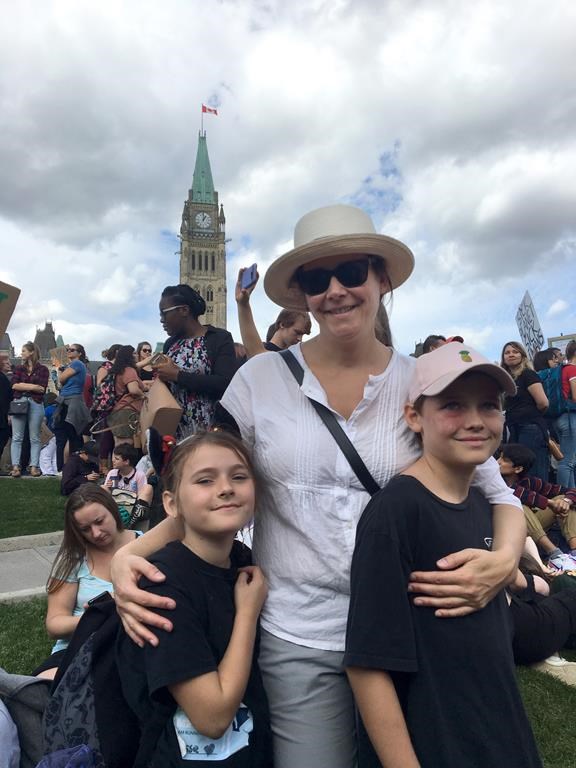
Worried about her own asthma and the health risks that her three teenage kids might face, Austin ran multiple air purifiers inside and tried to keep the amount of time spent outside to a minimum.
“There was the immediate feeling of needing to take action to try to protect myself and my family’s health,” she said. “But there’s also the longer-term concern of the fact that this is real and it’s happening and this is not going to be the last time and just the mental exhaustion that creates.”
Like many other Canadians who found their communities enveloped in smoke from devastating wildfires in B.C., Alberta, Quebec, Ontario and Nova Scotia over the last several weeks, Austin is experiencing what’s often called “eco-anxiety” or “climate anxiety.”
Climate anxiety is “a feeling of hopelessness about either the present environment and what’s going on in terms of the problem of climate change, but also the future,” said Dr. Lindsay McCunn, an environmental psychologist at Vancouver Island University in Nanaimo, B.C.
“It’s like this double-edged sword of anxiety where you’re anxious about what’s going on now and you feel hopeless about it changing. So then you’re anxious about the future because you can’t imagine that sufficient change will happen to make it better.”
The extent of the wildfires and the distances the smoke travelled brought the climate crisis “close to home” for many and likely caused a rise in climate anxiety, McCunn said.
“It’s sort of twofold. If you were previously suffering from feelings of climate anxiety and eco- anxiety, I would imagine that the wildfires are making that a little bit more salient and emotional,” she said.
If people weren’t already feeling climate anxiety but were “borderline concerned,” the wildfires might “tip you over into being a lot more worried and a lot more emotional,” McCunn said.
Kids Help Phone has seen a 30 per cent increase in text conversations with counsellors this month compared to last month, said Alisa Simon, the organization’s executive vice-president of e-mental health transformation and chief youth officer.
Although it’s not known how much of that increase can be attributed to climate anxiety, young people “see the news, they see the air, they hear the messages from their teachers and many of them are directly experiencing these wildfires,” Simon said.
“Those increases in conversations absolutely reflect the fact that young people are feeling more anxiety or heightened awareness or fear about what’s happening across Canada.”
After the wildfires first began in Alberta in May, Kids Help Phone used social media to reach out to affected communities, Simon said.
The organization also created a web page dedicated to letting young people know how to get mental health support, which also included tips on how to cope with feelings of distress, hopelessness, guilt and anger they may be feeling around climate change.
One of the most important things to tell people suffering from climate anxiety is “you’re not alone,” Simon said.
The first step is to help anxious young people calm down if they’re in a panicked state, often using breathing, relaxation and mindfulness exercises, as well as helping them identify their feelings, she said.
After that, it helps some young people to take an action “that makes them feel like they have some control …so that it doesn’t feel like something like climate change is just happening and they have to sit back and just deal with the ramifications,” Simon said.
The Kids Help Phone website suggests actions ranging from conserving energy to planting a community garden to volunteering with a climate advocacy group.
One of the key things to remember in dealing with climate anxiety is that it “isn’t a pathological problem,” said Dr. Joe Vipond, an emergency department physician in Calgary and past president of Canadian Association of Physicians for the Environment (CAPE).
“This is a normal response to seeing threats to essentially civilization and our existence that are not being dealt with,” Vipond said.
“For many people, this may be the first real, ‘Oh my God’ moments when they do see that smoke enveloping their cities. It does seem very apocalyptic.”
Vipond has felt “elements of eco-anxiety for decades,” he said.
“The way to manage, to get through those two-in-the-morning fetal position wake-up periods is to really start to get involved (in climate movements)” he said.
“I don’t really know of any other therapy for this. Like there’s no medication you can take for an existential threat.”
For Jennifer Austin, taking action has been critical to dealing with the mental fallout from the wildfire smoke.
“When something is happening like this, the only way that I can deal with any anxiety that I have around it is to be doing something to try to gain some level of control over it,” she said.

“For me, that meant sealing up all of my windows and getting my air purifiers running, changing the filter on my furnace, getting the masks out and watching the (air quality) numbers.”
But Austin, who took two of her children to a climate strike rally in 2019, said the current crisis may spur longer-term action.
“It does give me pause to think about, ‘What else can I do proactively?'”
This report by The Canadian Press was first published June 10, 2023.
Canadian Press health coverage receives support through a partnership with the Canadian Medical Association. CP is solely responsible for this content.
Advertisement Advertise With Us
Advertisement Advertise With Us