Interlake ambulance service in jeopardy over funding

Advertisement
Read this article for free:
or
Already have an account? Log in here »
To continue reading, please subscribe:
Digital Subscription
One year of digital access for only $1.44 a week*
- Enjoy unlimited reading on winnipegfreepress.com
- Read the E-Edition, our digital replica newspaper
- Access News Break, our award-winning app
- Play interactive puzzles
*Billed as $5.77 plus GST every four weeks. After 52 weeks, price increases to the regular rate of $19.95 plus GST every four weeks. Offer available to new and qualified returning subscribers only. Cancel any time.
To continue reading, please subscribe:
Add Free Press access to your Brandon Sun subscription for only an additional
$1 for the first 4 weeks*
- Enjoy unlimited reading on winnipegfreepress.com
- Read the E-Edition, our digital replica newspaper
- Access News Break, our award-winning app
- Play interactive puzzles
*Your next Brandon Sun subscription payment will increase by $1.00 and you will be charged $17.95 plus GST for four weeks. After four weeks, your payment will increase to $24.95 plus GST every four weeks.
Read unlimited articles for free today:
or
Already have an account? Log in here »
Hey there, time traveller!
This article was published 22/06/2023 (1213 days ago), so information in it may no longer be current.
A First Nations ambulance service that serves 14,000 people in the Interlake is in danger of shutting down over the lack of provincial funding.
The Fisher Ambulance Service, which employs roughly 80 paramedics, is expected to be without a primary funding source at the end of this month once Peguis First Nation pulls its funding.
Forty to 50 full-time paramedics, plus 30 casual paramedics and administrative staff, serve Peguis, Fisher River, Fisher Branch, Kinonjeoshtegon (Jackhead), and Dallas/Red Rose. They cover other Interlake communities, if needed.
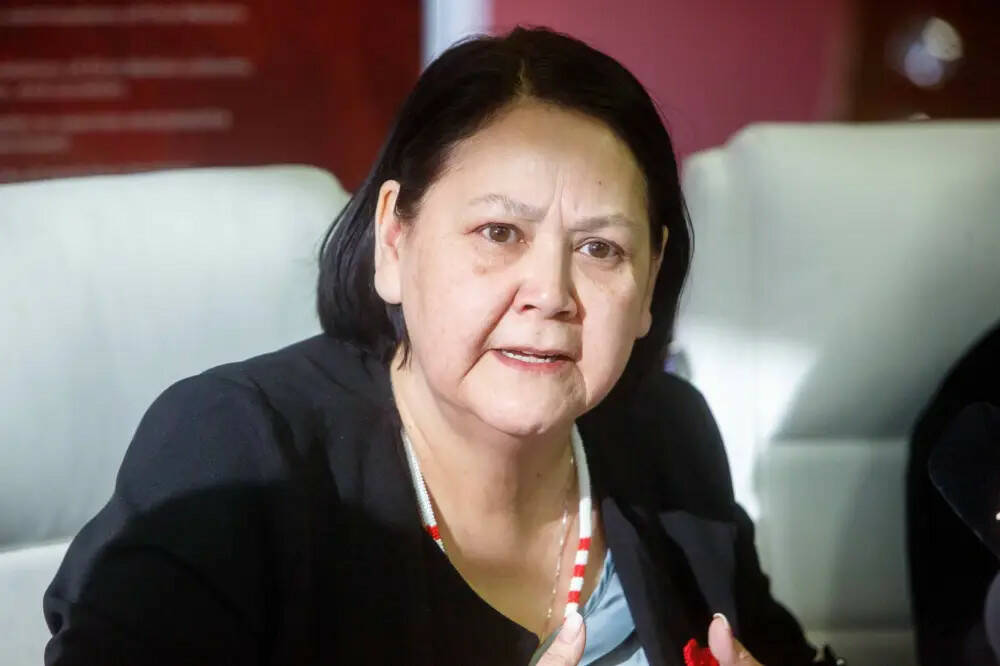
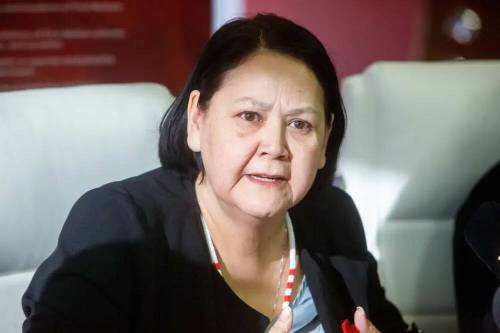
“It is putting lives at risk. It cannot shut down. Since 1985 it has saved many lives and will continue to save lives,” Assembly of Manitoba Chiefs Grand Chief Cathy Merrick said at a June 16 news conference. (Free Press files)
“That’s a lot of people that would be out of a job,” said Dr. John Neufeld, medical director and acting executive director of Fisher Ambulance Service, a contract position funded by Peguis.
The uncertainty over emergency medical response in the area prompted Peguis First Nation, Kinonjeoshtegon First Nation, and Fisher River Cree Nation and the Rural Municipality of Fisher to declare a state of emergency on June 6.
Neufeld said efforts to secure more provincial funding during the past two years have been unsuccessful.
“It’s really hard for me to think about what might happen if we aren’t able to get the funding,” he said.
The ambulance service costs $8 to $10 million annually, Neufeld said. Most of that money has been paid by Peguis First Nation, at the expense of other services such as housing, social work, and other health programs. The First Nation announced it can’t continue to bear the cost after June 30.
The service, which gets only $44,000 from the province annually, has always run a deficit. Its service agreement with the province expired in 2019.
The health minister’s office referred questions on this matter to Shared Health, which said it is working on a solution.
“Shared Health has met with Fisher Ambulance Emergency Medical Service and provided an analyst to assist in further developing a business case as they prepare their funding request for government. We have also provided the organization with relevant call data from the Medical Transportation Coordination Centre, cost-per-capita comparisons and other background material to help inform their analysis,” a Shared Health spokesperson stated.
“We appreciate their efforts and their commitment to the community they serve. We will continue to partner with them on working towards a solution.”
Neufeld said the data analyst met with him once and provided population data and a per capita estimate of what the ambulance service should cost “which was nowhere near what it costs for us to run the service.”
They requested $8 million from the province in fall 2022, but the province needed more data and a business case, Neufeld said.
If the service shuts down, the next closest ambulance run by the Interlake-Eastern Regional Health Authority is in Arborg, more than a 40-minute drive from Peguis. Rural ambulance service is already stretched thin, with closures and spotty service common owing to staff shortages in communities such as Gypsumville and Riverton.
The chiefs of Peguis, Fisher River and Kinonjeoshtegon have deemed the lack of stable funding systematic racism.
“It is putting lives at risk. It cannot shut down. Since 1985 it has saved many lives and will continue to save lives,” Assembly of Manitoba Chiefs Grand Chief Cathy Merrick said at a June 16 news conference.
David Crate, Fisher River Cree Nation chief, said there’s long been discrimination in ambulance service delivery in the area, despite a high-risk population where many residents suffer from heart problems, diabetes, and other medical conditions.

Prior to a Peguis-funded expansion of the ambulance service in spring 2021, there was one ambulance.
“I’m not clear why the province had a service purchase agreement for only one ambulance for a population of 14,000 people, but there are lots of community stories where people would get in car accidents, and they would call an ambulance, and watch their loved one die by the side of the road because the ambulance took over an hour to come,” Neufeld said.
Currently, three ambulances operate 24-7, plus there is one unit with advanced-care paramedics.
The service gets 3,000 calls for service a year. Neufeld said it’s the province’s responsibility to fund ambulance service and follow Truth and Reconciliation calls for First Nations’ right to self-determined health care services.
katie.may@freepress.mb.ca
Katie May is a multimedia producer for the Free Press.
Our newsroom depends on a growing audience of readers to power our journalism. If you are not a paid reader, please consider becoming a subscriber.
Our newsroom depends on its audience of readers to power our journalism. Thank you for your support.
Katie May is a multimedia producer for the Free Press.
Our newsroom depends on a growing audience of readers to power our journalism. If you are not a paid reader, please consider becoming a subscriber.
Our newsroom depends on its audience of readers to power our journalism. Thank you for your support.
Related Articles
B.C. shifts ambulance staffing to boost rural care

Advertisement Advertise With Us
Advertisement Advertise With Us