Redacted audit doesn’t inspire confidence in Millennium Library safety plan
Read this article for free:
or
Already have an account? Log in here »
To continue reading, please subscribe:

Digital Subscription
One year of digital access for only $205*
- Enjoy unlimited reading on winnipegfreepress.com
- Read the E-Edition, our digital replica newspaper
- Access News Break, our award-winning app
- Play interactive puzzles
*First annual payment billed as $205.00 + GST for one year. This annual subscription will automatically renew at $233.00 + GST every 52 weeks (10% off the regular annual price of $259.35). Offer available to new and qualified returning subscribers only. Cancel any time.
To continue reading, please subscribe:
Add Free Press access to your Brandon Sun subscription for only an additional
$1 for the first 4 weeks*
- Enjoy unlimited reading on winnipegfreepress.com
- Read the E-Edition, our digital replica newspaper
- Access News Break, our award-winning app
- Play interactive puzzles
*Your next Brandon Sun subscription payment will increase by $1.00 and you will be charged $17.95 plus GST for four weeks. After four weeks, your payment will increase to $24.95 plus GST every four weeks.
Read unlimited articles for free today:
or
Already have an account? Log in here »
Hey there, time traveller!
This article was published 23/06/2023 (1181 days ago), so information in it may no longer be current.
The city was so close to doing the right thing.
On Friday, the municipal government released a new-and-improved security plan for the Millennium Library, the flagship downtown branch of the library service, along with a facility audit conducted by GardaWorld Corp., a huge private security firm.
Supporters of the Millennium will be happy that some of the long-standing flaws in the facility’s security protocols may be addressed by recommendations that will be considered at next week’s community services meeting.
They include an investment to hire new community safety hosts, who are licensed security guards trained in conflict de-escalation. The city will also double the number of traditional security guards at Millennium and hire four full-time staff to reopen Community Connections, a space near the library entrance that helps people seeking social, community and health services support.
MIKAELA MACKENZIE / WINNIPEG FREE PRESS Walk-through metal detectors will remain at the Millennium Library.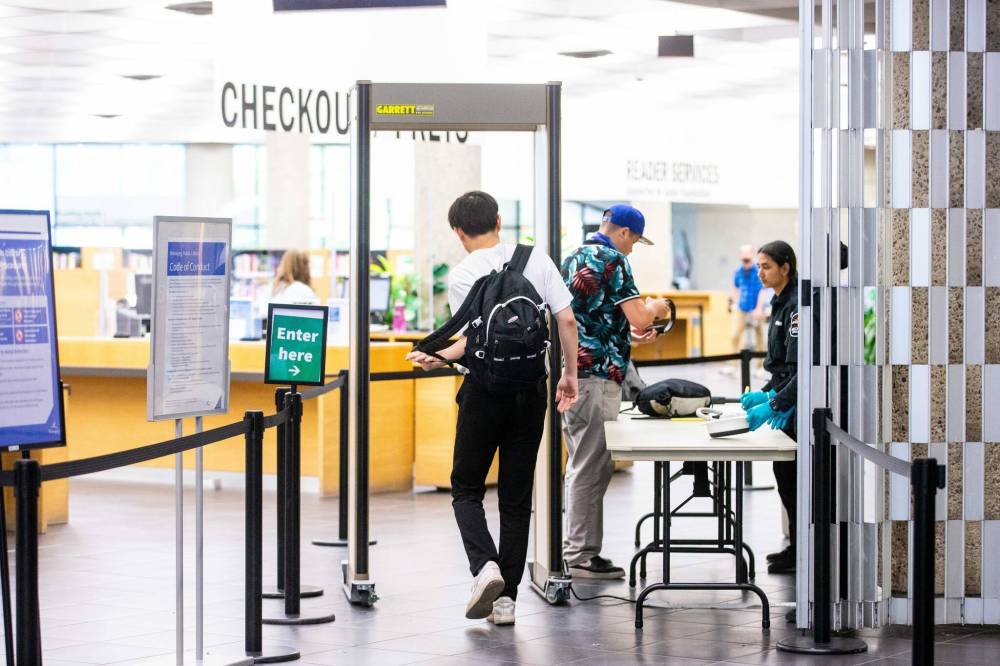
Walk-through metal detectors will remain for the time being and although the special duty police officers that have been at the Millennium since it reopened will be removed, there is commitment for increased contact from downtown police foot patrols.
The recommendations include a commitment to provide a $2.4-million bump in operating funds for the libraries to support the enhanced security in future, and a commitment to forge ahead with an as-yet undefined plan to redesign the Millennium’s lobby to make the facility safer.
However, as promising as these recommendations are, they miss one critically important element: accountability.
The security plan was delivered in the wake of a tragic event that took place on the main floor of the Millennium library in December 2022.
Tyree Cayer, a 28-year-old man who had mental health issues, was chased into the library by four teenagers. When they caught up to Cayer, he was stabbed to death in full view of patrons and staff.
Modest improvements in security were made, but almost all of them were severely underfunded half-measures that frustrated staff and patrons
Very quickly, it was revealed that security at the Millennium was severely compromised. Years of concerns and complaints from staff and patrons were largely ignored; modest improvements in security were made, but almost all of them were severely underfunded half-measures that frustrated staff and patrons, and did little to make the library safer.
It is unclear what kind of enhanced security measures would have saved Cayer’s life. But there is no getting away from the fact the city’s negligence — years and years of ignoring warning signs and pleas from staff — created favorable conditions for this kind of tragedy.
Unfortunately for the public, the extent of the woeful negligence exhibited by city council may never be fully known.
The motion recommending the security enhancements is pretty brief, and doesn’t really have a section explaining how we got to this sorry state of affairs. That kind of detail is found in the GardaWorld audit that was released at the same time as the recommendations.
Unfortunately, huge portions of the GardaWorld audit were redacted. Karin Borland, manager of library services, said the redactions were necessary to “protect people” who might be at risk from “existing vulnerabilities” in the library.
MIKAELA MACKENZIE / WINNIPEG FREE PRESS
She also said GardaWorld had requested some redactions to protect “proprietary information.”
How redacted was the report? GardaWorld made 38 recommendations that were divided into “priority,” “desirable” and “to be considered” measures. All 38 — including five deemed to be high priority — were blacked out.
Does hiding the recommendations, and by extension the security problems at Millennium, actually make the facility safer? Not in a million years. It allows the city to cherry pick security enhancements and keep from public view all of the things it isn’t doing.
Theoretically, publishing an inventory of the worst aspects of Millennium security would be very risky if — and this is a huge if — you didn’t plan to do anything about them. But, there would be nothing to fear if the city was fully committed to addressing each concern.
By hiding the recommendations, we must assume the city — both administration and council — is looking for the easiest and cheapest way out of this horrible situation. One that allows them to continue the woeful practice of applying the smallest Band-Aids they can find to treat gaping wounds that threaten the viability of the Millennium library.
By hiding the recommendations, we must assume the city is looking for the easiest and cheapest way out of this horrible situation.
There was hope something positive would come from the tragedy. Namely, the city would finally recognize not only how profoundly important Millennium is for people who live downtown, but also admit and address council’s chronic failure to deal with security problems.
Instead, we are being presented with a partial list of remedies that cannot be effectively judged. To do that, we would have to know how big the problem is and the city has conveniently made that impossible.
The recommendations, if accepted by council, are definitely a step in the right direction. But given council’s willful blindness to the problems at Millennium, there is also cause for concern.
What appears to be early positive steps may turn out to be little more than the latest iteration of half measures.
dan.lett@winnipegfreepress.com

Dan Lett is a columnist for the Free Press, providing opinion and commentary on politics in Winnipeg and beyond. Born and raised in Toronto, Dan joined the Free Press in 1986. Read more about Dan.
Dan’s columns are built on facts and reactions, but offer his personal views through arguments and analysis. The Free Press’ editing team reviews Dan’s columns before they are posted online or published in print — part of the our tradition, since 1872, of producing reliable independent journalism. Read more about Free Press’s history and mandate, and learn how our newsroom operates.
Our newsroom depends on a growing audience of readers to power our journalism. If you are not a paid reader, please consider becoming a subscriber.
Our newsroom depends on its audience of readers to power our journalism. Thank you for your support.
Related Articles
Report recommends increased security measures at city libraries after slaying