UK village marks struggle against US Army racism in World War II
Advertisement
Read this article for free:
or
Already have an account? Log in here »
To continue reading, please subscribe:

Digital Subscription
One year of digital access for only $205*
- Enjoy unlimited reading on winnipegfreepress.com
- Read the E-Edition, our digital replica newspaper
- Access News Break, our award-winning app
- Play interactive puzzles
*First annual payment billed as $205.00 + GST for one year. This annual subscription will automatically renew at $233.00 + GST every 52 weeks (10% off the regular annual price of $259.35). Offer available to new and qualified returning subscribers only. Cancel any time.
To continue reading, please subscribe:
Add Free Press access to your Brandon Sun subscription for only an additional
$1 for the first 4 weeks*
- Enjoy unlimited reading on winnipegfreepress.com
- Read the E-Edition, our digital replica newspaper
- Access News Break, our award-winning app
- Play interactive puzzles
*Your next Brandon Sun subscription payment will increase by $1.00 and you will be charged $17.95 plus GST for four weeks. After four weeks, your payment will increase to $24.95 plus GST every four weeks.
Read unlimited articles for free today:
or
Already have an account? Log in here »
Hey there, time traveller!
This article was published 24/06/2023 (1204 days ago), so information in it may no longer be current.
BAMBER BRIDGE, England (AP) — The village of Bamber Bridge in northwestern England is proud of the blow it struck against racism in the U.S. military during World War II.
When an all-Black truck regiment was stationed in the village, residents refused to accept the segregation ingrained in the U.S. Army. Ignoring pressure from British and American authorities, pubs welcomed the GIs, local women chatted and danced with them, and English soldiers drank alongside men they saw as allies in the war against fascism.
But simmering tensions between Black soldiers and white military police exploded on June 24, 1943, when a dispute outside a pub escalated into a night of gunfire and rebellion that left Private William Crossland dead and dozens of soldiers from the truck regiment facing court martial. When Crossland’s niece learned about the circumstances of her uncle’s death from an Associated Press reporter, she called for a new investigation to uncover exactly how he died.
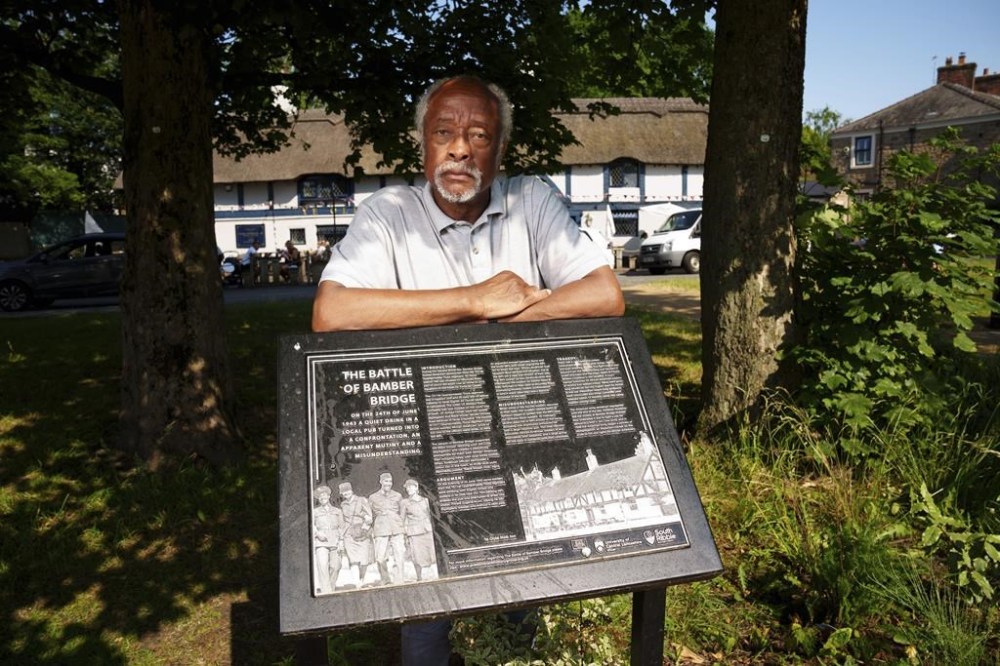
The community has chosen to focus on its stand against segregation as it commemorates the 80th anniversary of what’s now known as the Battle of Bamber Bridge and America reassesses its past treatment of Black men and women in the armed forces.
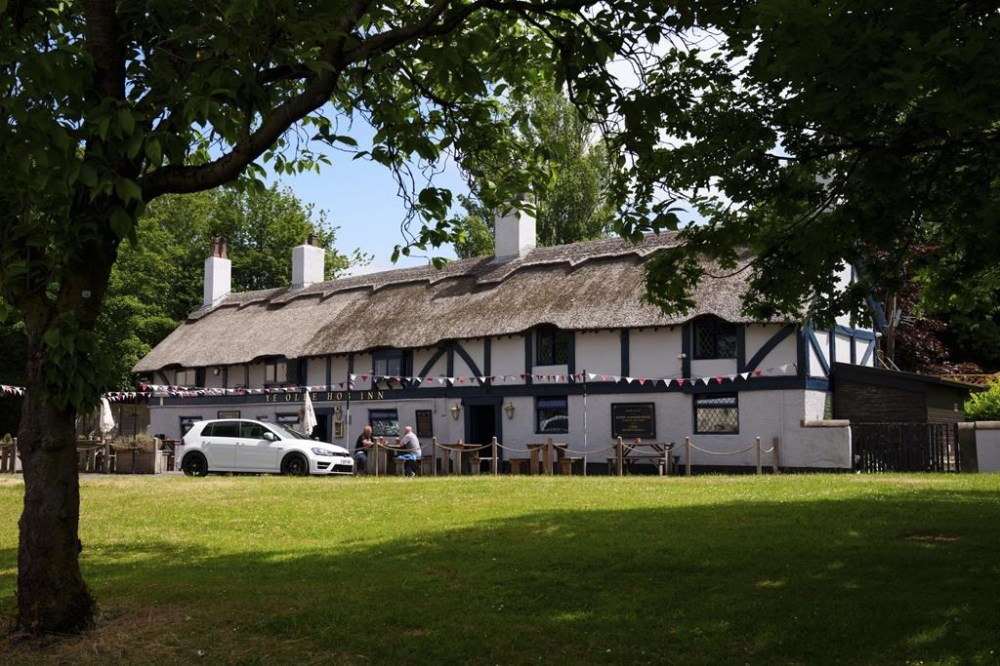
“I think maybe it’s a sense of pride that there was no bigotry towards (the soldiers),” said Valerie Fell, who was just 2 in 1943 but whose family ran Ye Olde Hob Inn, the 400-year-old thatched-roof pub where the conflict started. “They deserved the respect of the uniform that they were wearing. … That’s how people felt about it.”
That was in stark contrast to the treatment Black soldiers received in the wartime Army, which was still segregated by law.
The men of the 1511th Quartermaster Truck Regiment (Aviation) stationed at Bamber Bridge complained that they received poor food and often had to sleep in their trucks when they stopped at white bases, according to evidence presented during the court martial proceedings. They also said white military police harassed Black troops, hassling them for minor transgressions that were often ignored for other soldiers.
EXPORTING SEGREGATION
Black soldiers accounted for about 10% of the American troops who flooded into Britain during the war. Serving in segregated units led by white officers, most were relegated to non-combat roles such as driving trucks that delivered supplies to military bases.
U.S. authorities tried to extend those policies beyond their bases, asking pubs and restaurants to separate the races.
Bamber Bridge, then home to about 6,800 people, wasn’t the only British community to resist this pressure. In a country that was almost entirely white, there was no tradition of segregation, and after four years of war people welcomed any help they received from overseas.
What’s different about Bamber Bridge is the desire of local people to preserve this story and pass it on to others, said Alan Rice, co-director of the Institute for Black Atlantic Research at the University of Central Lancashire.
“If we’re going to have a fight against racism or fascism, these are the stories we need to talk about,” Rice said. “If you’re fighting fascism, which these people were, it’s ludicrous, absolutely ludicrous, that the U.S. Army (were) encouraging a form of fascism — segregation.”
Clinton Smith, head of the Black history group in nearby Preston, was among those who revived interest in the Battle of Bamber Bridge in the 1980s when he discovered bullet holes in the side of a bank and started asking long-time residents what had happened.
That helped attract wider interest, with local blogger Derek Rogerson publishing a short book, “The Battle of Bamber Bridge: The True Story,’’ that includes photos of Black troops hosting a Christmas party for village children and watching movies with kids perched on their laps. A filmmaker, Danny Lyons, compiled oral histories.
Last year, the local government council installed a plaque outside the Hob Inn that outlines the community’s relationship with the soldiers, the violence and its aftermath.
The story “just can’t be allowed to wither on the vine,” Smith said. “As much as it’s withered, we’re just now trying to rejuvenate it whilst maintaining the accuracy.’’
THE BATTLE OF BAMBER BRIDGE
Despite their friendships with the GIs, villagers weren’t able to head off the violence when Black soldiers, frustrated by their treatment and angry about news of race riots in Detroit, faced off with military police outfitted with batons and sidearms.
On that hot June night, Private Eugene Nunn was sitting at the Hob Inn bar when a white military police officer threatened to arrest him for wearing the wrong uniform. British soldiers and civilians intervened.
“Everyone was saying, ‘Leave him alone. He just wants a drink. It’s a hot day,’’’ Fell said as she recounted her mother’s story. “People just didn’t understand this viciousness.’’
When Nunn left the pub, the police were waiting. Tempers rose. A bottle smashed against the windshield of the police Jeep. Things escalated from there.
It wasn’t until 4 a.m. that order was restored. Military authorities sought severe penalties to head off unrest at other bases.
Thirty-seven Black soldiers were charged with mutiny, riot and unlawful possession of weapons, and some 30 were convicted on some or all of the charges. Most received sentences of between three and 15 years in prison, combined with loss of pay and dishonorable discharges. As the allies prepared for the D-Day landings, many of the sentences were shortened to time served so the men could be cycled back into the war effort.
While the court martial criticized the white officers for poor leadership, the records give no indication that either they or the military police were disciplined.
LONGSTANDING CHANGE
Ken Werrell, a U.S. Air Force Academy graduate and retired professor of history at Radford University in Virginia, studied the court martial proceedings and reviewed other military records for an article published in 1975.
The documents show the accused were badly treated, Werrell told The Associated Press.
But the broader story is that senior generals, focused on improving morale and performance, quickly ordered changes in the treatment of Black troops. Many of the officers commanding Black units were replaced, additional recreation facilities were provided and the army deployed more racially mixed military police patrols.
“In this way, the Bamber Bridge affair was more than just a minor incident in World War II,” Werrell wrote. “It was one of a number of incidents in the Black’s and America’s continuing crusade for freedom.”
President Harry Truman in 1948 ordered the end of segregation in the U.S. military, though it took years to fully achieve that goal. Lloyd Austin, a Black man and retired four-star general in the Army, is now secretary of defense.
That progress was too late for Crossland, a former railroad worker was 25 when he died. Evidence in the court martial proceedings provided little detail on how he was killed, saying only that he was found gravely injured with a bullet near his heart. Officers said they believed he had been caught in cross-fire between two groups of Black soldiers.
Investigators placed most of the blame for the violence on the Black soldiers, describing them as a “mob” that was “determined on revenge at any cost,” according to reports submitted during the court martial proceedings. But locals say they knocked on doors and told people to stay inside to avoid getting hurt.
RE-ASSESSING HISTORY
Nancy Croslan Adkins, the daughter of one of William’s brothers, said she was never told about the circumstances of her uncle’s death. The family later changed the spelling of its last name.
Adkins, of Upper Marlboro, Maryland, wants to know more about what happened at Bamber Bridge.
“Having dealt with direct discrimination myself by integrating the school system in North Carolina, and the racial injustice that my parents faced, I would love an investigation,” she said.
Aaron Snipe, the spokesman for the U.S. Embassy in London, said he couldn’t prejudge any military decision, but President Joe Biden’s administration has shown a willingness to “right the wrongs of the past.”
The U.S. Navy earlier this month issued a formal apology to the families of 15 Black sailors who were dishonorably discharged in 1940 after complaining that they were forced to serve as mess attendants who made beds and waited on tables. Earlier this month, the Army renamed a base for William Henry Johnson, a Black soldier who was awarded the Medal of Honor, the nation’s highest military award, almost a century after he was wounded 21 times while beating back attacking forces during World War I.
Snipe also said he planned to pay tribute to the people of Bamber Bridge at an 80th anniversary event.
“Part of this story is about their unwillingness to accept segregation orders or regulations that were pushed on them,” he said. “They pushed back … at a time where it might have been more convenient for local folks to just go along with what the United States, the United States military, had said. They’re to be commended for that.”
____
Associated Press writer Ben Finley in Norfolk, Virginia, and researcher Rhonda Shafner in New York contributed to this report.