

Academy helps newcomer and refugee youth participate in sports programs
Advertisement
Read this article for free:
or
Already have an account? Log in here »
To continue reading, please subscribe:
Digital Subscription
One year of digital access for only $1.44 a week*
- Enjoy unlimited reading on winnipegfreepress.com
- Read the E-Edition, our digital replica newspaper
- Access News Break, our award-winning app
- Play interactive puzzles
*Billed as $5.77 plus GST every four weeks. After 52 weeks, price increases to the regular rate of $19.95 plus GST every four weeks. Offer available to new and qualified returning subscribers only. Cancel any time.
To continue reading, please subscribe:
Add Free Press access to your Brandon Sun subscription for only an additional
$1 for the first 4 weeks*
- Enjoy unlimited reading on winnipegfreepress.com
- Read the E-Edition, our digital replica newspaper
- Access News Break, our award-winning app
- Play interactive puzzles
*Your next Brandon Sun subscription payment will increase by $1.00 and you will be charged $17.95 plus GST for four weeks. After four weeks, your payment will increase to $24.95 plus GST every four weeks.
Read unlimited articles for free today:
or
Already have an account? Log in here »
Hey there, time traveller!
This article was published 26/06/2023 (1214 days ago), so information in it may no longer be current.
Strike, catch, throw, run and repeat.
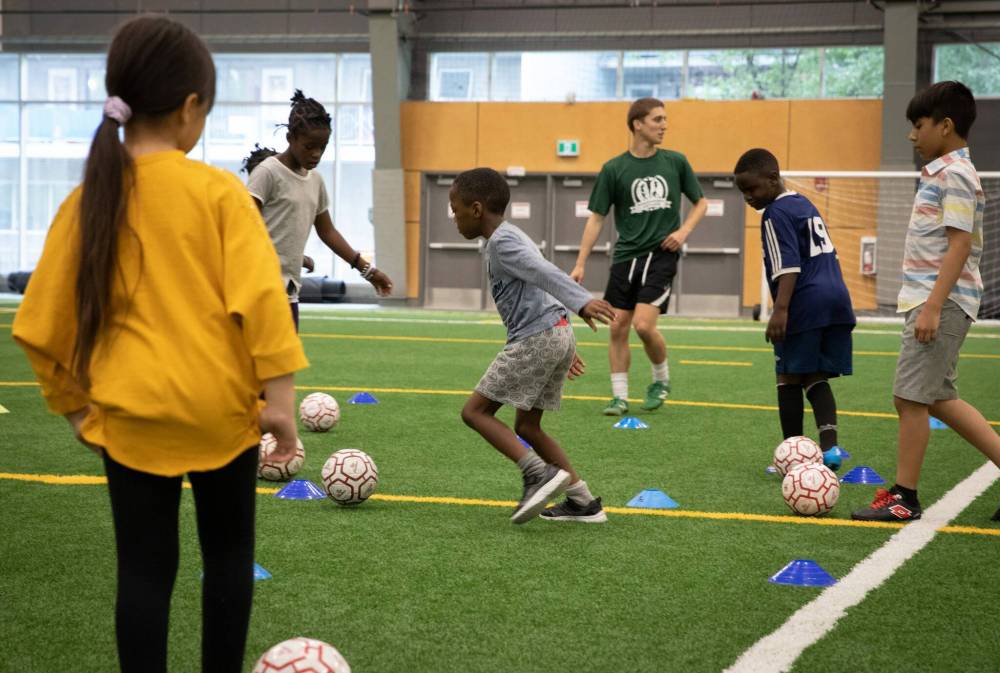
Children aged four to 14 who are enrolled in the Winnipeg Newcomer Sport Academy learn a new sport every four to eight weeks at one of two locations in the city.
This week, 25 children attended the program at the University of Winnipeg to play softball in partnership with Softball Manitoba.
JESSICA LEE / WINNIPEG FREE PRESS
Children including Raele Tresor, 8, (in grey) take part in the Winnipeg Newcomer Sport Academy at the U of W.
“I love seeing the excitement on their faces when they come in and try something new and love it. It makes me so happy,” said Morgan Reitberger, program co-ordinator.
The program helps low-income newcomer and refugee youth participate in culturally safe, accessible and inclusive multi-sport programs.
They are introduced to new sports at a slow and consistent pace, which allows them to grasp fundamental movements and the social and emotional learning skills to work as a team.
“I am very happy about the program because all of my kids are happy,” said Justine Tresor, a parent to Hope, 10, and Raele, 8.
Tresor and her husband, Kusomba, lived in Goma, Democratic Republic of Congo, before migrating to the Kakuma refugee camp in Kenya where Hope and Raele, two of their five children, were born.
Tresor said Hope and Raele were quiet and afraid to make friends when they started the program a year ago in Winnipeg. Now both children engage well with others and have significantly improved their English-language skills.
Raele loves to run very fast and Hope enjoys swimming and playing soccer, said Tresor.
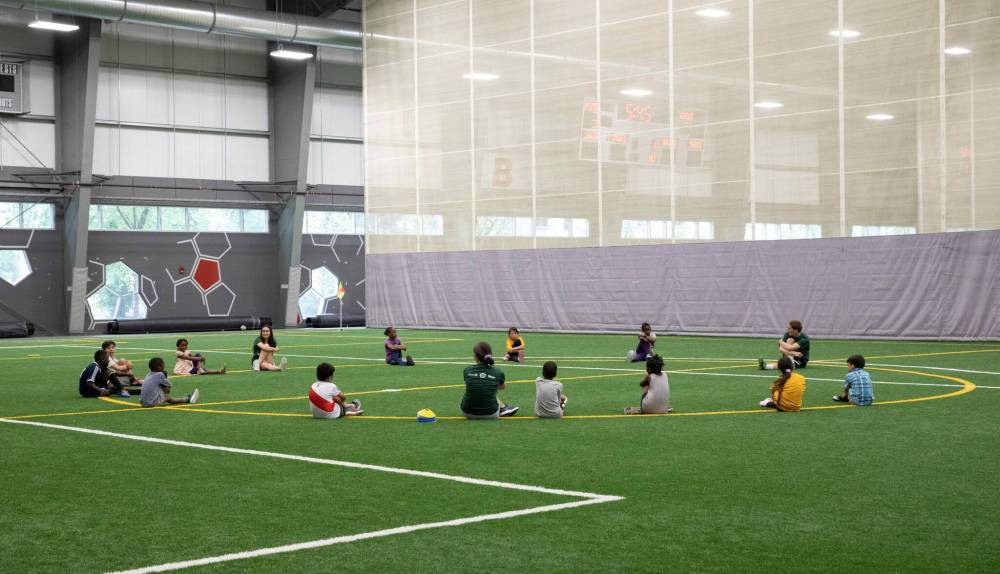
Each program session runs for 90 minutes, in which 30 minutes is dedicated to learning from a partnering sport organization, 30 minutes is for co-operative games and social and emotional learning and the final 30 minutes is snack time.
Shelley Harms, director of field and play, says it’s important for program leaders and volunteers to meet the children at their individual athletic skill level and use language and cues they can understand to explain key concepts.
Not only do they learn how to balance, jump, throw, catch, swim and more, they are guided by five important behaviours in sport: respect for others and their personal ‘bubble’, being kind, participating, listening to program leaders, and the importance of trying their best.
Harms said this social and emotional learning teaches the children how to work together to accomplish a goal.
Most of the children have experience playing soccer in their home country, so she will use the famous retired soccer player Lionel Messi as an example to teach them about leadership and being a team player.
“It’s a lot of just building self-awareness around how to be a good member in our program and we know that will translate into them being better in school and if they get to find a sports team that they get to go play on,” said Harms.
JESSICA LEE / WINNIPEG FREE PRESS
The goal is to get children feeling comfortable and safe so they can participate in any sport in their community, reducing the risk of serious injury, said Shelley Harms, director of field and play.
To create an inclusive environment and reduce barriers, Harms said sport organizations must be mindful of language, transportation and lack of accessibility, experiences involving trauma, and knowledge of cultural backgrounds and belief systems.
There’s a diverse group of children in the program, many of whom are learning how to swim and skate or play volleyball, badminton, archery, judo and karate for the first time.
Making cue cards with basic phrases such as “bend knees”, “eyes up”, or “arms out” for balance can be an easy way to get the message across to children learning to skate.
The goal is to get children feeling comfortable and safe so they can participate in any sport in their community, reducing the risk of serious injury, Harms said.
Program leaders are students who are working toward a degree in physical and health education or people who have gone through the program.

During the school year, program leaders and volunteers will pick up the children using EZ Transit Services, which helps families who cannot drive or only have one vehicle, allow their children to participate.
During the school year, youth can access the program on Wednesdays from 5:30 p.m. to 7 p.m. and Saturdays at noon at the U of W RecPlex. Children can also access WNSA’s newest site at the University of Manitoba’s sport and recreation facility on Thursdays from 5:30 p.m. to 7 p.m. and Sundays at noon.
In summer, the program occurs once a week and hosts special events in which kids go to Birds Hill Park or Camp Manitou.
“If we can change 75 lives for the better, and they can get into sport, participate, and they’re going to be healthier — why wouldn’t we?” said Harms.
tessa.adamski@freepress.mb.ca