Historic Arizona mining town backs copper project on land that Native American groups say is sacred
Advertisement
Read this article for free:
or
Already have an account? Log in here »
To continue reading, please subscribe:
Digital Subscription
One year of digital access for only $1.44 a week*
- Enjoy unlimited reading on winnipegfreepress.com
- Read the E-Edition, our digital replica newspaper
- Access News Break, our award-winning app
- Play interactive puzzles
*Billed as $5.77 plus GST every four weeks. After 52 weeks, price increases to the regular rate of $19.95 plus GST every four weeks. Offer available to new and qualified returning subscribers only. Cancel any time.
To continue reading, please subscribe:
Add Free Press access to your Brandon Sun subscription for only an additional
$1 for the first 4 weeks*
- Enjoy unlimited reading on winnipegfreepress.com
- Read the E-Edition, our digital replica newspaper
- Access News Break, our award-winning app
- Play interactive puzzles
*Your next Brandon Sun subscription payment will increase by $1.00 and you will be charged $17.95 plus GST for four weeks. After four weeks, your payment will increase to $24.95 plus GST every four weeks.
Read unlimited articles for free today:
or
Already have an account? Log in here »
Hey there, time traveller!
This article was published 29/06/2023 (1206 days ago), so information in it may no longer be current.
SUPERIOR, Ariz. (AP) — Growing up in a mining family that goes back generations, Mayor Mila Besich knew the Oak Flat Campground as the place where she attended union picnics as a girl and in earlier years her parents stood in a clearing to hear the World Series on the radio.
Now, Besich is overseeing Superior’s fight to build a new copper project at Oak Flat amid worries about the town’s economic future.
Today, the national forest land in the heart of Arizona’s “Copper Corridor” is scattered with 20 rustic campsites among ancient oaks and a hand-painted sign that reads: “Protect Oak Flat, Holy Land.” Buried deep underground is the world’s third-largest deposit of copper ore, big enough to yield 40 billion pounds (18 billion kilograms) of the metal over 60 years.
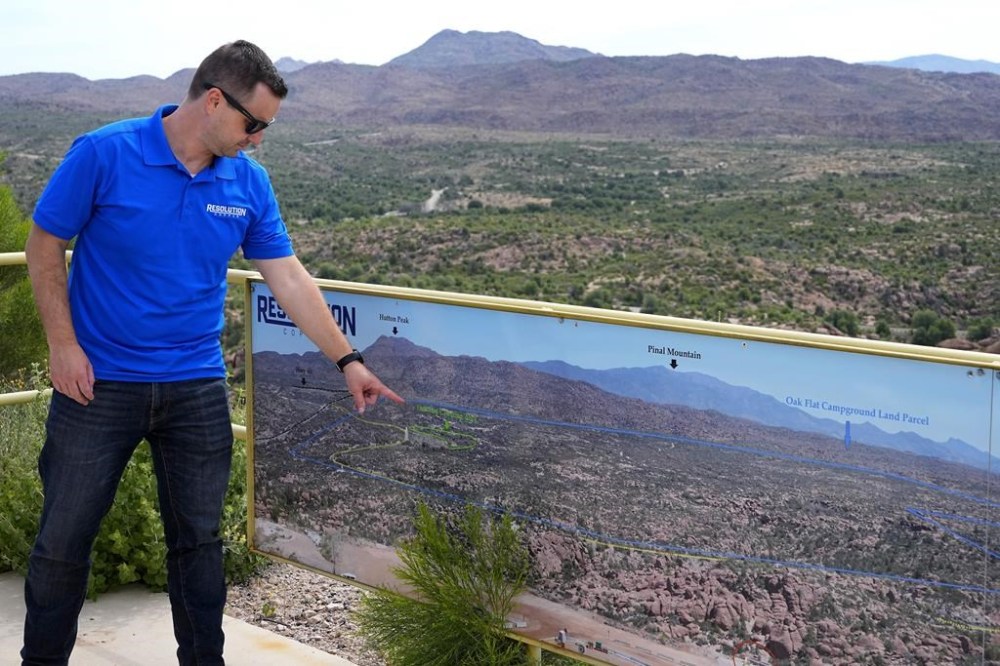
Competing interests have ignited a tug of war between the town of about 3,000 people who want a huge copper mine built there for its economic benefits, and Native American groups that consider the land sacred and are fighting to protect it from disturbance.
“Our town is going to be the most affected,” said the mayor. “What about our culture?”
Resolution Copper Mining, a joint subsidiary of U.K. and Australian mining giants Rio Tinto and BHP, hopes to build one of the world’s largest underground copper mines at the site outside Superior, about 70 miles (113 kilometers) east of Phoenix. Managing partner Rio Tinto says the mine could satisfy a quarter of growing U.S. demand for copper used in electric vehicles and smartphones.
Resolution began the permitting process nearly a decade ago, but the project has been delayed amid legal and political wrangling between U.S. agencies and the nonprofit Apache Stronghold, which challenges a planned land swap that would make the project possible. The full U.S. 9th District Court of Appeals is considering Apache Stronghold’s request to permanently halt the project, but the only thing stopping it now is the lack of a new environmental impact statement.
Two other lawsuits challenging the initial environmental review, one filed by the San Carlos Apache Tribe and the other by environmental groups, have gone nowhere since the U.S. government pulled the impact statement for more consultations.
Oak Flat is on Tonto National Forest property to be conveyed to Resolution under a land exchange that Congress approved in a 2014 rider to a must-pass defense bill.
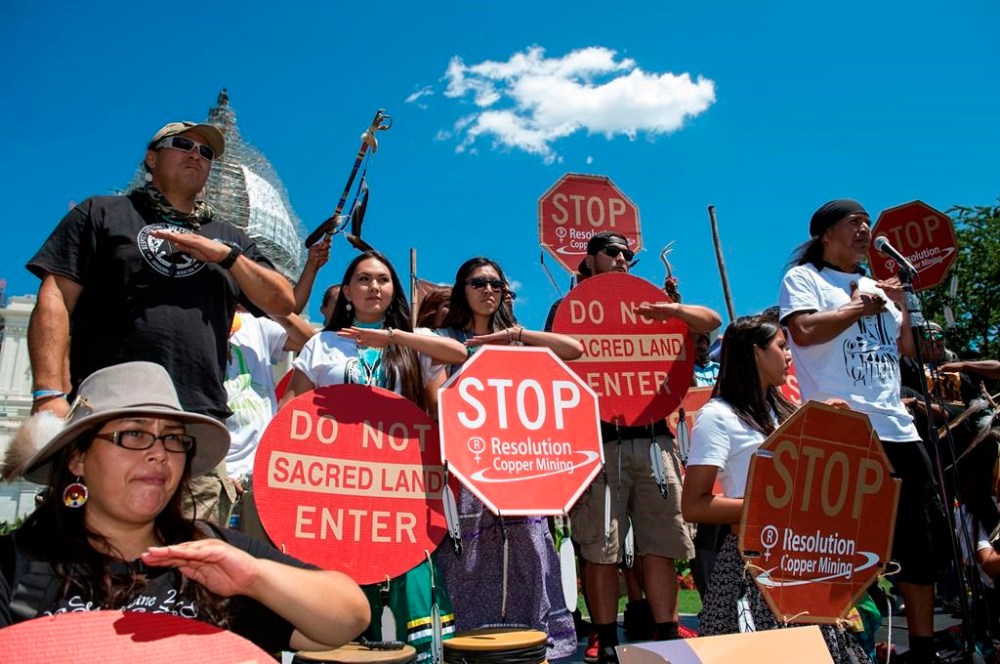
The congressional vote sparked outrage among some Apaches over the site, which features ancient Emory oaks and their acorns and other plants they consider important to their culture and religion. Called Chi’chil Bildagoteel, the site is about an hour’s drive from the San Carlos Apache Reservation and has been used for girls’ coming-of-age celebrations.
Rio Tinto has said it would keep the campground open during the mine’s first decades of operation. But Oak Flat could eventually collapse into a 1.8-mile (2.8-kilometer) crater when massive amounts of rock are removed from below.
Wendsler Nosie, a former San Carlos Apache tribal chairman and longtime activist, is the face of the Save Oak Flat campaign. He earlier fought unsuccessfully to stop a major telescope project on a site in southeastern Arizona that Apaches consider sacred: Mount Graham, or Dzil Nchaa Sí’an.
Nosie said he believes many townspeople quietly back his fight, but “they cannot openly show their support for me.”
When he was recently confronted in an area restaurant by a mining company employee who accused him of endangering jobs, development and good schools, “I stood up and talked about how I’m fighting for land, the water, the earth, religion and our children,” he said, prompting a group of diners to applaud and pay for his dinner.
While the San Carlos Apache leadership opposes the mine, some tribe members support it for the jobs it could generate amid high unemployment on the reservation.
“Oak Flat is not sacred,” said Karen Kitcheyan-Jones, 64, a member who lives on the reservation. “There are many places on the reservation where we can gather acorns and have ceremonies.”
Brenda Astor, Resolution’s principal adviser for Native affairs and a San Carlos Apache member, noted that dozens of other enrolled members also work for the mining company.
Amid strong opposition to the project by some tribes and others, the Forest Service withdrew Resolution’s original environmental impact statement for Oak Flat two years ago for additional consultations. No time frame has been announced. But once a new review is published, the formal transfer process can begin unless a federal court halts it.
U.S. Rep. Raul Grijalva of Arizona reintroduced legislation in March seeking to stop the land transfer, but it has not gained traction in Congress.
Rio Tinto says the mine woul help create 3,700 jobs over the course of the project and boost state and local tax revenues by $88 million to $113 million a year.
That’s a lot for a town still clawing back economically after the Magma copper mine first shut down in 1982, later opened for a few years, then closed for good in 1996. The closure devastated a community so small that it has no stoplight and can be traversed by car in just over three minutes.
Superior was originally established in 1882 as the town of Hastings when the big mine was the Silver King, producing silver. The former mining towns of Globe and Miami are nearby, burrowed into mountains studded with saguaro cactus.
Today, Superior still embraces its labor roots, a Democratic island in predominantly Republican Pinal County, said Besich, herself a Democrat.
More than a quarter of the town’s residents live below the poverty line. Nearly 70% of the population is Hispanic, largely descendants of mining families who immigrated from Mexico or already worked in the area when it was still part of Mexico until the mid-1800s.
“We didn’t cross the border, it crossed us,” said Manny Guzman, whose family in the area goes back seven generations. His ancestor Manuelita Guzman (1844–1916) is buried in the Historic Pinal Cemetery, also the resting place of Wyatt Earp’s common-law wife, Mattie Earp.
Guzman, president of the nonprofit economic development corporation Rebuild Superior, said he remains hopeful the mine will prevail, but finds the delays frustrating after spending innumerable hours debating the environmental review.
“There have been so many studies, so many roundtables,” he said.
The talks have secured important gains for Superior, such as ensuring protection of the town’s water supply and guaranteeing a minimum of $120 million in revenue to pay for police and fire services over the course of the project if it goes forward.
“We have seen some pretty dramatic changes to the plan,” said Vicky Peacey, Resolution’s president and general manager. “It’s important that a lot of voices are heard.”
Rio Tinto also agreed to permanently protect Apache Leap, the town’s backdrop where local legend says some 75 Apaches leapt 400 feet (122 meters) to their death in the early 1870s rather than surrender to the U.S. cavalry.
Town manager Todd Pryor said Resolution provided $2.25 million to help buy the old brick Superior High School that’s being renovated to house the town hall, a library and activities for seniors, and threw in another $1.29 million for an enterprise center to develop future entrepreneurs and teach people trades such as welding.
Officials in a town used to boom and bust cycles say they know they need to diversify their economy and can’t count only on Resolution and its mine for their future.
They are developing local tourism, every March hosting a popular Apache Leap Mining Festival that includes a parade, chihuahua races and a mining competition with hand-sawing and jackleg drilling contests. Hundreds visit the town each August for the Prickly Pear Festival, with cactus fruit ice cream and margaritas.
But in a state that produces 70% of the nation’s copper, and in a town where nearly everyone’s parents and grandparents worked for the mines, the biggest bets for the future are on the extraction of ore.

“It’s in our DNA,” said Rick Cartier, the chamber of commerce president.
——
Associated Press writer Deepa Bharath in Oak Flat, Arizona, contributed to this report.
___
Associated Press religion coverage receives support through the AP’s collaboration with The Conversation US, with funding from Lilly Endowment Inc. The AP is solely responsible for this content.
The Free Press acknowledges the financial support it receives from members of the city’s faith community, which makes our coverage of religion possible.