

Helping bear the burden of Great War’s onset
Advertisement
Read this article for free:
or
Already have an account? Log in here »
To continue reading, please subscribe:
Digital Subscription
One year of digital access for only $1.44 a week*
- Enjoy unlimited reading on winnipegfreepress.com
- Read the E-Edition, our digital replica newspaper
- Access News Break, our award-winning app
- Play interactive puzzles
*Billed as $5.77 plus GST every four weeks. After 52 weeks, price increases to the regular rate of $19.95 plus GST every four weeks. Offer available to new and qualified returning subscribers only. Cancel any time.
To continue reading, please subscribe:
Add Free Press access to your Brandon Sun subscription for only an additional
$1 for the first 4 weeks*
- Enjoy unlimited reading on winnipegfreepress.com
- Read the E-Edition, our digital replica newspaper
- Access News Break, our award-winning app
- Play interactive puzzles
*Your next Brandon Sun subscription payment will increase by $1.00 and you will be charged $17.95 plus GST for four weeks. After four weeks, your payment will increase to $24.95 plus GST every four weeks.
Read unlimited articles for free today:
or
Already have an account? Log in here »
Hey there, time traveller!
This article was published 30/06/2023 (1065 days ago), so information in it may no longer be current.
AS hosts of the One Great History podcast, Sabrina Janke and Alex Judge love exploring Winnipeg’s past. With Winnipeg’s sesquicentennial approaching, the two have produced a podcast series that explores the city’s colourful history. The series is presented through the lens of 15 historical figures, focusing on critical events surrounding their lives and their impact on Winnipeg. The series will conclude Nov. 9, the day when Winnipeg became a city 150 years ago. Summaries from each podcast will be republished in the Free Press. The podcast can be found on Apple Podcasts, Spotify and through the One Great History website — onegreathistory.wordpress.com
It was Aug. 4, 1914, and Europe was on the brink of war. In Winnipeg, outside of the Free Press offices on Carlton Street, a reporter stood on a wooden platform with a megaphone waiting to give information to the anxiously gathered crowd. Further down the road, at the Winnipeg Telegram’s newspaper offices, reporters plastered bulletins to the wall with updates.
At 8 p.m., the news came in: Great Britain had declared war on Germany. As a result of a cascading series of alliances, the rest of Europe was soon to follow. This also meant Canada, as a part of the British Empire, was at war too. As the Free Press reporter informed the crowd, the gathered masses burst into patriotic songs — though the faces of the veterans in the crowd were grim.
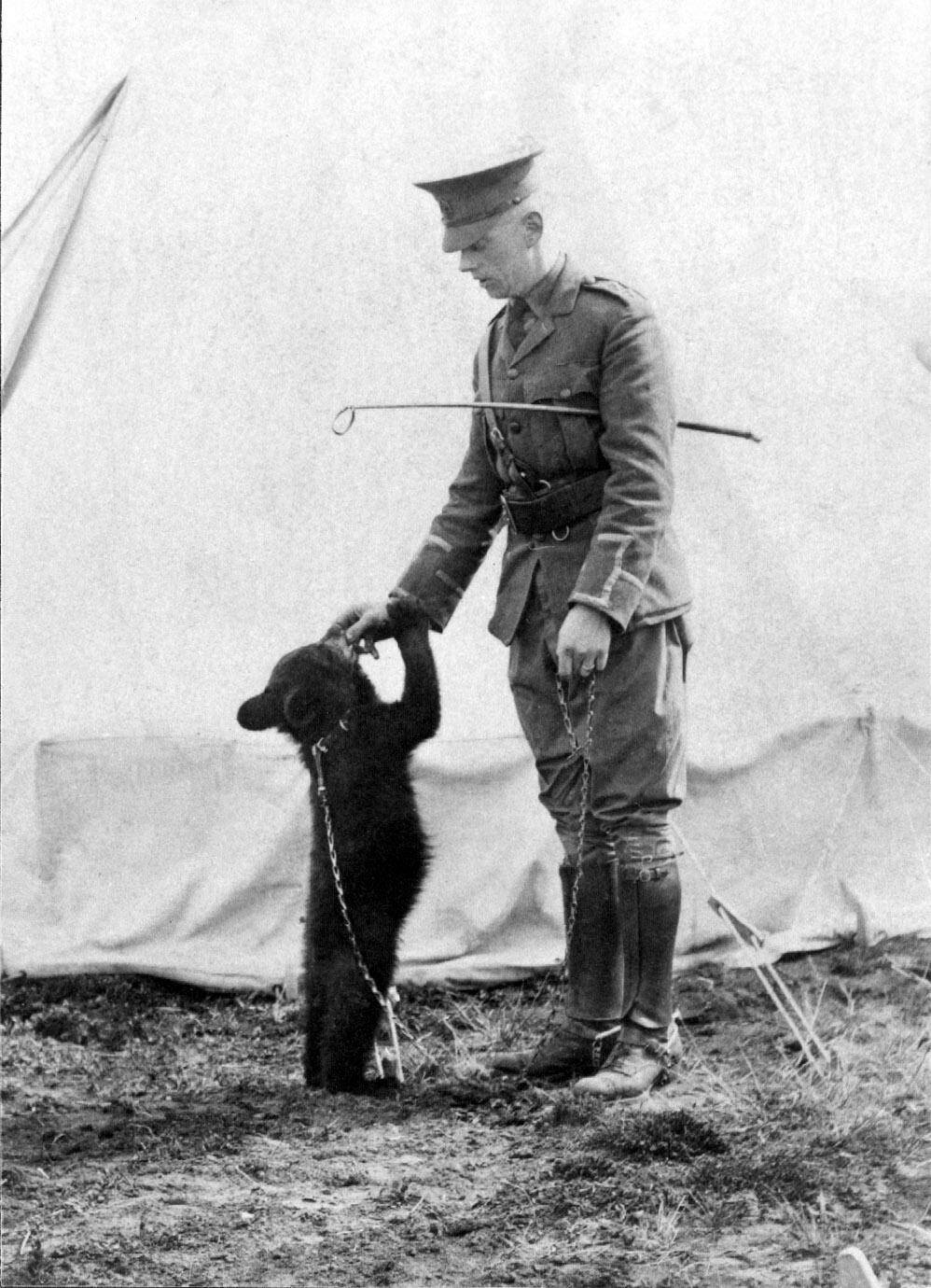
Winnie the Pooh with Lt. Harry Colebourn (Handout photo)
Among the hundreds of men rushing to enlist was Winnipeg veterinarian Harry Colebourn. Already a member of the Fort Garry Horse regiment, Colebourn was quickly sent for further training at an infantry camp in Valcartier, Que. Throughout his time in the war, Colebourn kept a small pocket diary. In his short, sporadic entries, Colebourn details the violence on the battlefield, the looming threat of enemy attacks, and the mental and physical toll incurred from the war. Among these entries, one from the summer of 1914 stands out:
“Aug 24th Bought cub bear at White River Stn. Paid $20.”
This part of Colebourn’s story is well-known. At a quick stopover in White River, Ont., Colebourn met a hunter with an orphaned black bear cub on a leash. The hunter, Colebourn learned, had killed the cub’s mother and was looking to find someone to take the young bear off his hands. Colebourn agreed, and named the bear Winnipeg — Winnie, for short.
A train full of soldiers might have been the perfect place to try and sell an orphaned bear cub. Capt. Williams, of the Strathconas, once remarked that nearly every unit training at Camp Sewell/Camp Hughes had pet bear cubs and that “the Men had a lot of fun with him, they are very playful.”
Winnie wasn’t even the only bear at Valcartier — Sam Greenlaw of the 236th Battalion had also recently adopted a young bear cub that stayed in the camp. It was typical for units to adopt pets, to serve as morale boosters and mascots for the war, though for many units the typical mascot was something as common as a dog. Most of the adopted bear cubs remained in Canada when the troops shipped out — except for Winnie, who came along with Colebourn after he was transferred to the Canadian Veterinary Corp. At their new home in Salisbury Plain, England, Winnie was the only bear and darling of the camp.

Soldiers taught her tricks, posed with her for photographs, all while Winnie followed them like a well-trained dog. The war front, however, was no place for a black bear — so when Colebourn was due to report to the front, he left Winnie behind with the London Zoo for safekeeping. There, Winnie was in the company of the zoo’s regular menagerie of animals — including a giant tortoise children would ride on — and the donated animals from other units.
The London Zoo took in other Canadian bears, deer and even a monkey that had survived two of the earliest battles of the war. Where Winnie stood out, though, was that she was unusually tame. Children could walk right up to her, and she quickly became a favourite of visitors. Colebourn, too, came to visit his beloved bear while on periodic leaves — but when the war was over, he decided the zoo was the best place for Winnie. Colebourn returned to Winnipeg in 1919 and established a veterinary clinic on Corydon Avenue.
Thousands of guests visited Winnie in her time at the London Zoo, but the most-well known and most significant was a young boy named Christopher Robin Milne and his father, Alan Alexander Milne. Taken with Winnie, Christopher named his teddy bear after her. He spent his days playing at the Milne country home, creating imagined worlds for Winnie-the-Pooh while his mother voiced Eeyore and Piglet. In 1926, A.A. Milne used the inspiration from these play sessions to create a book: Winnie-the-Pooh. This was followed by a second collection in 1928.
Though Milne wrote only two Winnie-the-Pooh books and refused thereafter to write for children, Winnie-the-Pooh had taken the world by storm. In the 1930s, branding expert Stephen Slesinger obtained the American merchandising rights to Pooh and began producing dolls, records, board games and more. The bear’s popularity grew, leading to Disney ultimately obtaining the rights to Winnie-the-Pooh in 1960.
Though Winnie left Winnipeg long ago, tributes to her can still be found throughout the city, including a statue at Assiniboine Park, a gallery of Winnie-the-Pooh art and objects at the Assiniboine Park Pavilion, and the Pooh-themed play area at McNally Robinson Booksellers.