New government rules spell end for Nova Scotia’s distinctive shark-fishing derbies
Advertisement
Read this article for free:
or
Already have an account? Log in here »
To continue reading, please subscribe:

Digital Subscription
One year of digital access for only $205*
- Enjoy unlimited reading on winnipegfreepress.com
- Read the E-Edition, our digital replica newspaper
- Access News Break, our award-winning app
- Play interactive puzzles
*First annual payment billed as $205.00 + GST for one year. This annual subscription will automatically renew at $233.00 + GST every 52 weeks (10% off the regular annual price of $259.35). Offer available to new and qualified returning subscribers only. Cancel any time.
To continue reading, please subscribe:
Add Free Press access to your Brandon Sun subscription for only an additional
$1 for the first 4 weeks*
- Enjoy unlimited reading on winnipegfreepress.com
- Read the E-Edition, our digital replica newspaper
- Access News Break, our award-winning app
- Play interactive puzzles
*Your next Brandon Sun subscription payment will increase by $1.00 and you will be charged $17.95 plus GST for four weeks. After four weeks, your payment will increase to $24.95 plus GST every four weeks.
Read unlimited articles for free today:
or
Already have an account? Log in here »
Hey there, time traveller!
This article was published 14/07/2023 (1158 days ago), so information in it may no longer be current.
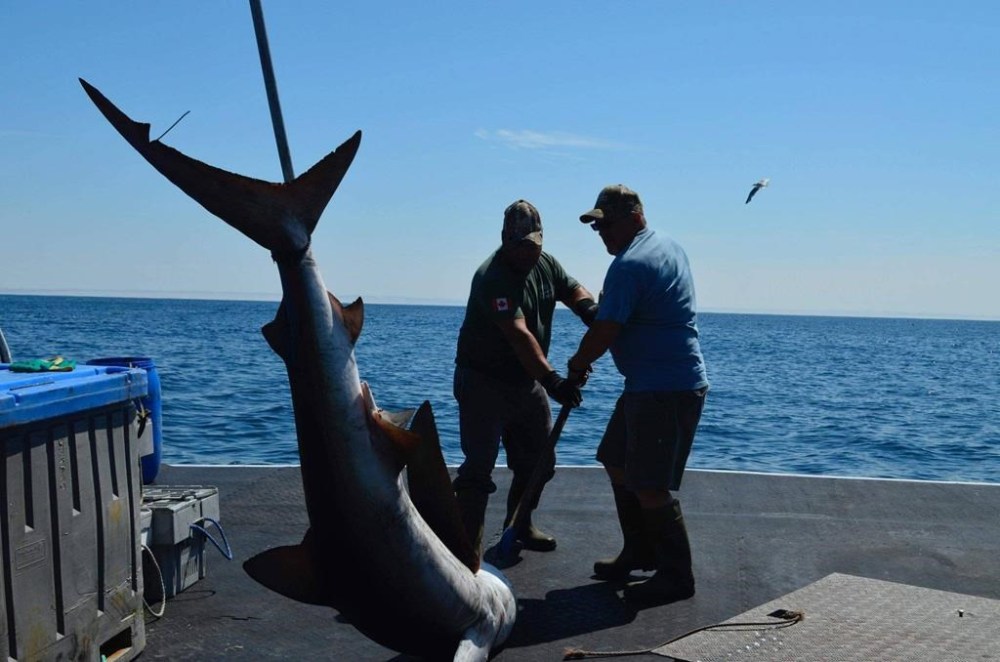
Nova Scotia shark derbies, which for 30 years offered anglers a chance to land one of the ocean’s top predators, have been called off after authorities determined they no longer served a scientific purpose.
Fisheries and Oceans Canada had authorized the shark-fishing tournaments by issuing scientific licences so the animals could be studied after they were caught. But the department has informed derby organizers that its research program no longer needs derby-caught specimens.
Organizers of the Yarmouth Shark Scramble in southwestern Nova Scotia, the Petit de Grat Shark Derby in Cape Breton and the Lockeport Sea Derby in Shelburne County were given three options if they want to continue: follow a catch and release model in which the sharks don’t leave the water; use all sharks caught for human consumption; or find another organization to support research on the sharks caught.
“The decision to proceed or not with any of these options — and the request for any applicable required licence — rests with shark tournament organizers,” the department said in an emailed statement. The department declined to make anyone available for an in interview.
Bob Gavel, organizer of the Yarmouth Shark Scramble, said he was extremely disappointed by the government directive. He said it is impossible for any of the province’s shark derbies to meet the conditions proposed by the Fisheries Department.
For conservation reasons, tournament participants have been allowed to catch only blue sharks since 2018, and Gavel said there is not enough demand for the meat to consume everything caught. He said trying to tag and release sharks would be too dangerous aboard the crowded fishing boats. And no other organizations are interested in the sharks for research, he said.
The August tournaments were unique in Canada. “We have people from all over Canada and the United States who have come to the tournament, and as far away as Australia,” Gavel said. “We have thousands of spectators every year. It generated a lot of revenue for our communities with regards to restaurants, hotels, fuel — people buying souvenirs, and just having the people in our town created quite an economic boost for us.”
The Lockeport Sea Derby said on its Facebook page there will be no shark fishing this year because of the new rules, and the Petit de Grat Shark Derby said the tournament wouldn’t be held this year because of the new licence requirements.
Gavel called Fisheries and Oceans Canada’s stipulations for the tournaments unfair, noting that the blue shark population was not affected by the derbies.
A report from the department published this year on shark tournament landings found that the derbies “accounted for three per cent of blue sharks killed annually in Canada, having a negligible effect on the overall population.” Department officials have said in the past that most of the blue sharks killed in Canada are hooked by fishing boats using long lines to catch swordfish and tuna.
Gavel started the Yarmouth tournament in 1998 and saw it adapt over the years. Four species of shark could be landed when the tournament began: shortfin mako, porbeagle, blue shark and common thresher.
In 2004, the Committee on the Status of Endangered Wildlife in Canada assessed the porbeagle as endangered, and two years later the tournament organizing committees voluntarily excluded the species from landings to promote conservation, the DFO report noted. Similar conservation concerns for shortfin mako and common thresher led to licence conditions being changed in 2018 to allow blue shark landings only.
The report said organizers also imposed additional restrictions to promote conservation, including increasing the minimum size of shark landed to nine feet in length and allowing one shark per participant and three per boat.
Gavel said the tournament was mostly a way for fishers to spend time with their families on the water. “We’re a little fishing community and the fishermen, all they do is work at their jobs,” he said. “But this was a way for them to take their families and so on to go out and have some fun.”

Data showed that since the first tournaments began in 1993, a total of 4,266 sharks were landed around Nova Scotia, including 4,193 blue sharks, 52 shortfin mako sharks, 15 porbeagles and six common threshers.
Between 1993 and 2005, the report said landings were made up of immature males and females, as well as mature males. Females of reproductive age were not caught “due to their absence from Canadian waters,” the report said.
Gavel remembers the first time he reeled in a shark.
“Oh, it’s quite the adrenalin rush,” he said. “To catch something that size that takes you sometimes three or four hours to land it. To fish a shark that weighs anywhere from 200 to over 300 to 400 pounds and land it. It’s that kind of adrenalin. It’s quite tiring. And it’s a lot of fun.”
This report by The Canadian Press was first published July 14, 2023.