Canada set to end domestic subsidies for unabated fossil-fuel production
Advertisement
Read this article for free:
or
Already have an account? Log in here »
To continue reading, please subscribe:

Digital Subscription
One year of digital access for only $205*
- Enjoy unlimited reading on winnipegfreepress.com
- Read the E-Edition, our digital replica newspaper
- Access News Break, our award-winning app
- Play interactive puzzles
*First annual payment billed as $205.00 + GST for one year. This annual subscription will automatically renew at $233.00 + GST every 52 weeks (10% off the regular annual price of $259.35). Offer available to new and qualified returning subscribers only. Cancel any time.
To continue reading, please subscribe:
Add Free Press access to your Brandon Sun subscription for only an additional
$1 for the first 4 weeks*
- Enjoy unlimited reading on winnipegfreepress.com
- Read the E-Edition, our digital replica newspaper
- Access News Break, our award-winning app
- Play interactive puzzles
*Your next Brandon Sun subscription payment will increase by $1.00 and you will be charged $17.95 plus GST for four weeks. After four weeks, your payment will increase to $24.95 plus GST every four weeks.
Read unlimited articles for free today:
or
Already have an account? Log in here »
Hey there, time traveller!
This article was published 14/07/2023 (1190 days ago), so information in it may no longer be current.
OTTAWA – Fourteen years ago, Canada joined the rest of the G20 in promising to wean fossil-fuel companies off of government subsidies that encouraged wasteful consumption and undermined efforts to slow climate change.
Next week, that promise is expected to finally be fulfilled.
Environment Minister Steven Guilbeault is set to publish policy guidelines that will dictate the circumstances under which future federal investments can still flow to Canadian oil and gas firms.
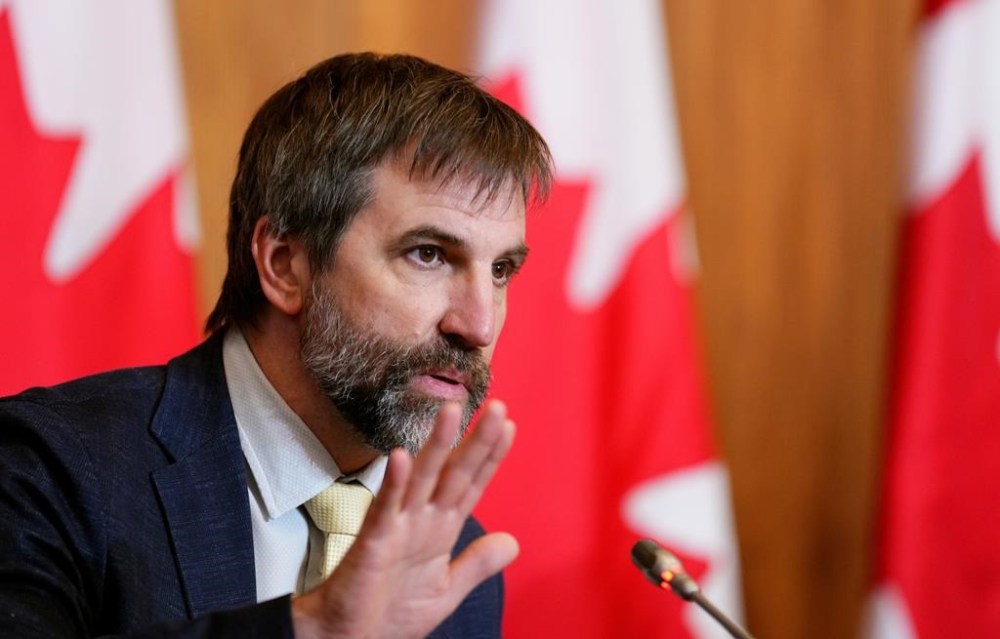
“Canada will no longer support subsidies that are directly aimed at the oil and gas sector that give that sector an advantage in comparison to other sectors, and subsidies that help the production of fossil fuels,” Guilbeault said during a media availability ahead of an environment ministers’ meeting in Belgium Wednesday.
In an interview from Brussels Friday, Guilbeault said the policy will be similar to one the government announced last year that ended most of Canada’s public financing for international fossil-fuel projects.
That means going forward, new domestic fossil-fuel projects are only to receive federal funding if the government can square them with Canada’s climate commitments.
He said tax credits or federal aid that helps companies lower their emissions will continue, including for fossil-fuel companies.
That means the new tax credit for carbon capture and storage systems is not on the chopping block.
The policy for international fossil fuel projects published in December barred any new, direct public financing for most “unabated fossil fuel investments,” meaning projects that don’t prevent greenhouse-gas emissions from ending up in the atmosphere.
There are limited exceptions if a project can prove it is consistent with the goal to limit global warming to as close to 1.5 C as possible, and doesn’t delay the transition to renewable alternatives.
It applies to financing from government departments, agencies and Crown corporations, including the Business Development Bank of Canada and Export Development Canada.
Canada has already eliminated nine different tax policies that benefited the oil and gas industry. There are differing opinions on what subsidies remain.
Canada and Argentina launched a peer review of each other’s fossil fuel subsidies in 2018 in a bid to get a better and somewhat independent take on what is in place. That review should have been done in 2020, but still hasn’t been completed, Guilbeault said Friday.
The Organization for Economic Co-operation and Development said in 2021 that Canada’s domestic subsidies included $3.4 billion in tax policies and $600 million in direct grants.
Advocacy group Environmental Defence argues more should be included in that number, such as the $10-billion loan guarantee Export Development Canada approved for the Trans Mountain pipeline expansion in 2022.
Environmental Defence and the International Institute for Sustainable Development are among the environment groups that also want Canada to include tax credits, government loans and grants that help fossil-fuel producers cut their emissions among the subsidies targeted by the incoming policy.
However, Guilbeault said that won’t be happening.
When Canada first agreed to phase out fossil-fuel subsidies in 2009 under the previous Conservative government, the promise targeted “inefficient” funding. When the Liberals reaffirmed the promise in 2016, they set a deadline for doing so by 2025, then later moved that up to 2023.
But in the 14 years since the initial promise, neither Canada nor the G20 has landed on a definition for “inefficient.” As recently as May 2022, Environment and Climate Change Canada officials said the definition was still being finalized.
Guilbeault would not say Friday what the definition will be, but he has been clear that he does not consider funding to help companies cut emissions to be “inefficient.”
The tax credit for carbon capture also isn’t specific to oil and gas companies, so it doesn’t give them a leg up on other industries, he said.
Environment groups want such technology excluded because they say anything that encourages continued fossil-fuel production is harmful.
They also note that carbon capture systems are new technologies that haven’t yet proven their worth — and even if they do work, they don’t abate the emissions caused by the burning of fossil fuels to power cars or heat homes.
The Canadian Association of Petroleum Producers has previously argued that it is not subsidized at all, and does not consider tax policies to be subsidies.
A spokeswoman said Friday the association won’t comment on the new policy before seeing it.
This report by The Canadian Press was first published July 14, 2023.