Flooded with sightseers, Europe’s iconic churches struggle to accommodate both worship and tourism
Advertisement
Read this article for free:
or
Already have an account? Log in here »
To continue reading, please subscribe:

Digital Subscription
One year of digital access for only $205*
- Enjoy unlimited reading on winnipegfreepress.com
- Read the E-Edition, our digital replica newspaper
- Access News Break, our award-winning app
- Play interactive puzzles
*First annual payment billed as $205.00 + GST for one year. This annual subscription will automatically renew at $233.00 + GST every 52 weeks (10% off the regular annual price of $259.35). Offer available to new and qualified returning subscribers only. Cancel any time.
To continue reading, please subscribe:
Add Free Press access to your Brandon Sun subscription for only an additional
$1 for the first 4 weeks*
- Enjoy unlimited reading on winnipegfreepress.com
- Read the E-Edition, our digital replica newspaper
- Access News Break, our award-winning app
- Play interactive puzzles
*Your next Brandon Sun subscription payment will increase by $1.00 and you will be charged $17.95 plus GST for four weeks. After four weeks, your payment will increase to $24.95 plus GST every four weeks.
Read unlimited articles for free today:
or
Already have an account? Log in here »
Hey there, time traveller!
This article was published 20/07/2023 (1180 days ago), so information in it may no longer be current.
BARCELONA, Spain (AP) — A recent Saturday evening Mass at Sagrada Familia parish had all the hallmarks of a neighborhood worship service, from prayers for ill and deceased members to name-day wishes for two congregants in the pews.
But it also featured security checks to get in and curious tourists peering down to take photos of the worshippers from above. The regular Mass is held in the crypt of modernist architect Antoni Gaudí’s masterpiece church, one of Europe’s most visited monuments.
With tourism reaching or surpassing pre-pandemic records in Barcelona and across southern Europe, iconic sacred sites are struggling to accommodate the faithful who come to pray and the millions of visitors who often pay to view the art and architecture.
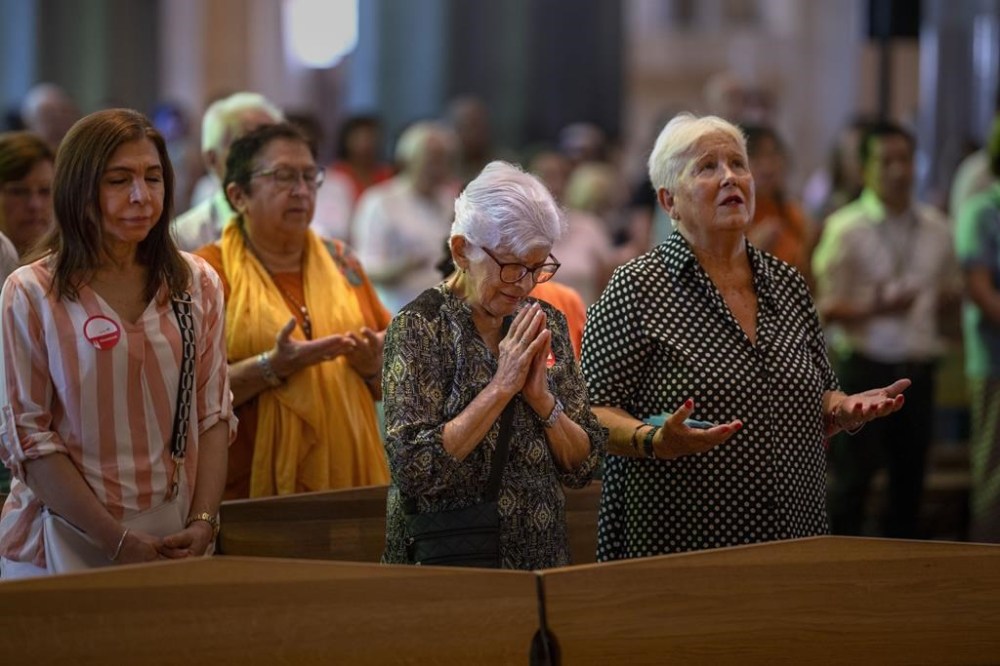
“We’re working to get ahead of this, so that we don’t get to a collapse,” said the Rev. Josep Maria Turull, rector at Sagrada Familia and the Barcelona archdiocese’s director for tourism, pilgrimage and sanctuaries.
An increasingly popular strategy is to have visitors and the faithful go separate ways – with services held in discrete places, visits barred at worship times, or altogether different entry queues.
This spring, the Vatican opened a separate “pathway” starting outside St. Peter’s Basilica for those who want to enter to pray or attend Mass, so they wouldn’t be discouraged by sometimes hours-long lines for the average of 55,000 daily visitors, said Basilica spokesperson Roberta Leone.
But the challenge remains: how to balance the churches’ competing roles amid the tourism surge without sacrificing their spiritual purpose.
“It’s just really hard because you also want people to experience your faith,” said Daniel Olsen, a Brigham Young University professor who researches religious tourism. With an estimated 330 million people visiting religious sites yearly around the world, it’s one of the tourism market’s largest segments.
Worshippers, who often come because celebrated churches tend to have more services than regular parishes, need free access even as tourists often pay fees that are crucial to maintaining the sites.
“The temple needs to be a place for services and not a theme park,” said Joan Albaiges after Mass in the Sagrada Familia crypt, which he’s attended regularly for six decades.
He praised the move in recent years to celebrate one multilingual Sunday Mass at the main altar in the soaring, color-filled basilica. There’s such demand for the 800 free tickets, however, that several hundred people queueing routinely don’t get in, Turull said.
Lay and religious leaders say the histories of the sacred sites should be presented to visitors, who are increasingly unfamiliar with faith traditions in rapidly secularizing countries where lesser-known churches are emptying out or being repurposed.
“Some people go to the cathedral, and they don’t realize they’re in a church. It’s a situation that’s developing in nations that were majority Christian, and now faith is cooling off,” said José Fernández Lago, rector of the Cathedral of Santiago de Compostela.
Filled with masterpieces from Romanesque sculpture to lavish Baroque decorations, Santiago’s cathedral attracts hundreds of thousands of tourists and pilgrims who since the Middle Ages have traveled along the Camino routes to venerate St. James’s tomb.
To preserve its role as a revered pilgrims’ church, Lago said, the cathedral doesn’t charge entry fees, cap visitor numbers or require a dress code. On a hot early summer morning, a steady stream of pilgrims ducked each other’s selfie sticks in front of the jewel-encrusted St. James statue, some still in tight cycling shorts or sweat-stained hiking shirts.
But visits aren’t allowed during the four daily Masses celebrated at the main altar, and priests as well as security guards constantly ask visitors to lower their voices to allow others to pray.
“It keeps getting harder,” said Juan Sexto, who in 10 years working security at the cathedral has noticed a change in how many visitors behave.
As crowds surged before the always-packed noon pilgrims’ Mass, he kept stepping to the main microphone asking for silence – which lasted a minute or so before enthusiastic visitors resumed chatting.
Sexto had a supporter in the second pew. Waiting for Mass to start, pilgrim Miguel Angel Ariño said the church did well to allow only the faithful during worship times, while leaving the cathedral open long hours for cultural visits.
“As people, we need the transcendent. Leisure and rest, and time with God, are not incompatible,” Ariño said.
Without some strategy, however, they can become so. Co-existence between worshippers and tourists has been controversial at Istanbul’s Hagia Sophia. Built as a landmark cathedral in the Byzantine era, turned into a mosque by the conquering Ottoman empire in the 1400s, and open as a museum for the last century, it was converted back into a functioning mosque in 2020 by Turkey’s Islamic-oriented government.
Now visitors can tour the structure for free outside of prayer hours. In Hagia Sophia’s main section where prayers are held, the vast mosaics depicting Christian figures are hidden behind drapes and most of the marble floor is covered with carpeting.
“We would like it to be a museum again,” said Ricardo Bravo, a tourist from Mexico visiting the monument with his family. “We would like to see more things to understand more, to appreciate more Turkish culture.”
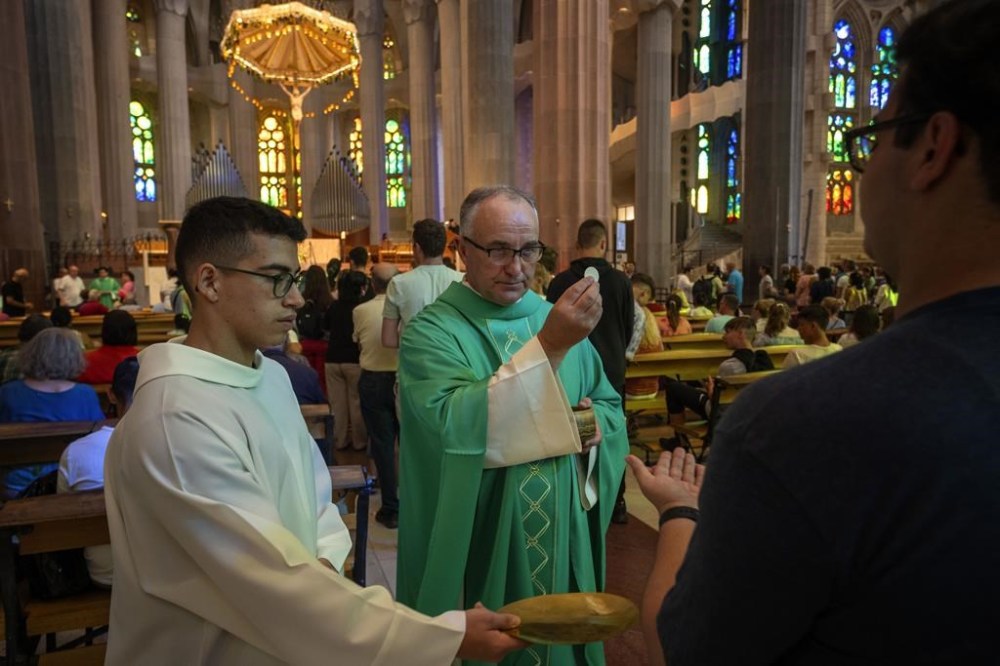
At many of Spain’s most-visited churches, the balance was often off-kilter in the opposite direction. So many visitors thronged the vast Basilica del Pilar in Zaragoza on a mid-June Saturday that it was nearly impossible to hear the midday Mass celebrated in the small chapel where a statue of Our Lady of the Pillar is venerated.
With some 2.5 million annual visitors, Barcelona Cathedral was also close to a breaking point before its council revolutionized the worship vs. tours balance over the last few years.
“It was like being in a market,” recalled Anna Vilanova, who directs the cathedral’s tourism strategy. “We had to put some order.”
The cathedral instituted caps on visitor numbers, required tour groups to use wireless audio guides to reduce noise, and added staffers to explain the new policies to visitors and those coming for daily Mass or confession, held in a side chapel with crystal doors to preserve silence.
“The point comes when tourism is so massive that it occupies the worship space,” said Xavier Monjo, who oversees the cathedral’s publications. “The cathedral is alive, it’s not a museum.”
The visitor guides included with the entry fee seek to prioritize the church’s role as an active place of worship.
The nave description in the “unmissable” list, for example, starts by stating that “this cathedral has been and is a space dedicated to prayer” before describing its stunning Catalan Gothic architecture. The entry for the rooftop terraces explains that this is where the blessing of the city happens each May on the feast of the Holy Cross.
“As tourism has been growing, it’s also an opportunity – not to proselytize, but to discover the deep meaning of what they can see,” Turull said. “All those who enter like tourists can leave like pilgrims, can have a spiritual experience.”
While 3.7 million tourists explored the Sagrada Familia’s arresting architecture and mesmerizing stained glass windows last year, Fenelon Mendez remains focused on the parish activity literally underneath.
Originally from Venezuela, he’s lived in the neighborhood with his family for a decade and often serves as sacristan and altar server. There are ministry programs for single moms and for migrants, and regular food distributions, he said.
The basilica provides a unique experience, so the faithful should continue to get full access to it, Mendez said. But the crypt where regular worshippers gather is the true core where many like him feel at home.

“You could take the basilica to New York, but we are here,” he said in the sacristy, long after the day’s tourists had stopped wandering above.
——
Associated Press journalists Francisco Seco in Istanbul and Suzan Fraser in Ankara, Turkey, contributed to this report.
___
Associated Press religion coverage receives support through the AP’s collaboration with The Conversation US, with funding from Lilly Endowment Inc. The AP is solely responsible for this content.
The Free Press acknowledges the financial support it receives from members of the city’s faith community, which makes our coverage of religion possible.