Montana train derailment report renews calls for automated systems to detect track problems
Advertisement
Read this article for free:
or
Already have an account? Log in here »
To continue reading, please subscribe:
Digital Subscription
One year of digital access for only $1.44 a week*
- Enjoy unlimited reading on winnipegfreepress.com
- Read the E-Edition, our digital replica newspaper
- Access News Break, our award-winning app
- Play interactive puzzles
*Billed as $5.77 plus GST every four weeks. After 52 weeks, price increases to the regular rate of $19.95 plus GST every four weeks. Offer available to new and qualified returning subscribers only. Cancel any time.
To continue reading, please subscribe:
Add Free Press access to your Brandon Sun subscription for only an additional
$1 for the first 4 weeks*
- Enjoy unlimited reading on winnipegfreepress.com
- Read the E-Edition, our digital replica newspaper
- Access News Break, our award-winning app
- Play interactive puzzles
*Your next Brandon Sun subscription payment will increase by $1.00 and you will be charged $17.95 plus GST for four weeks. After four weeks, your payment will increase to $24.95 plus GST every four weeks.
Read unlimited articles for free today:
or
Already have an account? Log in here »
Hey there, time traveller!
This article was published 28/07/2023 (1179 days ago), so information in it may no longer be current.
Federal investigators renewed their recommendation that major freight railroads equip every locomotive with the kind of autonomous sensors that could have caught the track flaws that caused a fatal 2021 Amtrak derailment in northern Montana.
But installing the sensors on the tens of thousands of locomotives in the fleet could be cost prohibitive, and it’s not entirely clear if one would have caught the combination of rail flaws that the National Transportation Safety Board said caused the crash near Joplin, Montana, that killed three people and injured 49 others. And rail unions caution that no technology should be a substitute for human inspectors.
The NTSB report laid blame in part on BNSF railroad, which owns the tracks, and “a shortcoming in its safety culture.” But it noted that even if track inspections had been more frequent, the severity of the problems may not have been noticed the day of the crash without devices and technology designed to enhance the inspections.
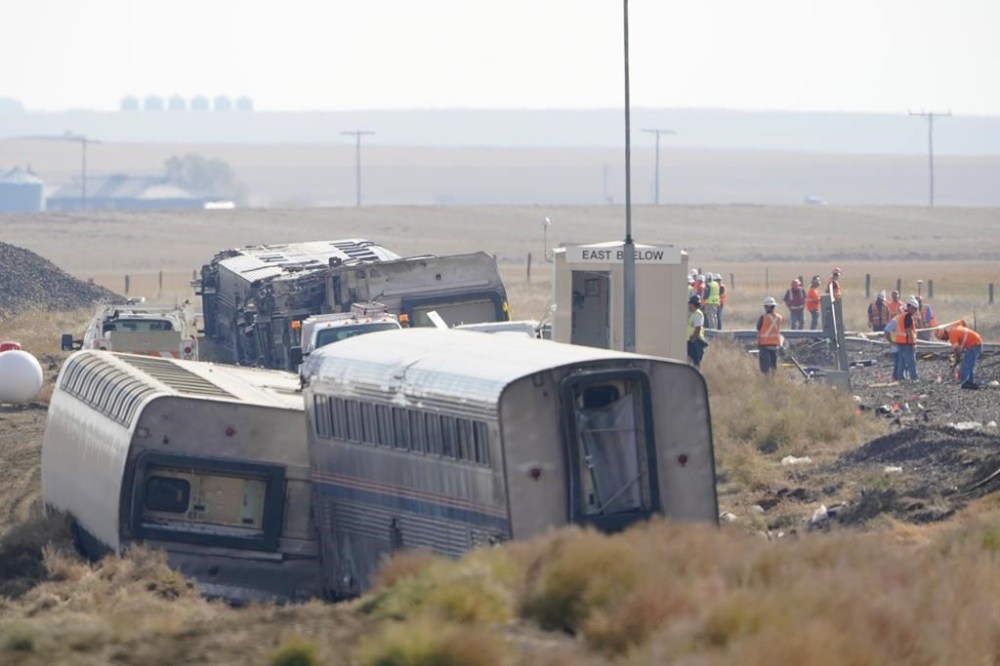
“It is unlikely that the track deviations would have been detected through the current track inspection process,” the board concluded in the report released Thursday. But “autonomous monitoring systems … have the ability to monitor track conditions and provide real-time condition monitoring that could be used for early identification and mitigation of unsafe track conditions.”
BNSF defends its safety record and said it already employs a number of the sensors that the NTSB is recommending, but spokeswoman Lena Kent said the Fort Worth, Texas-based railroad will review the report for any additional lessons and ways to improve safety.
But track problems have long been a safety concern for the NTSB, which can recommend but not mandate changes. In a 2021 report on the Joplin derailment, it attributed 592 U.S. derailments over a decade-long timespan to “track geometry,” which includes the distance between the rails and their horizontal and vertical alignment. Those issues were the second-leading cause of derailment in 2021.
Railroad safety expert Dave Clarke, the former director of University of Tennesse’s Center for Transportation Research, said it is important to remember that the NTSB doesn’t do any kind of cost-benefit analysis on its recommendations.
“If they think something is a good idea for safety they put it out there. In the real world there may be no way to economically or practically do everything NTSB recommends,” Clarke said.
Clarke said it’s also not clear that these sensors would have definitely caught the problems that caused the Montana derailment because none of the individual factors was severe enough to be considered a defect under Federal Railroad Administration rules. The NTSB said it was the combination of all those factors that caused the derailment.
The major freight railroads have more than 23,000 locomotives in their fleets, including thousands that have been put into storage in recent years as the railroads have overhauled their operations to rely more on longer trains that don’t need as many locomotives.
It would require a major investment to add detectors to every locomotive, although the Association of American Railroads trade group couldn’t immediately provide an estimate of how much each sensor costs. BNSF and the five other major U.S. freight railroads already spend roughly $23 billion every year on improving and maintaining their networks and investing in new equipment.
But attorney Jeff Goodman, who represented family members of the three passengers who died in the derailment, said he believes his clients would have lived if trains that had passed through the area before the Amtrak train had been equipped with these sensors.
Tracks will always bend or get out of sync because they’re exposed to the elements, but monitoring allows trains to know when to slow down and prevent accidents, he said.
“If the recommendations that the NTSB issued today were implemented prior to this tragedy, Zach Scheider and Don and Marjorie Varnadoe would all be alive today,” he said, naming the deceased family members of his clients.
Railroads have long resisted new regulations, Although there aren’t any rules requiring these automated inspection sensors or the thousands of trackside detectors they employ, railroads have spent millions developing the technology and installed them voluntarily to improve safety. But regulators are considering drafting rules for them in the wake of recent derailments.
An AAR trade group spokeswoman said that the type of sensors the NTSB singled out measure the force a locomotive exerts on the track and hasn’t proven as useful as other kinds of sensors railroads have developed.
“This technology has been difficult to maintain in real-world operations and lacks a strong correlation to track geometry defects,” Jessica Kahanek said.
Railroads are experimenting with a variety of technologies to find the best way to spot problems.
Another kind of autonomous sensor that can be installed on locomotives as well as the trucks inspectors use to ride along the rails can spot problems like misaligned track and wear on the rails by testing the track continuously.
Vehicle track interaction systems, like the ones the NTSB singled out, must be mounted on locomotives because they measure the force a train puts on the tracks.
Both kinds of sensors can help identify areas of concern for a human inspector to follow up on after computers analyze the data they generate. But the VTI sensors tend to be so sensitive that they flag areas where there aren’t true defects.
Kent said BNSF’s use of both kinds of sensors allows the railroad to check its track network multiple times — more than 450,000 miles (720,000 kilometers) of track each year — and that the technology has helped the railroad reduce the rate of defects that it finds by 82% over the past five years.
In the past, BNSF and other railroads have even petitioned the Federal Railroad Administration to get a waiver releasing them from some inspection requirements because they believe the track geometry sensors provide enough information that the frequency of human inspections can be safely reduced.
Federal officials approved a waiver allowing BNSF to reduce inspections on a couple of areas of its more than 30,000-mile (48,000-kilometer) network after the railroad successfully tested the devices for several years, but later declined to let the railroad expand that practice, including its tracks that cross Montana. BNSF took the FRA to court over that decision and the dispute is still pending.
Rail unions have opposed the waivers. They argue that while the new technology is helpful, it shouldn’t replace human inspections. Even with an interest in preserving jobs, they say safety is their primary concern.
Already, the unions say the widespread job cuts the major railroads have made — eliminating nearly one-third of all rail jobs over the past six years — have made it difficult for employees to keep up with inspection demands and meet all FRA requirements. The NTSB pointed out that the inspector responsible for the territory where the Montana derailment happened had worked an average of 13 hours a day in the four weeks prior to the crash.
Former NTSB director Bob Chipkevich, who spent years investigating rail crashes, said it often takes multiple derailments to force railroads to implement new safety technology.
One of the biggest recent advances in rail safety came after a commuter train collided head-on with a freight train near Los Angeles in 2008, killing 25 people and injuring more than 100. Congress mandated a $15 billion automatic braking system that stops trains when they’re in danger of colliding, derailing and other situations — but it took 12 years to complete.

“When there are safety issues that have been raised after multiple accidents that occurred again and again, the question is to the industry,” Chipkevich said. “Why haven’t you done it after all these years?”
___
Funk reported from Omaha, Nebraska, and Metz reported from Salt Lake City.
___
Follow Josh Funk on Twitter at www.twitter.com/funkwrite