Off Alaska coast, research crew peers down, down, down to map deep and remote ocean

Advertisement

Advertise with us

KODIAK, Alaska (AP) — For the team aboard the Okeanos Explorer off the coast of Alaska, exploring the mounds and craters of the sea floor along the Aleutian Islands is a chance to surface new knowledge about life in some of the world's deepest and most remote waters.

Read this article for free:


By clicking the button above, an account will be created and you will begin to receive some of our recommended newsletters. You may opt out of any newsletter by visiting your Email and Communication Preferences page or by clicking "unsubscribe" at the bottom of any email.

or

Already have an account? Log in here »

To continue reading, please subscribe:

Digital Subscription

One year of digital access for only $1.44 a week*

  • Enjoy unlimited reading on winnipegfreepress.com
  • Read the E-Edition, our digital replica newspaper
  • Access News Break, our award-winning app
  • Play interactive puzzles

*Billed as $5.77 plus GST every four weeks. After 52 weeks, price increases to the regular rate of $19.95 plus GST every four weeks. Offer available to new and qualified returning subscribers only. Cancel any time.

To continue reading, please subscribe:

Add Free Press access to your Brandon Sun subscription for only an additional

$1 for the first 4 weeks*

  • Enjoy unlimited reading on winnipegfreepress.com
  • Read the E-Edition, our digital replica newspaper
  • Access News Break, our award-winning app
  • Play interactive puzzles
Start now

*Your next Brandon Sun subscription payment will increase by $1.00 and you will be charged $17.95 plus GST for four weeks. After four weeks, your payment will increase to $24.95 plus GST every four weeks.

Hey there, time traveller!
This article was published 14/08/2023 (1163 days ago), so information in it may no longer be current.

KODIAK, Alaska (AP) — For the team aboard the Okeanos Explorer off the coast of Alaska, exploring the mounds and craters of the sea floor along the Aleutian Islands is a chance to surface new knowledge about life in some of the world’s deepest and most remote waters.

The National Oceanic and Atmospheric Administration research vessel is on a five-month mission aboard a reconfigured former Navy vessel run by civilians and members of the NOAA Corps. The ship, with a 48-member crew, is outfitted with technology and tools to peer deep into the ocean to gather data to share with onshore researchers in real time. The hope is that this data will then be used to drive future research.

“It’s so exciting to go down there and see that it’s actually teeming with life,” said expedition coordinator Shannon Hoy. “You would never know that unless we were able to go down there and explore.”
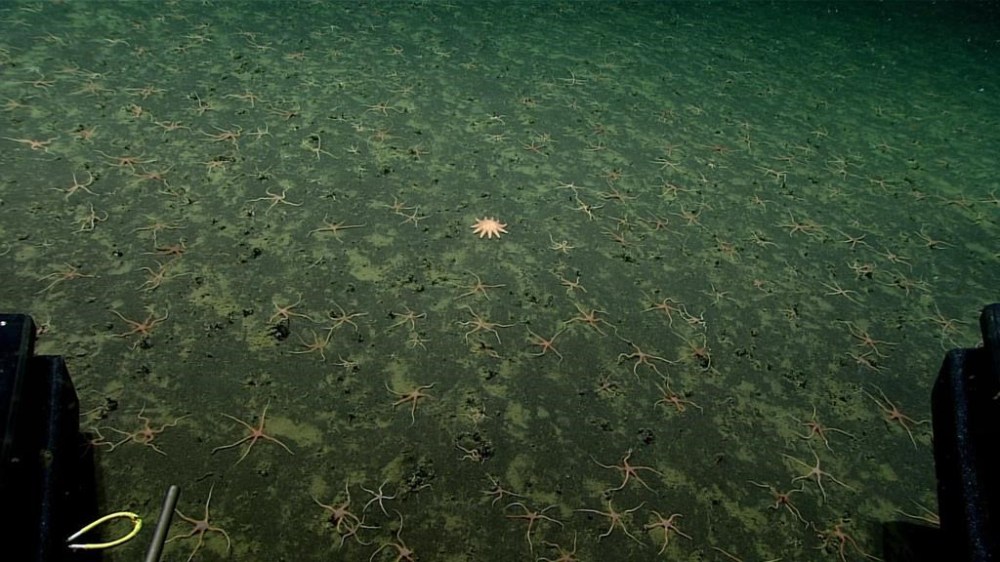
In this photo provided by NOAA Ocean Exploration, a lone sunstar rests among many brittle stars taken from the Okeanos Explorer off the coast of Alaska on July 24, 2023, while exploring the mounds and craters of the sea floor along the Aleutian Islands. The ship, a reconfigured former U.S. Navy vessel run by civilians and members of the NOAA Corps, is specially outfitted with technology and tools needed to access deep into the ocean, and to share that data with the public and on-shore researchers in real-time. (NOAA Ocean Exploration via AP)

Using a variety of sonars and two remotely operated vehicles — Deep Discoverer and Serios — researchers aboard the ship are mapping and collecting samples from areas along the Aleutian Trench and Gulf of Alaska. High-resolution cameras that can operate at depths of up to 6,000 meters (19,685 feet) allow researchers to document and immediately share their findings. The ship can also livestream dives to the public.

Many factors, such as depth, speed and sonar capability, influence how much sea floor can be mapped. In 2 to 4 weeks, the Okeanos Explorer can map as much as 50,000 square kilometers (31,069 square miles), Hoy said.

During these dives, Hoy said the team plans to investigate some of the area’s cold seep communities — places where gases from under the sea floor rise through cracks and where plants don’t rely on photosynthesis for food production.

“We’re also going to be looking through the water column to see what interesting animals and fauna that we can see there,” she said.

Kasey Cantwell, the ship’s operations chief, said the data will help researchers and the public better understand these remote stretches of ocean, including marine life and habitats in the area. That could inform management decisions in fisheries. Data could also help detect hazards and improve nautical charts.

“It’s really hard to care for things you don’t understand, to love things you don’t understand,” Cantwell said.

The deep ocean off Alaska’s Aleutian Islands is one of the least mapped places in the U.S., partly due to its remoteness. Modern mapping standards have covered just 34% of the sea floor around Alaska, which has one of the nation’s largest coastal ecosystems, and only a fraction of that has been seen, according to the expedition’s web site.

Closing these gaps is a mission priority, and will help meet a goal of mapping all of the United States’ deep waters by 2030 and near-shore waters by 2040, according to Emily Crum, a communications specialist with the National Oceanic and Atmospheric Administration.

But the data collection process is laborious.

Thomas Morrow, a physical scientist on the ship, likened the effort to “walking the length of several city blocks in complete darkness with a tiny flashlight.”

Nevertheless, all these small looks add up to a better understanding of what lies in the deepest parts of the sea.

In the expedition’s first two months, researchers recorded methane seeps and saw a Brisingid sea star at a depth of 2,803 meters (9,200 feet) that had not been documented in the Aleutians before. At least two potential new species have also been discovered.

Earlier this year while on an expedition off the coast of Washington state, researchers aboard the ship documented a jellyfish floating in the deep, and soon had a call from an excited scientist who told them the jellyfish was behaving in ways not seen before.

“The feeling of wonder that sometimes happens in that control room is so palpable,” he said.

___

Associated Press climate and environmental coverage receives support from several private foundations. See more about AP’s climate initiative here. The AP is solely responsible for all content.

Report Error Submit a Tip

More Stories

Medical supplies, equipment distribution firm unpacks new, larger local hub

Aaron Epp 5 minute read Preview

Medical supplies, equipment distribution firm unpacks new, larger local hub

Aaron Epp 5 minute read 7:44 PM CDT

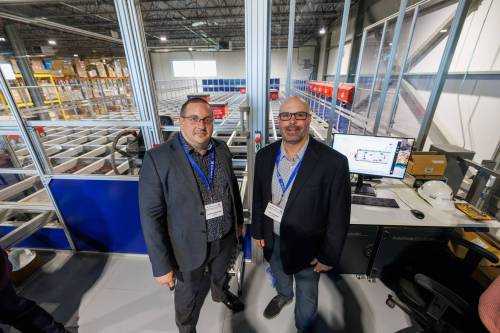
Seven red robots were some of the main attractions as Canadian medical equipment and supplies distributor Stevens Company Inc. celebrated the grand opening of its new 42,000-square-foot distribution centre in northwest Winnipeg.

The company invested more than $4 million to create the new space, which includes what it believes to be Manitoba’s first AutoStore automated storage and retrieval system — a robotic technology that will help employees fill about 20,000 orders annually.

More than 80 employees, vendors and customers gathered for the grand opening Monday afternoon. It was held fewer than four years after the celebration for the Stevens Company’s previous Winnipeg facility, a 33,000-sq.-ft. warehouse in Transcona the company quickly outgrew.

Company president Jay Stevens noted the Stevens Company’s long history in Manitoba.

Read
7:44 PM CDT

Movie theatre reopening generates excitement in Selkirk

Gabrielle Piché 3 minute read Preview

Movie theatre reopening generates excitement in Selkirk

Gabrielle Piché 3 minute read Saturday, Oct. 17, 2026

Selkirk got an extra dose of lights, cameras and action this weekend.

And ribbon cutting — for the grand reopening of the city’s sole theatre.

“It’s fantastic,” Mayor Larry Johannson said. “The sky’s the limit.”

The Garry Theatre now operates under a non-profit charity. It’s been closed since 2021, when Landmark Cinemas left the city.

Read
Saturday, Oct. 17, 2026

Province looks to keep nearly $1M from traffic stop

Erik Pindera 4 minute read Preview

Province looks to keep nearly $1M from traffic stop

Erik Pindera 4 minute read 2:01 AM CDT

The RCMP constable could see that Alireza Haghgoo was nervous. The 22-year-old, seated as a passenger in a rental Nissan SUV the Mountie pulled over for speeding outside Brandon in late July, was breathing heavily and tapping his foot constantly.

Read
2:01 AM CDT

Yager ready to fly with the Jets

Ken Wiebe 6 minute read Preview

Yager ready to fly with the Jets

Ken Wiebe 6 minute read 6:06 PM CDT

Brayden Yager understood the assignment.

By recording five goals and nine points in six American Hockey League games with the Manitoba Moose to open the season, it was clear Yager brushed aside any lingering disappointment of being the last cut by the Winnipeg Jets following a strong training camp.

Yager, who set up the tying goal and scored the game-winner for the Moose on Sunday against the Texas Stars, was officially recalled by the Jets on Monday morning.

The 14th overall pick in the 2023 NHL Draft was essentially the extra forward during line rushes, but did see some action with the penalty kill and the second power-play unit with the NHL club on Monday, so it’s still unclear whether or not Yager will be in the lineup against the St. Louis Blues.

Read
6:06 PM CDT

Winnipeg: Home of IG’s past and future

Damon Murchison 4 minute read Preview

Winnipeg: Home of IG’s past and future

Damon Murchison 4 minute read 2:00 AM CDT

Shortly after IG Wealth Management was established in Canada, our founders chose Winnipeg as the home of our young, ambitious company.

Read
2:00 AM CDT

Off Alaska coast, research crew peers down, down, down to map deep and remote ocean

Joshua A. Bickel, The Associated Press 4 minute read Preview

Off Alaska coast, research crew peers down, down, down to map deep and remote ocean

Joshua A. Bickel, The Associated Press 4 minute read Monday, Aug. 14, 2023

KODIAK, Alaska (AP) — For the team aboard the Okeanos Explorer off the coast of Alaska, exploring the mounds and craters of the sea floor along the Aleutian Islands is a chance to surface new knowledge about life in some of the world's deepest and most remote waters.

The National Oceanic and Atmospheric Administration research vessel is on a five-month mission aboard a reconfigured former Navy vessel run by civilians and members of the NOAA Corps. The ship, with a 48-member crew, is outfitted with technology and tools to peer deep into the ocean to gather data to share with onshore researchers in real time. The hope is that this data will then be used to drive future research.

"It’s so exciting to go down there and see that it’s actually teeming with life,” said expedition coordinator Shannon Hoy. “You would never know that unless we were able to go down there and explore.”

Using a variety of sonars and two remotely operated vehicles — Deep Discoverer and Serios — researchers aboard the ship are mapping and collecting samples from areas along the Aleutian Trench and Gulf of Alaska. High-resolution cameras that can operate at depths of up to 6,000 meters (19,685 feet) allow researchers to document and immediately share their findings. The ship can also livestream dives to the public.

Read
Monday, Aug. 14, 2023