

Ford announces $1.2B EV battery material plant with funding from Quebec, feds
Advertisement
Read this article for free:
or
Already have an account? Log in here »
To continue reading, please subscribe:

Digital Subscription
One year of digital access for only $205*
- Enjoy unlimited reading on winnipegfreepress.com
- Read the E-Edition, our digital replica newspaper
- Access News Break, our award-winning app
- Play interactive puzzles
*First annual payment billed as $205.00 + GST for one year. This annual subscription will automatically renew at $233.00 + GST every 52 weeks (10% off the regular annual price of $259.35). Offer available to new and qualified returning subscribers only. Cancel any time.
To continue reading, please subscribe:
Add Free Press access to your Brandon Sun subscription for only an additional
$1 for the first 4 weeks*
- Enjoy unlimited reading on winnipegfreepress.com
- Read the E-Edition, our digital replica newspaper
- Access News Break, our award-winning app
- Play interactive puzzles
*Your next Brandon Sun subscription payment will increase by $1.00 and you will be charged $17.95 plus GST for four weeks. After four weeks, your payment will increase to $24.95 plus GST every four weeks.
Read unlimited articles for free today:
or
Already have an account? Log in here »
Hey there, time traveller!
This article was published 17/08/2023 (1104 days ago), so information in it may no longer be current.
BÉCANCOUR, Que. – Ford Motor Co. and its South Korean partners said Thursday they’re building a $1.2 billion manufacturing plant for electric vehicle battery material in Quebec with the help of government funding.
The Quebec and federal governments are covering about half the cost, each putting up $322 million for the project they say is good for the environment and the economy.
Ford said the 280,000-square-metre site in Bécancour, Que. is the company’s first investment in the province and that it will help build the regional electric vehicle ecosystem.
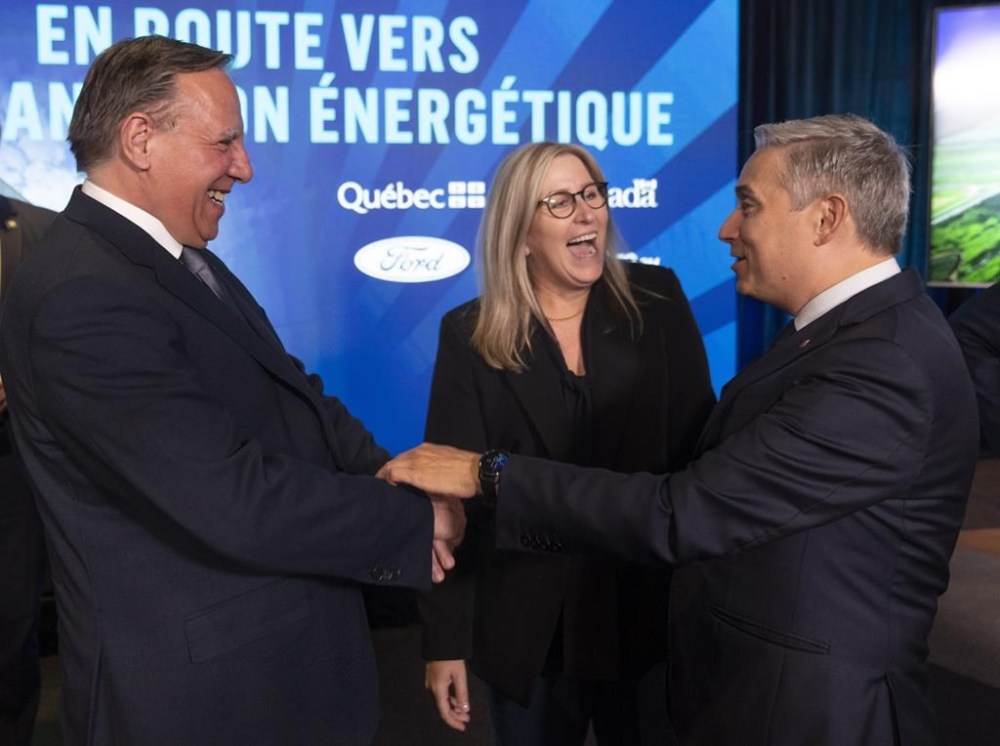
“We’re excited to invest in this new facility to create a vertically integrated, closed-loop battery manufacturing supply chain in North America,” said Ford of Canada chief executive Bev Goodman.
Ford says the cathode materials facility, located on the south shore of the St. Lawrence River halfway between Montreal and Quebec City, will create 345 jobs once it’s operational in 2026.
Industry Minister François-Philippe Champagne, who has been aggressively courting electric vehicle-related investments in Canada, said the investment will help maintain well-paying jobs for years to come.
“This investment shows once again that Canada is the green strategic partner of choice for global leaders in the automotive industry.”
At a press conference, Quebec Premier François Legault praised the announcement as evidence of the province’s growing leadership in the green economy.
Canada has seen a wave of investments in the electric vehicle transition as governments boost incentives and compete for investments.

Ford committed $1.8 billion in 2020 to transition their Oakville, Ont. plant to produce electric vehicles, while overall electric vehicle-related commitments across Canada in the past three years have topped $25 billion, according to Unifor.
Government support for battery plants, including from Volkswagen and Stellantis, have drawn scrutiny and criticism because of the size of the subsidies that are expected to run north of $10 billion each as Canada tries to match the generous incentives being offered in the U.S.
Battery plant subsidies are tied to how much the factories produce and wind down over time, as governments look to incentivize the huge and rapid buildup in capacity needed to transition to an electric-based automotive sector.
Funding for the Ford plant in Quebec will come from the federal government’s Strategic Innovation Fund, while the Quebec portion is coming from a partially forgivable loan through Investissement Québec.
This report by The Canadian Press was first published Aug. 17, 2023.