

New harvest view on Prairie horizon

Advertisement
Read this article for free:
or
Already have an account? Log in here »
To continue reading, please subscribe:
Digital Subscription
One year of digital access for only $75*
- Enjoy unlimited reading on winnipegfreepress.com
- Read the E-Edition, our digital replica newspaper
- Access News Break, our award-winning app
- Play interactive puzzles
*Billed as $5.77 plus GST every four weeks. After 52 weeks, price increases to the regular rate of $19.95 plus GST every four weeks. Offer available to new and qualified returning subscribers only. Cancel any time.
Monthly Digital Subscription
$4.99/week*
- Enjoy unlimited reading on winnipegfreepress.com
- Read the E-Edition, our digital replica newspaper
- Access News Break, our award-winning app
- Play interactive puzzles
*Billed as $19.95 plus GST every four weeks. Cancel any time.
To continue reading, please subscribe:
Add Free Press access to your Brandon Sun subscription for only an additional
$1 for the first 4 weeks*
- Enjoy unlimited reading on winnipegfreepress.com
- Read the E-Edition, our digital replica newspaper
- Access News Break, our award-winning app
- Play interactive puzzles
*Your next Brandon Sun subscription payment will increase by $1.00 and you will be charged $17.95 plus GST for four weeks. After four weeks, your payment will increase to $24.95 plus GST every four weeks.
Read unlimited articles for free today:
or
Already have an account? Log in here »
Hey there, time traveller!
This article was published 19/08/2023 (1008 days ago), so information in it may no longer be current.
A subtle but significant shift in Prairie harvest practices has taken hold over the past decade or so.
Swaths, those long rows of crop cut and laid out in a square maze around the fields, are gradually disappearing, and with that trend so goes one of the more picturesque images equated with autumn.
Ever since the McCormick swather was invented in 1831, farmers have swathed their crop and left it to dry for several days in the late summer sun before collecting it with the combine. For many of us, seeing the swathers at work has marked the beginning of harvest.
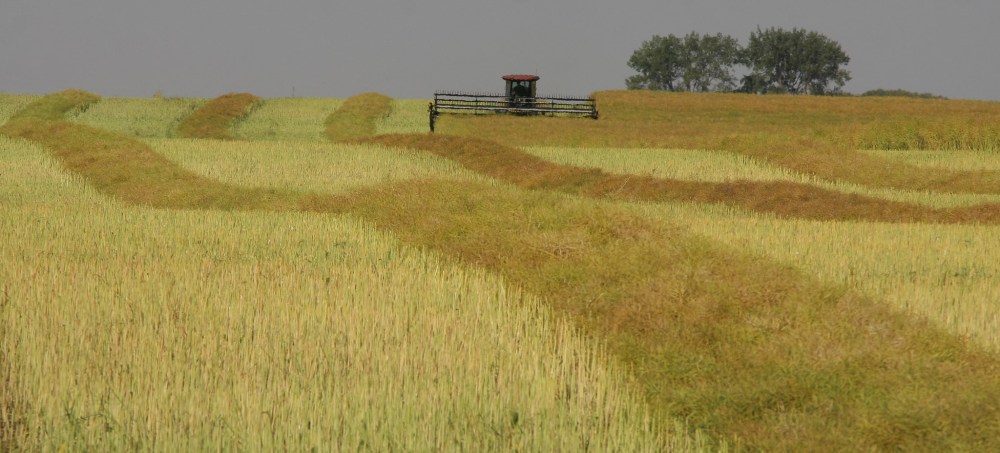
Today as you travel through rural areas, you can pass a standing field of crop one day and drive by the next to see only stubble. The crop has been cut and collected in one pass thanks to advancements in combine technology and new crop genetics.
While those geometric patterns in soft golden hues against the Prairie sky have inspired countless photographers and artists over the past century, for farmers, those swaths are a source of worry until they can get their grain in the bin.
That said, it’s taken a while for straight cutting to catch on and the practice of swathing is far from obsolete. Swathers may be seeing less action on an increasing number of farms, but they are parked where the farmer can readily pull them back into service.
The industry has debated the pros and cons of straight cutting over the past two decades, especially for a crop such as canola. Researchers have delved into the question from numerous angles to help farmers understand the implications of choosing one approach over the other.
The Canola Council of Canada isn’t taking sides. Its extension material says there are benefits and drawbacks to both. One of the main advantages of swathing is the potential for an earlier harvest. Swathing can result in more uniform seed maturity and better dry-down of the plant material that will be pulled through the combine, which makes for easier harvesting.
Meanwhile, direct cutting reduces the labour and equipment farmers need to pull off their crop. That has a lot of appeal in an era when good farm hands are hard to find.
Canola isn’t typically prone to moisture damage whether it’s standing or swathed, but cereals are less likely to lose quality if they are still standing when it rains.
Rain on a swathed cereal crop, however, usually becomes a significant downgrading factor. If it rains a lot, cereals will even start to sprout while lying in the swaths, which quickly turns top milling-quality grain into livestock feed.
Traditionally, standing canola was highly prone to seed loss due to the pods shattering as they became ripe. The development of varieties resistant to shattering has been a huge factor in farmers’ adoption of straight combining.
Meanwhile, a swathed canola crop is typically less likely to suffer pod shatter, except when winds like we’ve seen this week lift the windrows and tumble them into tangled piles — sometimes in an adjacent field — which makes harvest a nightmare.

Regardless of their harvest method, farmers must still assess the state of the crop, its maturity and whether it’s a candidate for either. They may have to apply a desiccant to hasten dry-down. If they move too early, they’ll be stuck with high chlorophyll levels or green seeds and be downgraded; too late and they’ll see more seed lost during harvest. Eventually, even shatter-resistant pods will shatter.
Research also shows that farmers can spit as much as 10 per cent of their yield out the back end of the combine if it’s not calibrated correctly or operated at the wrong speed. That easily adds up to tens of thousands of dollars in lost revenue. It also increases production costs because that seed germinates and becomes a weed they must manage in next year’s crop — usually with more herbicides.
Any farmer who reduces harvest seed losses could quickly justify any investment needed to transition to straight combining.
The pundits are predicting that straight combining will ultimately win the day. So, get used a different harvest view.
Laura Rance is vice-president of content for Glacier FarmMedia. She can be reached at lrance@farmmedia.com
Laura Rance is editorial director at Farm Business Communications.
Our newsroom depends on a growing audience of readers to power our journalism. If you are not a paid reader, please consider becoming a subscriber.
Our newsroom depends on its audience of readers to power our journalism. Thank you for your support.
Laura Rance is editorial director at Farm Business Communications.
Our newsroom depends on a growing audience of readers to power our journalism. If you are not a paid reader, please consider becoming a subscriber.
Our newsroom depends on its audience of readers to power our journalism. Thank you for your support.
Advertisement Advertise With Us
Advertisement Advertise With Us