Ecuadorians reject oil drilling in the Amazon, ending operations in a protected area

Advertisement

Advertise with us

RIO DE JANEIRO (AP) — Ecuadorians voted against drilling for oil in a protected area of the Amazon, an important decision that will require the state oil company to end its operations in a region that’s home to isolated tribes and is a hotspot of biodiversity.

Read this article for free:


or

Already have an account? Log in here »

To continue reading, please subscribe:

Subscribe and receive a limited-edition Free Press branded hat or tote.

Digital Subscription

One year of digital access for only $205*

  • Enjoy unlimited reading on winnipegfreepress.com
  • Read the E-Edition, our digital replica newspaper
  • Access News Break, our award-winning app
  • Play interactive puzzles

*First annual payment billed as $205.00 + GST for one year. This annual subscription will automatically renew at $233.00 + GST every 52 weeks (10% off the regular annual price of $259.35). Offer available to new and qualified returning subscribers only. Cancel any time.

To continue reading, please subscribe:

Add Free Press access to your Brandon Sun subscription for only an additional

$1 for the first 4 weeks*

  • Enjoy unlimited reading on winnipegfreepress.com
  • Read the E-Edition, our digital replica newspaper
  • Access News Break, our award-winning app
  • Play interactive puzzles
Start now

*Your next Brandon Sun subscription payment will increase by $1.00 and you will be charged $17.95 plus GST for four weeks. After four weeks, your payment will increase to $24.95 plus GST every four weeks.

Hey there, time traveller!
This article was published 21/08/2023 (1145 days ago), so information in it may no longer be current.

RIO DE JANEIRO (AP) — Ecuadorians voted against drilling for oil in a protected area of the Amazon, an important decision that will require the state oil company to end its operations in a region that’s home to isolated tribes and is a hotspot of biodiversity.

With over 90% of the ballots counted by early Monday, around six in 10 Ecuadorians rejected the oil exploration in Block 43, situated within Yasuni National Park. The referendum took place along with the presidential election, which will be decided in a runoff between leftist candidate Luisa González and right-wing contender Daniel Noboa. The country is experiencing political turmoil following the assassination of one of the candidates, Fernando Villavicencio.

Yasuni National Park is inhabited by the Tagaeri and Taromenani, who live in voluntary isolation, and other Indigenous groups. In 1989, it was designated, along with neighboring areas, a world biosphere reserve by the United Nations Educational, Scientific and Cultural Organization, also known as UNESCO. Encompassing a surface area of around 1 million hectares (2.5 million acres), the area boasts 610 species of birds, 139 species of amphibians and 121 species of reptiles. At least three species are endemic.
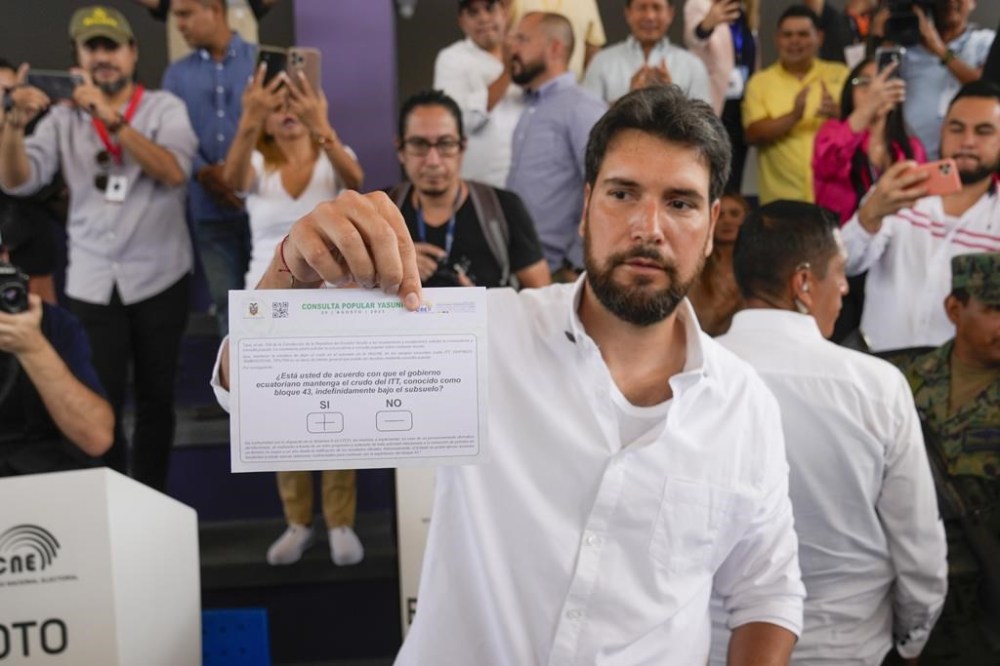
Presidential candidate Jan Topic, of the Country Without Fear Coalition, shows his ballot in a referendum on whether the country should ban oil operations in the Amazons during in a snap election in Guayaquil, Ecuador, Sunday, Aug. 20, 2023. In a historic decision, Ecuadorians voted on Sunday against the oil drilling of Yasuni National Park, which is a protected area in the Amazon that's home to two uncontacted tribes and serves as a biodiversity hotspot. (AP Photo/Martin Mejia, File)

“Ecuadorians have come together for this cause to provide a life opportunity for our Indigenous brothers and sisters and also to show the entire world, amidst these challenging times of climate change, that we stand in support of the rainforest,” Nemo Guiquita, a leader of the Waorani tribe, told The Associated Press in a phone interview.

The referendum is the result of a long and winding process. It started in 2007, when then-President Rafael Correa announced that Ecuador would refrain from oil exploration in Block 43 if rich nations compensated the poverty-stricken country. This was to be accomplished through establishment of a $3.6 billion fund, equal to 50% of the projected revenue from the block.

However, the fund drew in only a small fraction of the intended amount. As a result, in August 2013, Correa declared Ecuador’s intention to proceed with oil exploration in the block. In response, Indigenous and environmentalist movements initiated a campaign under the banner of the Yasunidos movement, seeking to amass signatures for the referendum. After almost one decade of legal battles and bureaucratic hurdles, the Supreme Court ruled in May that the measure must be incorporated into this year’s election.

The outcome represents a significant blow to Ecuadorian President Guillermo Lasso who advocated for oil drilling, asserting that its revenues are crucial to the country’s economy. State oil company Petroecuador, which currently produces almost 60,000 barrels a day in Yasuni, will be required to dismantle its operations in the coming months.

The South American country started exploring oil on a large scale in the Amazon in the 1970s when it became an Organization of the Petroleum Exporting Countries member —membership it withdrew in 2020. For decades, oil has been Ecuador’s main export. In 2022, it represented 35.5% of total exports, according to the country’s Central Bank. Block 43 alone contributes $1.2 billion annually to the federal budget.

In a statement Monday, Petroecuador said it would await the conclusion of the ballot counting before commenting on the referendum. The company added that it would comply with the decision of the Ecuadorian people.

The referendum applies only to Block 43. Within the Amazon region, oil production extends to other sections of Yasuni park and into Indigenous territories. Accidents are commonplace, mostly through oil spills into the rivers.

“It’s not that we’re going to feel relieved. We can breathe a moment of calm, we’re happy, but there are many more oil wells in Waorani territory causing harm,” says Indigenous leader Guiquita. “We hope that with this public consultation, there will be a path marked by the fact that the decision belongs to the people and that we can remove all those who are extracting oil and polluting our land.”
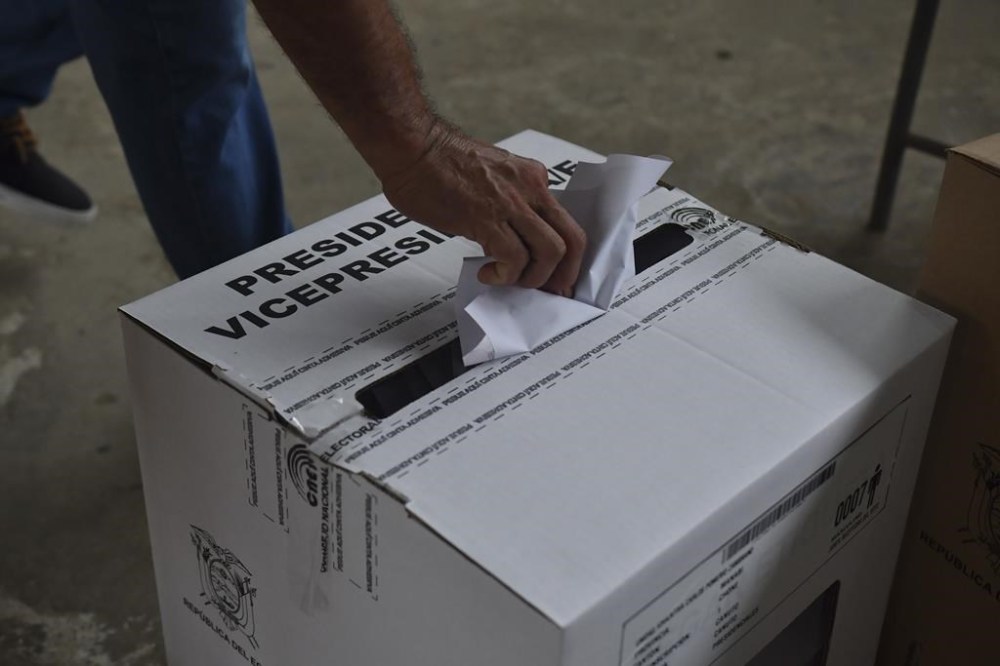
FILE - A voter casts his ballot in a snap election in Canuto, Ecuador, Sunday, Aug. 20, 2023. In a historic decision, Ecuadorians voted on Sunday against the oil drilling of Yasuni National Park, which is a protected area in the Amazon that's home to two uncontacted tribes and serves as a biodiversity hotspot. (AP Photo/Ariel Ochoa, File)

___

A previous version of this story was corrected to reflect the referendum was on oil exploration in Block 43, not 44.

___

Associated Press climate and environmental coverage receives support from several private foundations. See more about AP’s climate initiative here. The AP is solely responsible for all content.

Report Error Submit a Tip

More Stories

Green growth focus of hydroponic gathering

Aaron Epp 4 minute read Preview

Green growth focus of hydroponic gathering

Aaron Epp 4 minute read Yesterday at 8:00 PM CDT

In a town where fresh produce is hard to come by, Rick Barentsen has a line on some lettuce.

Barentsen is part of an initiative at an education centre in Leaf Rapids that grows 60 heads of fresh leafy greens each week, year-round, using indoor hydroponic growing systems.

The veggies are distributed to many of the northwestern Manitoba town’s 300 residents. It’s a boon to a community where Barentsen said the local grocery store has not carried fresh produce for the last six months.

“Being the only food grower in the community, it makes a big difference for the 90 families that we have,” he said. “We harvest it, we wrap it in plastic food bags (and) we hand it out the same day.”

Read
Yesterday at 8:00 PM CDT

Police on scene at Fairmont hotel construction site

1 minute read Updated: 12:19 AM CDT

At least three police cars were present at the under-construction Fairmont Winnipeg Thursday evening.

The nature of the response was unclear, but officers were guiding traffic outside of the construction zone at 2 Lombard Place while the response was underway. At 6:50 p.m., traffic was flowing normally.

Security on site provided no information on the response, but an individual working behind site fencing told the Free Press there’d be no comment from anyone on site as to why police were on scene at this time.

An SUV with a Government of Manitoba logo on its side was also present alongside personnel from Manitoba Workplace Safety and Health. However, it’s unknown if it’s connected to the police response.

Other cities build rapid transit, while we wait

Ken Klassen 4 minute read Preview

Other cities build rapid transit, while we wait

Ken Klassen 4 minute read 2:00 AM CDT

Winnipeg’s civic election campaign has produced no shortage of promises to improve transit safety and fix problems with the new network. Those issues are real and urgent. But they should not distract from a larger failure — while other Canadian urban regions secure billions in federal support to transform their transit systems, Winnipeg is falling further behind.

The Winnipeg Transit Master Plan, approved in 2021, sets the right vision — frequent, reliable service anchored by an expanded bus rapid transit (BRT) network. Yet not a single additional BRT corridor has been approved for construction. The modest network proposed in the plan is not projected to be completed until 2045 or beyond. Despite that, city council voted this summer to delay updating the master plan by two years.

The full BRT network was estimated at $588 million to $1.1 billion in 2020 — or roughly $720 million to $1.34 billion today, after accounting for construction inflation. That is substantial, but modest compared with what other cities are spending. Calgary, Edmonton, Hamilton, Ottawa and Quebec City have rapid transit projects under way or recently completed, totalling about $26 billion and backed by $7.3 billion in federal commitments. Vancouver, Toronto and Montreal are spending billions more with federal support.

Other cities build. Winnipeg waits.

Read
2:00 AM CDT

Letters, Oct. 8

6 minute read Preview

Letters, Oct. 8

6 minute read Yesterday at 2:01 AM CDT

Computer scientist Melvin Conway once stated, “Any organization that designs a system (defined broadly) will produce a design whose structure is a copy of the organization’s communication structure.”

Read
Yesterday at 2:01 AM CDT

‘Please excuse us from writing these notes …’

Editorial 4 minute read Preview

‘Please excuse us from writing these notes …’

Editorial 4 minute read 2:01 AM CDT

It’s a common-sense prescription for the health-care system. The only wonder is that it took so long to happen.

On Oct. 1, new provincial legislation came into effect that will stop employers from requiring employees to get a sick note from a physician unless the employee has been absent for more than a week or has called in sick 10 or more times in a calendar year.

And the legislation could have a big effect.

Doctors Manitoba has calculated that its members write over 600,000 sick notes every year — a process that costs the provincial health-care system approximately $8 million annually. And the effort doesn’t even help sick workers get better: one-third of sick notes are written for patients who don’t even have symptoms anymore, making them little more than a comfortable fiction. To put it simply, doctors have to trust that a symptom-less patient was sick and write a note saying they were ill, in order to satisfy an employer who doesn’t share that same level of trust.

Read
2:01 AM CDT

Manitoba worker dead after fall from roof

Matthew Frank 3 minute read Updated: Yesterday at 5:56 PM CDT

The province is investigating after a worker died on the job after falling off a roof last month.

The worker, who was employed by Winnipeg-based Pristine Roofing & Siding, was critically injured on Sept. 22 after falling from a roof during a residential re-roofing project in the Rural Municipality of St. Andrews, a provincial spokesperson said in an email.

The man later died.

The investigation is ongoing, and no other information will be provided, the spokesperson said Thursday.