

Mooving Moonshadow forward
While the number of dairy farms in Manitoba steadily declines, one second-generation family-run operation in the southeast continues to grow

Advertisement
Read this article for free:
or
Already have an account? Log in here »
To continue reading, please subscribe:
Monthly Digital Subscription
$0 for the first 4 weeks*
- Enjoy unlimited reading on winnipegfreepress.com
- Read the E-Edition, our digital replica newspaper
- Access News Break, our award-winning app
- Play interactive puzzles
*No charge for 4 weeks then price increases to the regular rate of $19.95 plus GST every four weeks. Offer available to new and qualified returning subscribers only. Cancel any time.
Monthly Digital Subscription
$4.99/week*
- Enjoy unlimited reading on winnipegfreepress.com
- Read the E-Edition, our digital replica newspaper
- Access News Break, our award-winning app
- Play interactive puzzles
*Billed as $19.95 plus GST every four weeks. Cancel any time.
To continue reading, please subscribe:
Add Free Press access to your Brandon Sun subscription for only an additional
$1 for the first 4 weeks*
*Your next subscription payment will increase by $1.00 and you will be charged $16.99 plus GST for four weeks. After four weeks, your payment will increase to $23.99 plus GST every four weeks.
Read unlimited articles for free today:
or
Already have an account? Log in here »
Hey there, time traveller!
This article was published 25/08/2023 (860 days ago), so information in it may no longer be current.
The calf barely had her eyes open.
She lay beside her mother, hair matted, as the elder licked her clean.
“That baby is probably about 10 minutes out,” Joshua Verhoog guessed, watching from behind a fence.
It’s not an uncommon sight for Verhoog. After all, calves are born two or three times a day at Moonshadow Holsteins.
Eventually, they join more than 1,000 cows producing milk at the rapidly expanding farm. The number of dairy farms continues to shrink, but some operations keep expanding — and Moonshadow Holsteins has no plans of slowing down.
“Growth has… always been a natural thing that’s happened around here.”–Joshua Verhoog
“Growth has… always been a natural thing that’s happened around here,” said Verhoog, the company president, while taking a walk around the site in St. Labre, located about 120 kilometres southeast of Winnipeg.
The company produces 2.6 per cent of Manitoba’s milk, about 30,000 litres shipped out daily.
Verhoog passed through barn after barn — this one for 880 cows resting between milking times, that one for heifers ready to give birth, another for calves.
“We’re working on buying… room to milk another 400 cows,” he explained. “That might be five or six years down the pipe.”
Verhoog crossed a road, his back to the new barns. He ventured towards the farmhouse his parents bought when they arrived in Manitoba 26 years ago.
Moonshadow Holsteins began in New Jersey in 1977. Teresa and Garry, Verhoog’s parents, started with 25 cows. They moved to New York and tripled their operation before hitting a roadblock: the United States had undertaken a national farm buyout program, looking to take billions of pounds of milk out of production to reduce a surplus.
It was the 1980s; the family decided to move north.
They started a small farm in Ontario with about 40 cows. After a decade, they decided to move to Manitoba.
“There was a little more opportunity out west — cheaper land, cheaper quotas,” said Verhoog, 40.
The 1,200 acre parcel they bought in St. Labre held 80 cows.
GABRIELLE PICHE / WINNIPEG FREE PRESS Moonshadow Holsteins has more than 1,000 milking cows spread over several barns.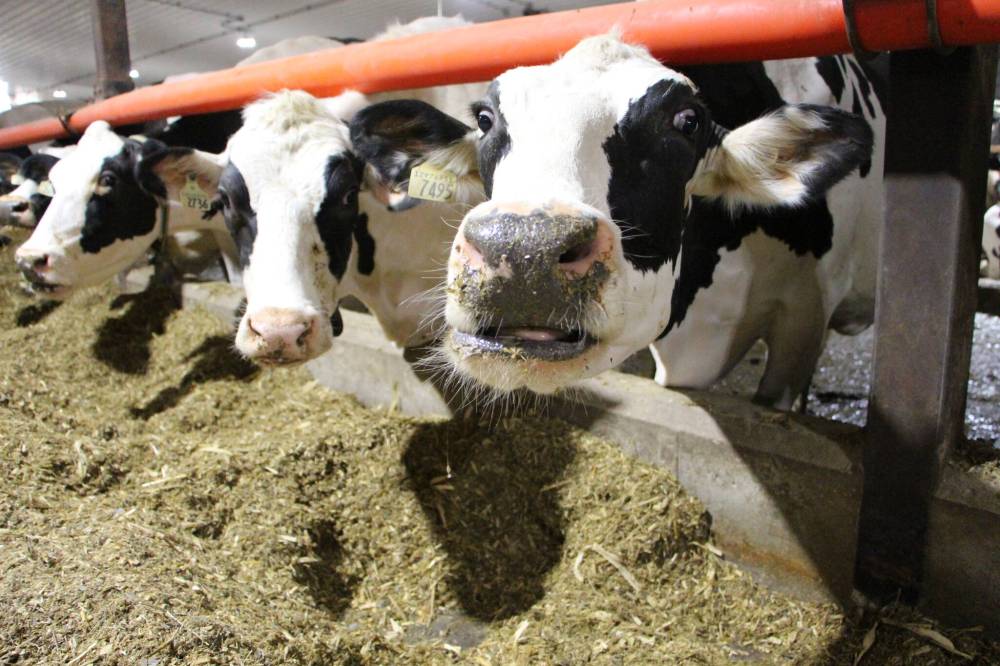
“My mom used to give them all names,” Verhoog said. “We just give them all numbers now…. We’ve basically kept growing since we started.”
The first year in Manitoba brought a farm expansion and 200 more cows. Verhoog left for university; when he returned, the farm had already grown to approximately 400 milking animals, he said.
His parents left for Ukraine about 14 years ago during the construction of a second large barn (leading to a capacity of 600 cows).
Garry and Teresa headed overseas and started a trade school teaching dairy farming in the now war-torn country. It left room for Verhoog’s brothers to join the family business; there are seven in total, all involved. Their sister teaches elementary school.
“We are a pretty large family,” Verhoog noted. “If you want to leave room for growth and families… either people need to find jobs somewhere else, or you need to (make) room.”
Moonshadow Holsteins has 40 employees, all local. The company accounts for most of St. Labre’s population.
The brothers bought the farm from their parents when it was valued at $7 million and could produce 400 kilograms of butterfat for sale daily, Verhoog said.
GABRIELLE PICHE / WINNIPEG FREE PRESS Joshua Verhoog with a group of calves at Moonshadow Holsteins. The calves, nearing adulthood, are still bottle fed.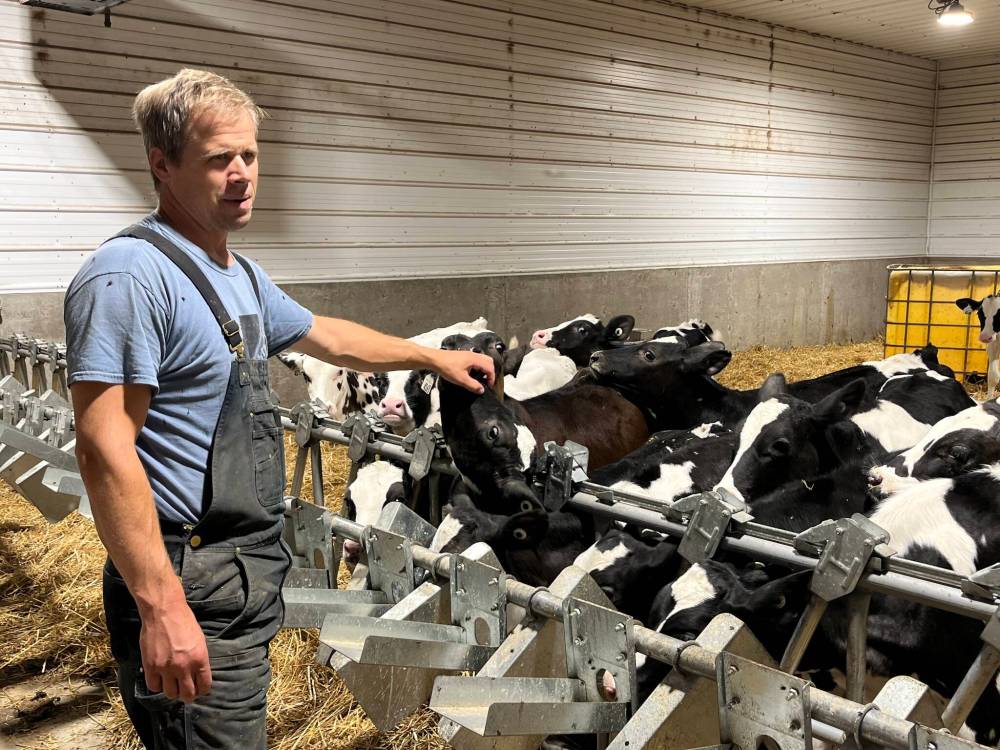
(Dairy farms produce milk based on butterfat quota. Their quota corresponds to how much milk they can sell. Farmers sell their quota when they’re downsizing or leaving the industry; other farms buy the quota in a blind bidding process. Dairy Farmers of Manitoba regulates the amount of quota available in the market based on consumer demand.)
Now, Moonshadow Holsteins has roughly 1,240 kilos of butterfat quota and a $60 million-value operation, Verhoog said.
It also has about $16 million of debt because of expansions, he added.
Adrien Grenier owned the farm and sold it to Verhoog’s parents; he helps at Moonshadow in his retirement.
“It’s the ability to repay the debt,” the veteran farmer said. “(You) don’t let that bother you.”
Manitoba dairy farms are disappearing every year, said Henry Holtmann, chair of the Dairy Farmers of Manitoba.
In 2018, there were 282 farms in the province. Last year, there were 243; this year its 240.
Meantime, the market for dairy milk grows about 1.5 per cent annually, Holtmann said.
“It is fewer farms producing more milk,” he said. “It really moves the lifestyle to (becoming) a prudent business owner and taking care of the needs of the cows, land and environment.”
The average farm produces 200 kilos of butterfat daily with 200 cows.
Holtmann predicts a future of fewer and larger dairy farms. Too few is “always a concern,” but shrinkage should plateau eventually, he said.
“A lot of times, the next generation doesn’t want… to have that lifestyle. The lifestyle of the farm, it’s a 365-day-a-year job.”–Henry Holtmann
“A lot of times, the next generation doesn’t want… to have that lifestyle,” Holtmann said. “The lifestyle of the farm, it’s a 365-day-a-year job.”
Canada’s 2021 census pegged the average Manitoba farmer at 54 years old.
Farming is increasingly expensive. It’s always been a low-margin business, but the input costs continue to rise, Holtmann said.
Verhoog paid 1.2 per cent interest on a portion of his debt two years ago; that rate is now 5.5 per cent.
“In this kind of business, you can’t really worry about those kinds of things,” Verhoog said. “We focus on doing the job as well as we can.”
He hopes Moonshadow Holsteins will command a herd of up to 2,000 dairy cows in 10 years time. The brothers are committed to the farm, he said.
Moonshadow’s president has at least 13 Verhoog children to think about, plus employees’ kids.
“I don’t know what they’ll end up doing,” he said with a shrug. “I had no plans on farming when I was growing up.”
For now, the youth spend their free time at the community gym. A Moonshadow Holsteins banner hangs from the ceiling; on the floor, a basketball shooting machine decked with Moonshadow Holsteins’ logos stands near red floor mats.
“The story goes, we lost too many basketball games, and we decided we had to have somewhere to practice,” Verhoog said, laughing while dribbling a ball.
In reality, the family considered the options their kids had for entertainment. There wasn’t much nearby.
“We (landed) on the idea of, ‘Well, why don’t we just build something ourselves?’” he said.
SUPPLIED Moonshadow Holsteins hopes to command a herd of up to 2,000 dairy cows in 10 years time.
Some $330,000 later, the 20-metre by 16-metre facility was up, attached to Moonshadow Holsteins’ shop and a quick drive from the company’s barns.
Anyone in the community is welcome, Verhoog said.
“I think that gym is used every day,” said Dale Edbom, a councillor in the Rural Municipality of Piney, in which Moonshadow Holsteins is located. “They go above and beyond, there’s no two ways about it.”
A few steps from the gym is an outdoor go-kart track used annually for charity races.
Further down the road, past the heifers and calves, Moonshadow Holsteins has erected attached houses for its staff. It helps with employee retention, Verhoog said.
“They’re very good for the community, and anything that you ask them for, they want to be involved,” Edbom said.
Further growth of the business would benefit the municipality, the politician added.
Half of Manitoba’s dairy farms use automated milking systems; cows step on machines at their leisure for milking. Moonshadow Holsteins isn’t yet an adopter.
“I like hiring people,” Verhoog said.
Like clockwork, groups of cows enter the St. Labre milking parlour. Staff attach units to each udder thrice daily.
Technology is integrated: machines milk cows and monitor the amount of milk flowing out to tanks. Each cow spends roughly three minutes a day with the milking unit on. More often, they’re found lazing on sand piles or eating feed.
Verhoog isn’t saying “never” to robots, he added. Technology helps.
“You can use the best genetics in the world,” he said, looking across a barn of milking cows.
GABRIELLE PICHE / WINNIPEG FREE PRESS Each cow gets milked three times daily in the parlour.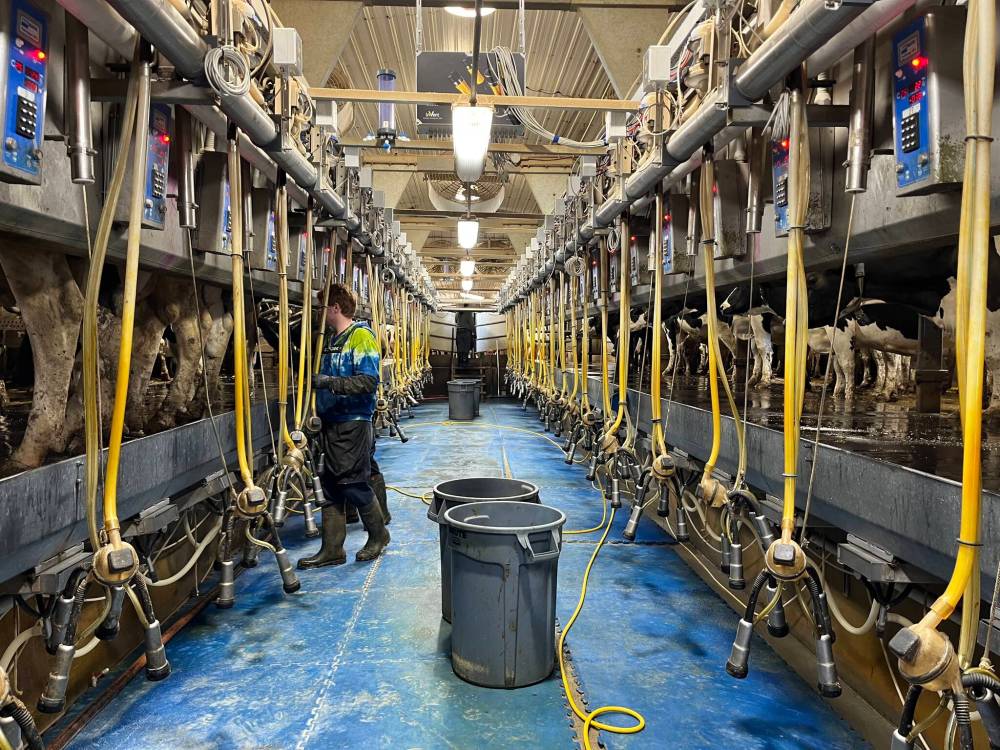
DNA is drawn from cattle while they’re young; it’s used to find the best mate for producing new calves. The females are, for the most part, artificially inseminated
Bessies wear neck collars tracking their movements and eating patterns. If something is wrong — perhaps a cow stops eating — staff spot the issue quickly.
Automated milking has likely extended the current generation’s interest in dairy farming, Holtmann suggested.
Retirees, including truck drivers, regularly get involved with Moonshadow Holsteins: several help during harvest with the 4,200 acres of corn and other crops the company grows for its cattle.
Feed mainly sprouts within an eight-kilometre radius of the barns. Having it nearby cuts back on greenhouse gas emissions in an industry regularly targeted for its economic footprint, Verhoog noted.
As long as farmers sell quota, Moonshadow Holsteins will keep buying, Verhoog said. Farmers don’t have a quota ceiling.
Oat milk, almond milk — competition will always be around, he said. However, the dairy industry contributes $16 billion annually to Canada’s gross domestic product. Last year in Manitoba, it was linked to 6,269 jobs and produced roughly 404 million litres of milk. Demand will likely continue as the country grows.
The family hosts an open farm day annually, hosting free tours and showcasing its milking process. This year, they’ve slotted the event for Sept. 10 from 10 a.m. to 4 p.m.
Regular visitors, such as Edbom, keep coming back to a bigger farm.
gabrielle.piche@winnipegfreepress.com
Gabrielle Piché reports on business for the Free Press. She interned at the Free Press and worked for its sister outlet, Canstar Community News, before entering the business beat in 2021. Read more about Gabrielle.
Every piece of reporting Gabrielle produces is reviewed by an editing team before it is posted online or published in print — part of the Free Press‘s tradition, since 1872, of producing reliable independent journalism. Read more about Free Press’s history and mandate, and learn how our newsroom operates.
Our newsroom depends on a growing audience of readers to power our journalism. If you are not a paid reader, please consider becoming a subscriber.
Our newsroom depends on its audience of readers to power our journalism. Thank you for your support.
Gabrielle Piché reports on business for the Free Press. She interned at the Free Press and worked for its sister outlet, Canstar Community News, before entering the business beat in 2021. Read more about Gabrielle.
Every piece of reporting Gabrielle produces is reviewed by an editing team before it is posted online or published in print — part of the Free Press‘s tradition, since 1872, of producing reliable independent journalism. Read more about Free Press’s history and mandate, and learn how our newsroom operates.
Our newsroom depends on a growing audience of readers to power our journalism. If you are not a paid reader, please consider becoming a subscriber.
Our newsroom depends on its audience of readers to power our journalism. Thank you for your support.
Advertisement Advertise With Us
Advertisement Advertise With Us
History
Updated on Monday, August 28, 2023 9:21 AM CDT: Removes reference to bulls