FBI and European partners seize major malware network in blow to global cybercrime

Advertisement

Advertise with us

LOS ANGELES (AP) — U.S. officials said Tuesday that the FBI and its European partners infiltrated and seized control of a major global malware network used for more than 15 years to commit a gamut of online crimes including crippling ransomware attacks.

Read this article for free:


or

Already have an account? Log in here »

To continue reading, please subscribe:

Subscribe and receive a limited-edition Free Press branded hat or tote.

Digital Subscription

One year of digital access for only $205*

  • Enjoy unlimited reading on winnipegfreepress.com
  • Read the E-Edition, our digital replica newspaper
  • Access News Break, our award-winning app
  • Play interactive puzzles

*First annual payment billed as $205.00 + GST for one year. This annual subscription will automatically renew at $233.00 + GST every 52 weeks (10% off the regular annual price of $259.35). Offer available to new and qualified returning subscribers only. Cancel any time.

To continue reading, please subscribe:

Add Free Press access to your Brandon Sun subscription for only an additional

$1 for the first 4 weeks*

  • Enjoy unlimited reading on winnipegfreepress.com
  • Read the E-Edition, our digital replica newspaper
  • Access News Break, our award-winning app
  • Play interactive puzzles
Start now

*Your next Brandon Sun subscription payment will increase by $1.00 and you will be charged $17.95 plus GST for four weeks. After four weeks, your payment will increase to $24.95 plus GST every four weeks.

Hey there, time traveller!
This article was published 29/08/2023 (1138 days ago), so information in it may no longer be current.

LOS ANGELES (AP) — U.S. officials said Tuesday that the FBI and its European partners infiltrated and seized control of a major global malware network used for more than 15 years to commit a gamut of online crimes including crippling ransomware attacks.

They then remotely removed the malicious software agent — known as Qakbot — from thousands of infected computers.

Cybersecurity experts said they were impressed by the deft dismantling of the network but cautioned that any setback to cybercrime would likely be temporary.

U.S. Attorney Martin Estrada, left, and FBI Asst. Director in Charge Don Alway announce in Los Angeles on Tuesday, Aug. 29, 2023 the multinational take down operation of Qakbot malware which infected more than 700,000 computers including LAUSD and San Bernardino County Sheriff Department computer systems. (Sarah Reingewirtz/The Orange County Register via AP)

“Nearly ever sector of the economy has been victimized by Qakbot,” Martin Estrada, the U.S. attorney in Los Angeles, said Tuesday in announcing the takedown. He said the criminal network had facilitated about 40 ransomware attacks alone over 18 months that investigators said netted Qakbot administrators about $58 million.

Qakbot’s ransomware victims included an Illinois-based engineering firm, financial services organizations in Alabama and Kansas, along with a Maryland defense manufacturer and a Southern California food distribution company, Estrada said.

Officials said $8.6 million in cybercurrency was seized or frozen but no arrests were announced.

Estrada said the investigation is ongoing. He would not say where administrators of the malware, which marshaled infected machines into a botnet of zombie computers, were located. Cybersecurity researchers say they are believed to be in Russia and/or other former Soviet states.

Officials estimated the so-called malware loader, a digital Swiss knife for cybercrooks also known as Pinkslipbot and Qbot, was leveraged to cause hundreds of millions of dollars in damage since first appearing in 2008 as an information-stealing bank trojan. They said millions of people in nearly every country in the world have been affected.

Typically delivered via phishing email infections, Qakbot gave criminal hackers initial access to violated computers. They could then deploy additional payloads including ransomware, steal sensitive information or gather intelligence on victims to facilitate financial fraud and crimes such as tech support and romance scams.

The Qakbot network was “literally feeding the global cybercrime supply chain,” said Donald Alway, assistant director in charge of the FBI’s Los Angeles office, calling it “one of the most devastating cybercriminal tools in history.” The most commonly detected malware in the first half of 2023, Qakbot impacted one in 10 corporate networks and accounted for about 30% of attacks globally, a pair of cybersecurity firms found. Such “initial access” tools allow extortionist ransomware gangs to skip the initial step of penetrating computer networks, making them major facilitators for the far-flung, mostly Russian-speaking criminals who have wreaked havoc by stealing data and disrupting schools, hospitals, local governments and businesses worldwide.

Beginning Friday in an operation officials dubbed “Duck Hunt,” the FBI along with Europol and law enforcement and justice partners in France, the United Kingdom, Germany, the Netherlands, Romania and Latvia seized more than 50 Qakbot servers and identified more than 700,000 infected computers, more than 200,000 of them in the U.S. — effectively cutting off criminals from their quarry.

The FBI then used the seized Qakbot infrastructure to remotely dispatch updates that deleted the malware from thousands of infected computers. A senior FBI official, briefing reporters on condition he not be further identified, called that number “fluid” and cautioned that other malware may have remained on machines liberated from Qakbot.
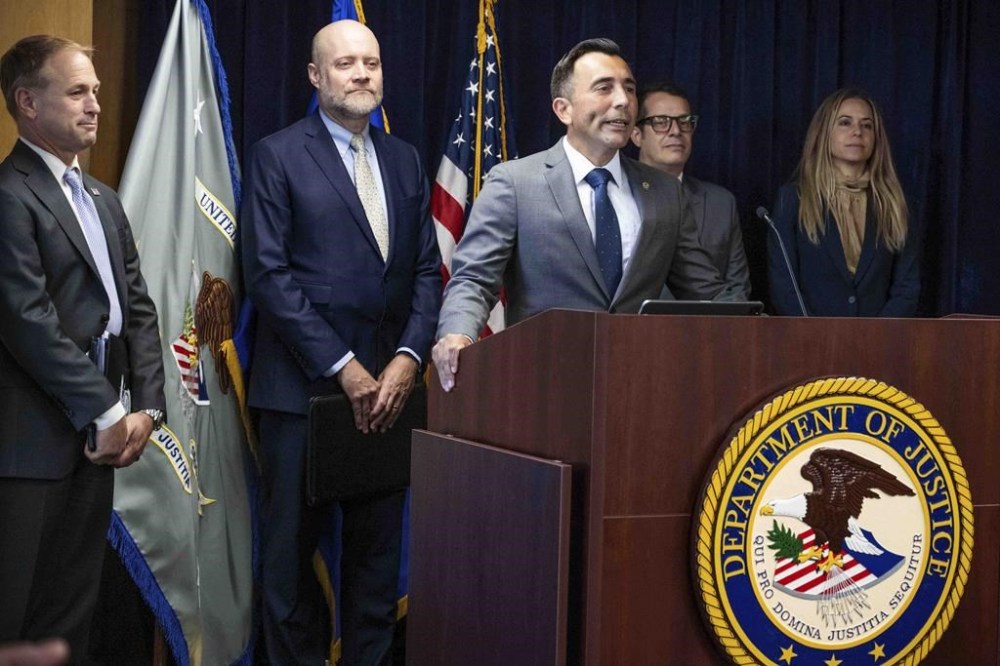
U.S. Attorney Martin Estrada announces in Los Angeles on Tuesday, Aug. 29, 2023 the multinational take down operation of Qakbot malware which infected more than 700,000 computers including LAUSD and San Bernardino County Sheriff Department computer systems. (Sarah Reingewirtz/The Orange County Register via AP)

It was the FBI’s biggest success against cybercrooks since it “hacked the hackers” with the January takedown of the prolific Hive ransomware gang.

“It is an impressive takedown. Qakbot was the largest botnet” in number of victims, said Alex Holden, founder of Milwaukee-based Hold Security. But he said it may have been a casualty of its own success in its staggering growth over the past few years. “Large botnets today tend to implode as too many threat actors are mining this data for various types of abuse.”

Cybersecurity expert Chester Wisniewski at Sophos agreed that while there could be a temporary drop in ransomware attacks, the criminals can be expected to either revive infrastructure elsewhere or move to other botnets.

“This will cause a lot of disruption to some gangs in the short term, but it will do nothing from it being rebooted,” he said. “Albeit it takes a long time to recruit 700,000 PCs.”

___

Bajak reported from Boston.
Report Error Submit a Tip

More Stories

A dozen straight titles for Indigenous trainers at Downs

GEORGE WILLIAMS 6 minute read Preview

A dozen straight titles for Indigenous trainers at Downs

GEORGE WILLIAMS 6 minute read Yesterday at 9:49 PM CDT

THAT’S a wrap!

The 69th season of live racing at Assiniboia Downs came to a close on Wednesday and for the 12th consecutive year the training title was won by an Indigenous horseman.

Trainer Jerry Gourneau of the Turtle Mountain Band of Chippewa in North Dakota won his sixth trainer title at the Downs with a record of 54-45-43 from 280 starts and purse earnings of US$559,191.

And for the eighth straight year, Gourneau’s main owner, former champion race car driver Henry S. Witt, Jr. won the owner title at the Downs. He compiled a record of 46-41-40 from 242 starts and purse earnings of US$535,983.

Read
Yesterday at 9:49 PM CDT

Manitoba worker dead after fall from roof

Matthew Frank 3 minute read Thursday, Oct. 8, 2026

The province is investigating after a worker died on the job after falling off a roof last month.

The worker, who was employed by Winnipeg-based Pristine Roofing & Siding, was critically injured on Sept. 22 after falling from a roof during a residential re-roofing project in the Rural Municipality of St. Andrews, a provincial spokesperson said in an email.

The man later died.

The investigation is ongoing, and no other information will be provided, the spokesperson said Thursday.

Crime spree lands accused murderers behind bars

Dean Pritchard 4 minute read Preview

Crime spree lands accused murderers behind bars

Dean Pritchard 4 minute read Yesterday at 6:00 AM CDT

Three men have been sentenced to jail terms for a commercial robbery spree in southern Manitoba launched just two weeks after they are accused of killing a 19-year-old man in Abbotsford, B.C.

Twenty-two-year-old Ravdeep Gill of Winnipeg, pleaded guilty Monday to four counts of robbery and Harmandeep Gill, 27, of Brampton, Ont. and Jaskaran Singh, 21, of Surrey, B.C., each pleaded guilty to two counts of robbery for a 10-day crime blitz that targeted gas bars in Swan Lake, Teulon and St. Laurent, and a meat shop in Winnipeg.

Ravdeep Gill was sentenced to four years custody while Harmandeep Gill and Singh each received sentences of 30 months.

According to B.C. media reports, all three men are charged with first-degree murder in a Feb. 1, 2025 killing in Abbotsford that police there described as a targeted hit.

Read
Yesterday at 6:00 AM CDT

Dozens of Uber, Lyft drivers switched to cheaper insurance coverage: MPI probe

Erik Pindera 5 minute read Preview

Dozens of Uber, Lyft drivers switched to cheaper insurance coverage: MPI probe

Erik Pindera 5 minute read Thursday, Oct. 8, 2026

Ride-service drivers have been defrauding Manitoba Public Insurance by improperly insuring their vehicles as for personal use.

The public insurer and the City of Winnipeg, which regulates ride-hailing services like Uber and Lyft, discovered the widespread fraud after MPI conducted a review in December last year.

“When a driver changes their coverage from ride-share insurance to a personal vehicle coverage and continues to operate as a ride-share driver, that is fraud, plain and simple,” said MPI chief executive officer Satvir Jatana at a news conference Thursday.

MPI’s review looked at a random sample of 408 ride-hailing vehicles and found 108 were operating without the proper vehicle-for-hire insurance coverage. In order to register with the city as a ride-service driver, a vehicle must have such insurance and proof must be provided to the ride-booking company.

Read
Thursday, Oct. 8, 2026

Chopped trees will leave a ‘blight’ on Windsor Park

Kelly-Anne Riess 3 minute read Preview

Chopped trees will leave a ‘blight’ on Windsor Park

Kelly-Anne Riess 3 minute read Yesterday at 8:04 PM CDT

Robert Gordon has watched the trees grow along a popular Windsor Park walking path for nearly six decades.

Now, as Manitoba Hydro cuts them down to protect nearby power lines, he says a familiar part of his childhood neighbourhood is disappearing.

Although he no longer lives in the area, Gordon regularly returns to walk or cycle along the tree-lined path, which runs parallel to Archibald Street.

He was concerned when he recently spotted crews clearing vegetation near the entrance to the path, but initially assumed they were removing brush. When he returned, he discovered the clearing had extended farther along the corridor.

Read
Yesterday at 8:04 PM CDT

Powerful allegory, magic wonder as ballet takes on Stravinsky

Holly Harris 5 minute read Preview

Powerful allegory, magic wonder as ballet takes on Stravinsky

Holly Harris 5 minute read Yesterday at 6:50 PM CDT

The Royal Winnipeg Ballet opened its mainstage season with fire and ice Thursday, as it paid homage to Russian composer Igor Stravinsky with Stravinsky Stories.

Local balletomanes may remember Alexei Ratmansky as a principal dancer during the early 1990s. The internationally renowned dance artist returns in a full-circle moment to stage The Fairy’s Kiss, the 50-minute work his first collaboration with the RWB in more than 30 years. He began flexing his choreographic muscles in its downtown studios with an earlier, reimagined incarnation in 1994, based on Hans Christian Andersen’s fairy tale The Ice Maiden, in turn set to Stravinsky’s own tribute to Tchaikovsky’s lushly romantic ballet scores.

Its narrative follows the journey of a Young Man (newly minted principal dancer Skylar Campbell, with all leads alternating) saved — and kissed — by a Fairy (principal dancer Elizabeth Lamont, who rips off a dizzying set of “fouettes”) after his Mother (former principal dancer Vanessa Léonard adding her own gravitas) perishes in a blizzard.

After falling in love with his fiancée (principal dancer Alanna McAdie, infusing her character with innocent youthfulness grounded by intricate footwork), he is tricked on his wedding day by the now disguised Fairy who reveals her true identity — and his ultimate destiny.

Read
Yesterday at 6:50 PM CDT