Founding father Gen. Anthony Wayne’s legacy is getting a second look at Ohio’s Wayne National Forest

Advertisement

Advertise with us

NELSONVILLE, Ohio (AP) — Some 40 Native American tribes have ancestral ties to Wayne National Forest, a quarter-million acres spread across portions of Appalachian southeastern Ohio. Their citizens have never stopped helping the U.S. Forest Service manage this expanse of forested hills, hollows, streams and lakes — even as the name recalls a violent past.

Read this article for free:


or

Already have an account? Log in here »

To continue reading, please subscribe:

Subscribe and receive a limited-edition Free Press branded hat or tote.

Digital Subscription

One year of digital access for only $205*

  • Enjoy unlimited reading on winnipegfreepress.com
  • Read the E-Edition, our digital replica newspaper
  • Access News Break, our award-winning app
  • Play interactive puzzles

*First annual payment billed as $205.00 + GST for one year. This annual subscription will automatically renew at $233.00 + GST every 52 weeks (10% off the regular annual price of $259.35). Offer available to new and qualified returning subscribers only. Cancel any time.

To continue reading, please subscribe:

Add Free Press access to your Brandon Sun subscription for only an additional

$1 for the first 4 weeks*

  • Enjoy unlimited reading on winnipegfreepress.com
  • Read the E-Edition, our digital replica newspaper
  • Access News Break, our award-winning app
  • Play interactive puzzles
Start now

*Your next Brandon Sun subscription payment will increase by $1.00 and you will be charged $17.95 plus GST for four weeks. After four weeks, your payment will increase to $24.95 plus GST every four weeks.

Hey there, time traveller!
This article was published 02/09/2023 (1106 days ago), so information in it may no longer be current.

NELSONVILLE, Ohio (AP) — Some 40 Native American tribes have ancestral ties to Wayne National Forest, a quarter-million acres spread across portions of Appalachian southeastern Ohio. Their citizens have never stopped helping the U.S. Forest Service manage this expanse of forested hills, hollows, streams and lakes — even as the name recalls a violent past.

Now, a vigorous debate is underway over a Forest Service proposal to replace the name of Gen. Anthony Wayne, a founding father who Americans of an earlier era celebrated as an “Indian fighter,” with something more neutral: Buckeye National Forest, after the state tree.

Forest Manager Lee Stewart said tribes had been asking for a name change for decades, but their request was formalized last year as part of a sweeping review of derogatory place names undertaken by the Biden administration.
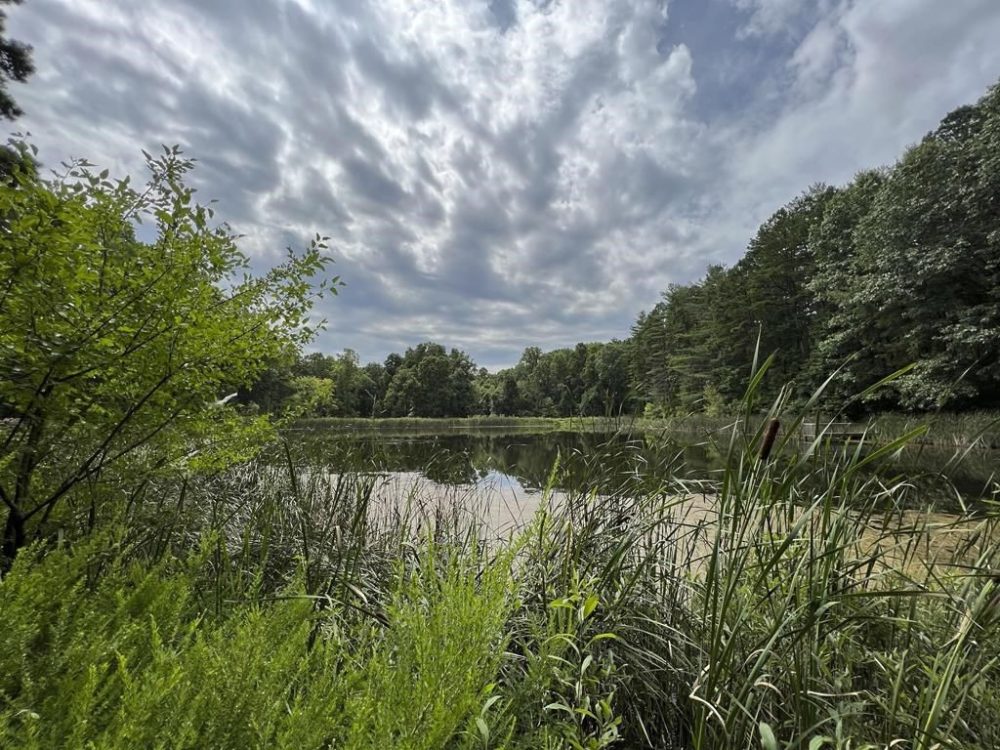
Utah Ridge Pond is seen inside Wayne National Forest in Millfield, Ohio on Tuesday, Aug. 29, 2023. A vigorous debate is under way over a U.S. Forest Service proposal to rename the 250,000-acre Wayne National Forest after Ohio's state tree, the buckeye. (AP Photo/Patrick Orsagos)

Since 2021, the names of about 650 places and geographic features across the country have been renamed, with involvement by the same federal board that in earlier eras helped get rid of the N-word and a pejorative word for Japanese.

“In thinking of the offensive nature (of the name) to tribes, it’s the opportunity to begin to heal, to begin to connect our forest deeper than just around a name,” Stewart said. “Ohio has thousands of years of history. The history here is very, very deep — pre-history to historic times, where Wayne occupies his space, to the history once we became a state. So Buckeye, we feel, reflects that.”

The public comment period ends Monday, with U.S. Agriculture Secretary Tom Vilsack to receive the feedback and make a final decision. It would be the first national forest renaming since 2007.

Proponents see the name change as an act of respect for Indigenous people whose ancestors lived on the land and whose citizens continue to offer their skill and expertise to stewardship of the land, some through treaties with the U.S. government.

The forest’s 381 square miles (987 square kilometers) are used for timber and other natural resources, in addition to featuring campgrounds, a horseback riding network and off-highway vehicle trails.

Before a federal government purchase in 1934, the land was dug, blasted and mined for coal. It was 1951 when the forest was named for Wayne, a Revolutionary War leader whose legacy has been revisited during the nation’s recent racial reckoning.

Wayne commanded Army forces during the Northwest Indian War, a confrontation on the American frontier that ended with the Battle of Fallen Timbers, a key victory over confederated Native forces that allied with the British. The resulting truce, the Treaty of Greenville, largely ceded Native rights to most of the territory that became the future state of Ohio, a result some these days see as “ethnic cleansing.”

Logan York, a representative of the Miami Tribe of Oklahoma, said in a statement that Anthony Wayne’s actions “ultimately led to the forced removal at gunpoint of our Miami ancestors from our homelands in 1846.”

“Wayne may be a Revolutionary War hero to some, but he is also the main villain in our story of resistance, trying to keep our homes and maintain our lives,” said Logan, the tribal historic preservation officer. “For a National Forest to bear the name of Anthony Wayne is a harmful, and painful reminder and devalues us as Native peoples of Ohio.”

Opposition to the proposed name change, which has an estimated $400,000 price tag, also is vigorous.

Donald Schultz, 89, who has lived in proximity to the forest all his life, dropped by Wayne headquarters this week to register his objections.

“I am concerned about changing the name of everything, just history,” he said. “We need to keep the history this country had. We don’t need to change the names of all the history.”

Schultz said he recognizes the U.S. government “treated the people horribly that were here, but by the same token, those same people treated the people that were coming here horribly.”

“This was border warfare. It was ugly on all sides,” said Toledo-based historian Mary Stockwell, author of “Unlikely General: ‘Mad’ Anthony Wayne and the Battle for America” and a book about the removal of Native Americans from Ohio.

Stockwell opposes removing Wayne’s name from the forest. She believes he has been miscast by history as the “mad” general, when he actually viewed it as his “great misfortune” that President George Washington chose him “to come out to Ohio in 1791, raise an army and face the British-Indian coalition that was stopping the advance of the U.S. across the Ohio River.”

“You take down all the statues and rename everything, that’s not going to change our turbulent, creative, wonderful and often difficult past,” she said. “We’ve got to tell everybody’s story.”

Stewart said the Forest Service appreciates Wayne’s significant legacy, which included building the fort at Fort Wayne, Indiana, and inspiring the screen name of Hollywood icon John Wayne.

“We get it,” he said. “This isn’t about erasing Wayne out of history, it’s about reconciliation. To make (the tribes) say ‘Wayne’ every time they engage, it’s difficult.”

It’s appropriate for societal viewpoints to evolve, York said.

“As we look back on history, today we all have increased knowledge that leads to greater understanding, and an excellent way to reflect that is not to forget the past but to change as we change as a people,” he said in the tribal statement.

“Wayne might have been a hero to some but not to all, and National Forests are for everyone to enjoy equally, and the name should reflect that,” York said.

Report Error Submit a Tip

More Stories

Chrétien says Canada bows to no one in fiery address at 9/11 commemoration

Sarah Smellie, The Canadian Press 6 minute read Preview

Chrétien says Canada bows to no one in fiery address at 9/11 commemoration

Sarah Smellie, The Canadian Press 6 minute read Updated: Yesterday at 8:15 PM CDT

GANDER - Former prime minister Jean Chrétien drew a standing ovation inside a Gander, N.L., hockey arena on Friday as he delivered a pointed message to American leaders during a ceremony marking the 9/11 terrorist attacks in the United States, 25 years ago.

The 92-year-old warned Americans never to mistake Canadian generosity for weakness, nor its kindness for softness.

U.S. Ambassador Pete Hoekstra looked on as Chrétien insisted his pointed words were a sign of friendship. Friends tell each other the truth, he said.

“We embraced our friends and we helped them in their moment of need, but we bow to no one,” Chretien said, as the crowd erupted again.

Read
Updated: Yesterday at 8:15 PM CDT

Lone Manitoba 9/11 victim's legacy lives on helping Inuit students become nurses

Melissa Martin 13 minute read Preview

Lone Manitoba 9/11 victim's legacy lives on helping Inuit students become nurses

Melissa Martin 13 minute read Thursday, Sep. 10, 2026

On the night before the morning that everyone remembers, Ellen Judd spoke to her partner, Christine Egan, several times on the phone. Egan was in New York, where she’d gone to look after her nephews so her beloved brother, Michael, and his wife, Anna, could treat themselves to an anniversary vacation.

Usually, Judd would have been there, too. The couple had been together for more than 15 years, and loved sharing all the good parts of life. But at the time, she was an anthropology professor at the University of Manitoba, and the school year was just starting; she had classes the next day. Staying connected by phone would have to suffice.

In their calls that night, Judd remembers, Egan was happy. Christmas was the main topic. They were planning to spend the holiday with Judd’s family in Ontario, and talked about when to book flights. Egan was looking forward to that visit; Judd’s family “loved her to bits,” the now-retired professor says, and the affection was mutual.

The next day, Egan said, she planned to go into Manhattan with Michael. He was an executive at Aon, a global risk, retirement and health services corporation, and had an office on the 105th floor of the World Trade Centre’s South Tower.

Read
Thursday, Sep. 10, 2026

Nifty neighbours also jonesing for geniality

Maureen Scurfield 4 minute read 2:01 AM CDT

DEAR MISS LONELYHEARTS: Recently, a new couple with no children moved onto our cul de sac, and everybody is taking notice! This attractive pair with no kids both drive amazing cars, work from home and leave their garage doors up a lot. Everybody on the street walks by to sneak a peek into the big garage at just about any time of day.

Lately, the man’s been out on his front lawn in a muscle shirt in the late afternoon, planting shrubs and putting up stylish fall-themed ornaments. At night they often leave the living-room curtains open. That makes for convenient viewing for curious neighbours like us!

A few days ago, my wife invited the new couple over for a barbecue and swim in our pool. They are really nice people, but mentioned that other people nearby have been pretty stand-offish. They wonder why. Should I tell them it’s probably just jealousy over their beautiful vehicles and enviable lifestyle, or should I just shut up?

—Wanting to Help, Sage Creek

Highway-safety upgrades in progress after tragic Interlake crash

Chris Kitching 5 minute read Preview

Highway-safety upgrades in progress after tragic Interlake crash

Chris Kitching 5 minute read Updated: Yesterday at 6:25 PM CDT

Provincial workers have started to update or install safety measures at a rural Interlake intersection where four teenage friends died in a crash on Labour Day weekend.

Pavement markings were repainted at Highway 8 and Provincial Road 229, just west of Winnipeg Beach, ahead of work to refresh worn-down rumble strips, starting Monday, and install flashing lights atop two stop signs, following an assessment earlier this week.

“They will also need to incorporate any information from the RCMP report that might be helpful if we were to consider any additional safety measures at this intersection,” Transportation and Infrastructure Minister Lisa Naylor said of department staff.

“The most important thing is safety, and any kinds of changes we make at any intersection actually have to make it safer.”

Read
Updated: Yesterday at 6:25 PM CDT

City rapped for taking five days to remove animal carcass

Morgan Modjeski 2 minute read Thursday, Sep. 10, 2026

A Winnipeg resident said she’s upset it took the city five days to retrieve a dead fawn from her yard after she reported it to 311.

Amy Gelhorn said she and her family noticed the animal carcass in her garden on Saturday. She called 311 and was told it would be picked up after the long weekend.

“It was removed this afternoon,” the north River Heights resident said Thursday. “So it took six days to remove it and we had to basically phone every day.”

She said neighbours on both sides of her house told her they saw the animal acting strangely on Friday and reported their concerns to 311. It’s believed the animal died overnight. As the days dragged on, the body continued to rot.

9 to 5:

Tory McNally 8 minute read Preview

9 to 5:

Tory McNally 8 minute read 2:00 AM CDT

I watched the 1980 comedy 9 to 5 for the first time this week.

I know: I’m an HR consultant. I’ve been doing this work for 13 years, I write about workplaces for a living, and somehow I had never actually watched the movie that gave us one of the most recognizable workplace songs of all time.

I knew the premise, of course. I knew American music icon Dolly Parton was in it. I knew there was a terrible boss and three women who eventually decided they had enough.

I expected a funny, somewhat dated movie about three women getting revenge on an awful boss. What I didn’t expect was to spend the next two hours thinking about how much has changed in the workplace since 1980 — and how much really hasn’t.

Read
2:00 AM CDT