

Flag football at the Olympics? Stop chuckling, it might happen
Advertisement
Read this article for free:
or
Already have an account? Log in here »
To continue reading, please subscribe:

Digital Subscription
One year of digital access for only $205*
- Enjoy unlimited reading on winnipegfreepress.com
- Read the E-Edition, our digital replica newspaper
- Access News Break, our award-winning app
- Play interactive puzzles
*First annual payment billed as $205.00 + GST for one year. This annual subscription will automatically renew at $233.00 + GST every 52 weeks (10% off the regular annual price of $259.35). Offer available to new and qualified returning subscribers only. Cancel any time.
To continue reading, please subscribe:
Add Free Press access to your Brandon Sun subscription for only an additional
$1 for the first 4 weeks*
- Enjoy unlimited reading on winnipegfreepress.com
- Read the E-Edition, our digital replica newspaper
- Access News Break, our award-winning app
- Play interactive puzzles
*Your next Brandon Sun subscription payment will increase by $1.00 and you will be charged $17.95 plus GST for four weeks. After four weeks, your payment will increase to $24.95 plus GST every four weeks.
Read unlimited articles for free today:
or
Already have an account? Log in here »
Hey there, time traveller!
This article was published 15/09/2023 (1105 days ago), so information in it may no longer be current.
Flag football at the Olympics?
Admit it: You chuckled a bit at the thought.
Well, hold the laughter. This apparently is a serious thing, though it’s increasingly difficult to keep a straight face with anything involving the International Olympic Committee.
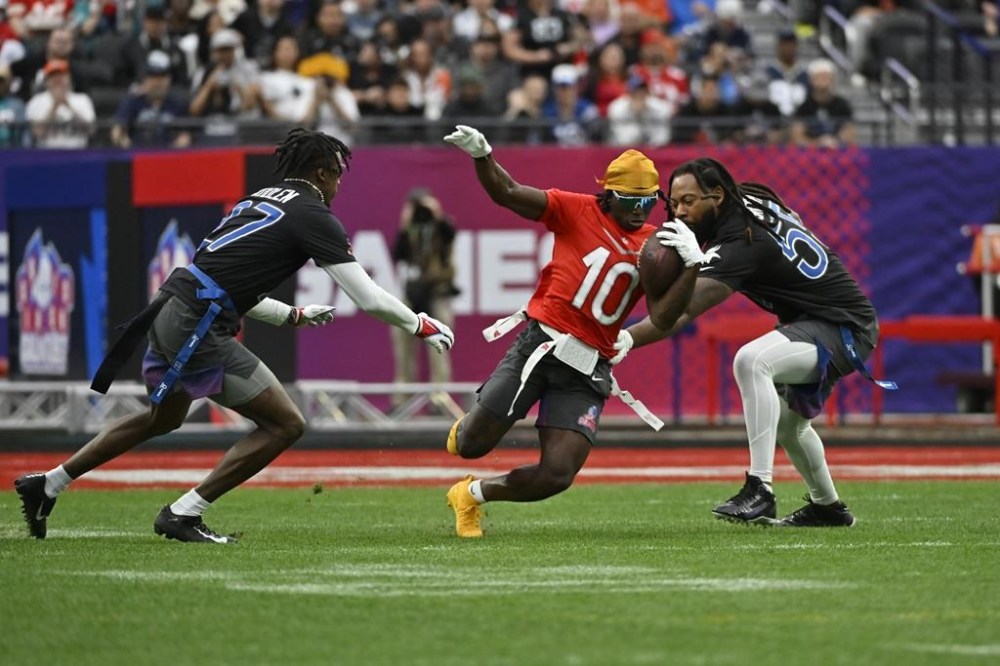
The suits who allowed 3-on-3 basketball — also known as pickup games at the local Y — into their grandiose spectacle and went along with the idea of handing out gold medals next summer for breakdancing are trying to lock down which new sports make the cut for the 2028 Los Angeles Games.
Nine are under consideration, but the most eye-catching is the flagged, noncontact version of the game that dominates the American sporting landscape but is barely a blip to the rest of the world.
Not surprisingly, the NFL is a big part of the push to make flag football an Olympic sport — at least for a one-off in Los Angeles — because it’s a way for the world’s richest league to generate potentially even more revenue.
The NFL already plays regular-season games in Europe and is staking out territories of influence around the globe, all in a bid to expand the fan base beyond its traditional borders.
Now it’s pushing for football in the Olympics, even if means using a version where tackles are made by grabbing a strip of cloth. The sport has grown significantly across the U.S., especially at the youth and high school levels where it provides equal opportunities for both males and females to play our true national pastime — without turning one’s brain to mush.
Then again, the Summer Games are supposed to be for the best athletes in sports that are popular across a wide range of nations, a standard that flag football doesn’t come close to meeting.
In every country other than the United States (and maybe throw in Canada, too), American-style football is nothing more than a niche sport, no matter what version is being played.
And, sure, there are plenty of highly skilled flag players taking part in international competitions, but it’s not like anyone is mistaking them for Patrick Mahomes or Joe Burrow.
Then again, the Olympics already includes racewalking, which we can only presume was conceived by those who weren’t fast enough in track.
For the 2028 Games, flag football is being considered as a discretionary sport along with lacrosse, squash, cricket, baseball-softball, karate, kickboxing and motorsports, as well as breakdancing, which hopes to remain in the Olympics after making its debut in Paris.
A decision on which sports get in was supposed to be finalized last week. Instead, the vote was put off as the IOC and Los Angeles organizers try to hammer out an agreement on what to include in an already bloated program.
In the meantime, those who compete for the U.S. national flag football teams are awaiting word on whether they have a shot at being actual Olympians in less than five years’ time.
“I grew up watching the Olympics, all the athletes on the U.S. teams and even the athletes from other countries,” said Housh Doucette, a 34-year-old New Orleans native and charismatic leader of the men’s squad. “If others are able to watch me and some of my teammates go out and compete in the Olympics, that would be just amazing.”
Madison Fulford, a former college track athlete who is now a 28-year-old rookie on the women’s national team, was asked how she responds to those who say flag football has no business in the Olympics.
“Hmm,” she said, pausing for the right words. “I can respond to that in two different ways. One way would be: go out on the field and try to guard me. My second response I would put out there is: give it a chance. Take a good look at the games. Watch the clips that people have out there, the athleticism is takes to do a lot of this stuff. Our sport is a fantastic sport that requires a lot of skill.”
No argument there. These men and women are very good at what they do, and their sport — with all its trickery and speed and none of the bone-crushing, head-jarring violence of the real thing — certainly has its appeal.
But is it Olympic-worthy?
That seems like a stretch, especially since many consider flag football nothing more than a watered-down version of a violent game that parents let kids play growing up so they don’t get hurt, or maybe one that’s goofed around with on the intramural fields at college.
Of course, as with all sports, flag football is much more complex and requires a far greater level of athleticism at its highest levels.
It might not be Chiefs vs. Eagles, but it’s a pretty thrilling game if one gives it a look.
“A lot of people have misconstrued the idea that flag football is powder puff,” said Fulford, a native of Charlotte, North Carolina. “But there’s a bunch of strategies and techniques you have to master to be the best of the best. It takes elite skills to be on this team.”
The 5-on-5 version of flag football got a tryout last summer at the World Games, an Olympic-modeled event for sports that aren’t on the Olympic program.
The United States won gold in the men’s competition, beating Italy 46-36 in the final, but the Americans settled for a silver on the women’s side after a 39-6 loss to Mexico in the title game.
“Some countries are taking flag football more seriously than our own country,” Doucette said. “They train. They work hard. They have great athletes like we have in the U.S. We’re playing countries that I didn’t even know played the game growing up. You go out there and see how much they love the sport.”
Flag football at the Olympics?

Maybe it’s no laughing matter after all.
___
Paul Newberry is the national sports columnist for The Associated Press. Write to him at pnewberry@ap.org
___
AP NFL: https://apnews.com/hub/nfl
Related Articles
Canada downs Dutch in Olympic volleyball qualifier

Advertisement Advertise With Us
Advertisement Advertise With Us