Long-secret Canadian intelligence sealed Avro Arrow’s cancellation, new paper says
Advertisement
Read this article for free:
or
Already have an account? Log in here »
To continue reading, please subscribe:

Digital Subscription
One year of digital access for only $205*
- Enjoy unlimited reading on winnipegfreepress.com
- Read the E-Edition, our digital replica newspaper
- Access News Break, our award-winning app
- Play interactive puzzles
*First annual payment billed as $205.00 + GST for one year. This annual subscription will automatically renew at $233.00 + GST every 52 weeks (10% off the regular annual price of $259.35). Offer available to new and qualified returning subscribers only. Cancel any time.
To continue reading, please subscribe:
Add Free Press access to your Brandon Sun subscription for only an additional
$1 for the first 4 weeks*
- Enjoy unlimited reading on winnipegfreepress.com
- Read the E-Edition, our digital replica newspaper
- Access News Break, our award-winning app
- Play interactive puzzles
*Your next Brandon Sun subscription payment will increase by $1.00 and you will be charged $17.95 plus GST for four weeks. After four weeks, your payment will increase to $24.95 plus GST every four weeks.
Read unlimited articles for free today:
or
Already have an account? Log in here »
Hey there, time traveller!
This article was published 19/09/2023 (1116 days ago), so information in it may no longer be current.
OTTAWA – The Diefenbaker government’s 1959 decision to scrap the fabled Avro Arrow was significantly influenced by Canadian intelligence that pointed to a diminishing need for the costly aircraft in the evolving Cold War, says a new research paper based on previously secret information.
The intelligence highlighted the Soviet Union’s shift away from manned bombers to long-range ballistic missiles, suggesting interceptors like the Arrow would increasingly play a smaller role in the defence of North America.
The paper makes the case that these strategic intelligence assessments — long the “missing dimension” in the debate over the Arrow’s demise — now allow for a fuller understanding of an important episode in Canadian history.
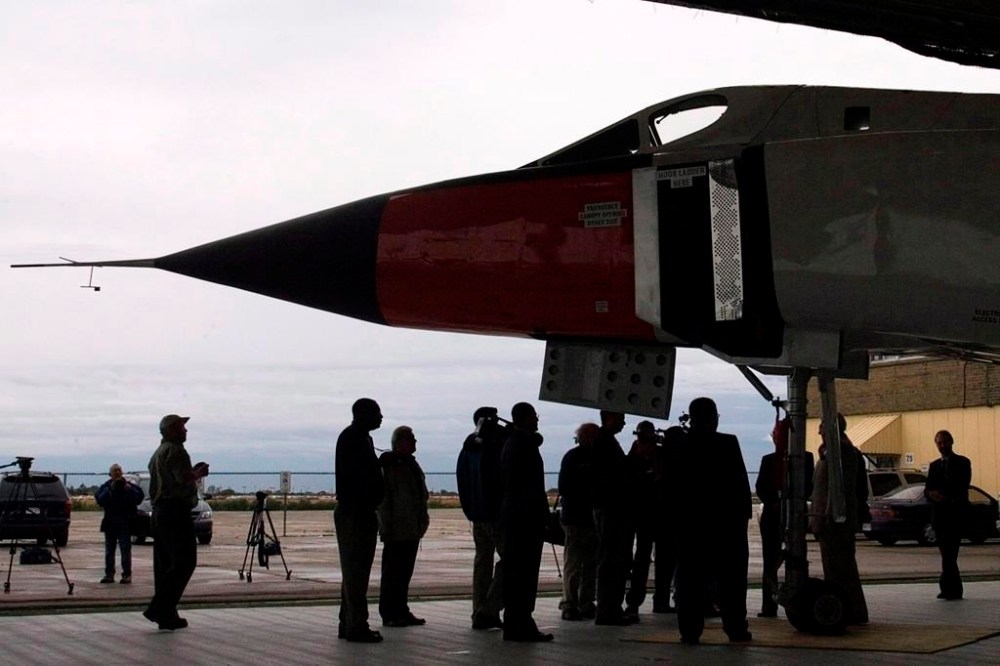
“Arrows, Bears and Secrets: The Role of Intelligence in Decisions on the CF-105 Program,” was published Tuesday in the peer-reviewed academic journal Canadian Military History.
The paper’s author, researcher Alan Barnes, tells of how the sudden cancellation of the impressive delta-winged interceptor, once a symbol of Canada’s high-tech future in aircraft manufacturing, remains a source of nationalistic anguish decades later.
Barnes, a former federal intelligence official who is now a senior fellow of the Centre for Security, Intelligence and Defence Studies at Carleton University, used the Access to Information Act to obtain classified records that shed fresh light on the saga.
“It has taken more than 60 years to get a more complete picture of the decisions surrounding the Avro Arrow,” Barnes told The Canadian Press. “Only now can we address many of the myths about the Arrow that have grown up in those decades.”
One is the notion that Canada was misled by poor U.S. intelligence. Another is that Washington deliberately manipulated the intelligence it gave Ottawa to induce Diefenbaker to cancel the Arrow. It has also been suggested that Canadian intelligence officers intentionally discounted contrary information to support a decision that had already been made by their political masters, or the government simply ignored the intelligence provided by both the Canadian and U.S. militaries.
“All of these claims cannot be true; it is possible that none of them are,” Barnes writes.
In the years after the Second World War, Canada developed its ability to prepare strategic intelligence assessments on defence and foreign policy, the paper notes. It would no longer have to rely entirely on assessments from the United States and Britain.
The analytic capability allowed Canada to fully participate in preparing the assessments on the Soviet threat to North America that would underpin joint Canada-U.S. planning for continental defence, Barnes notes.
“The CF-100 Canuck, a jet interceptor developed and manufactured in Canada, was just entering service, but there were already concerns that it might soon be outclassed by newer Soviet bombers operating at higher altitudes and faster speeds.”
In November 1952, the Royal Canadian Air Force called for an aircraft with a speed of Mach 2 and the ability to fly at 50,000 feet. “These demanding specifications contributed to the escalating costs and frequent delays in the CF-105 program.”
The Soviets would soon display a new long-range jet bomber, the Bison, at the 1954 May Day parade in Moscow. At an airshow the following year, a fly-past of 28 Bison seemed to indicate that the bomber had entered serial production, two years earlier than predicted, the paper says. In fact, only 18 prototype aircraft participated in the airshow, flying past several times to give the impression of larger numbers.
Even so, this display, along with the appearance of a new Soviet long-range turboprop bomber, the Tu-95 (dubbed the Bear), raised fears that the Soviet Union would soon outnumber the United States in intercontinental bombers, sparking a “Bomber Gap” controversy that figured prominently in American politics, the paper says.
These developments spurred acceleration of the CF-105 program.
However, Canadian intelligence would begin to cast doubt on the degree of the Soviet threat.
A 1957 report from the federal Joint Intelligence Bureau noted that the Canadian estimate of Soviet bomber production was consistently lower than the U.S. calculation, and that the Americans were reluctant to budge even when presented with new information.
In February of that year, the Liberal government approved continuing work on the CF-105, now officially known as the Arrow, but limited the scope to just eight developmental aircraft.
“There was a growing recognition among ministers that the escalating cost of the CF-105 was becoming unsustainable, but there was no interest in cancelling the program just before an election.”
The newly elected Conservative government of John Diefenbaker kept the program alive, authorizing an order for 29 pre-production aircraft.
This decision followed the first public appearance of the Arrow in October 1957.
Barnes notes the plane was rolled out for the cameras the same day the Soviet Union launched its pioneering Sputnik satellite with the help of a powerful rocket — a demonstration of Moscow’s growing ability to produce inter-continental ballistic missiles capable of striking North America.
A January 1958 assessment, “The Threat to North America, 1958-1967,” by Canada’s Joint Intelligence Committee, a co-ordinating body, ultimately had the greatest impact on decisions related to the Arrow, the paper says.
The assessment laid out clear judgments concerning the imminent transition from crewed bombers to ballistic missiles and described the limited size and capabilities of the Soviet bomber force, Barnes notes.
It observed that the Soviet ballistic missiles which were on the verge of being developed were likely to be markedly superior to the foreseeable defences, and concluded that missiles would progressively replace aircraft as the main threat to North America.
The assessment said this meant there would be little justification for the Soviet Union to increase the number of bombers, or to introduce new ones, after 1960.
“The (Joint Intelligence Committee)’s January 1958 assessment was correct in foreseeing Moscow’s shift from bombers to missiles over the subsequent decade,” Barnes writes.
He points out that following the Sputnik launch, Soviet leader Nikita Khrushchev came to see missiles as a panacea for a range of defence problems and as a cheaper alternative to conventional weapons. “With the Soviet bomber force now looking irrelevant and obsolete, it was relegated to a secondary position in Soviet military thinking.”
Diefenbaker announced the cancellation of the Arrow in the House of Commons in February 1959, citing the changing strategic threat as the main reason.
“Diefenbaker’s statement made little mention of the escalating — and unsustainable — cost of the CF-105 program. He likely wanted to avoid accusations by the opposition that the government was unwilling devote the necessary resources to the defence of Canada,” Barnes reasons.
Skeptical opposition Liberals pressed for more details and argued the prime minister’s claim was contradicted by public statements from U.S. Air Force officers in testimony to congressional committees.
Much of the information on which the Canadian assessments were based came from U.S. and other allied sources, but Canadian analysts brought their own judgment to bear to evaluate this information, reaching their own conclusions about the Soviet Union’s current and likely future capabilities, Barnes found.
The Canadian forecast of the capabilities of Soviet long-range aviation in the early 1960s proved to be broadly accurate, and the lower Canadian calculation of the number of Soviet operational heavy bombers was generally closer to reality than U.S. estimates, the paper says.
“As well, the Canadian view of the significance of Moscow’s imminent shift from bombers to missiles as the main means of attacking North America was essentially correct,” Barnes writes.
“By the late 1950s, with the advent of U-2 reconnaissance flights over the Soviet Union, the U.S. estimates of Soviet bomber numbers were also gradually reduced and the Bomber Gap ceased to be a political issue in the United States.”
From August 1958 on, the military advice to cabinet consistently stressed the Joint Intelligence Committee’s estimate of the Soviet bomber threat as a primary factor in the recommendation to cancel the CF-105, the paper says.
It is not clear whether ministers saw the committee assessment itself, although the defence minister of the day likely received a copy. In any case, the assessment’s main conclusions were summarized in the memoranda sent to the cabinet defence committee and to the full cabinet in August and September.
In addition, the officials in External Affairs, as Global Affairs Canada was then known, and the Privy Council Office who were involved in drafting Diefenbaker’s statement to the House were aware of the committee’s paper, Barnes found.
“The arguments put forward in the statement — and some of the wording — tracked closely with the (Joint Intelligence Committee) assessment, as did the government’s references to the diminished bomber threat in the subsequent parliamentary debate,” he writes. “From this it can be concluded that the Canadian intelligence assessment of the changing Soviet bomber threat to North America was an important factor in the fateful decision to cancel the Arrow.”

Barnes believes the process of drawing conclusions was unnecessarily difficult.
Historians are hampered by the fact that Canada, unlike its close allies, has no process for the systematic declassification of historical government records after a certain period of time, said Barnes, who was director of the Middle East and Africa Division at the Intelligence Assessment Secretariat of the Privy Council Office from 1995 to 2011.
“Researchers therefore have to work through the cumbersome and slow access-to-information process, which was never intended to deal with quantities of historical records,” he said.
“This means that Canadians do not have adequate access to their history and therefore have a poorer understanding of government decisions and actions in many areas, not just intelligence matters.”
This report by The Canadian Press was first published Sept. 19, 2023.
Related Articles
Bombardier seeks answers on military contract
Advertisement Advertise With Us
Advertisement Advertise With Us