
New Brunswick group drops attempt to eradicate invasive fish in Miramichi watershed

Advertisement

Advertise with us

MIRAMICHI, N.B. - A group that used a pesticide to rid New Brunswick’s Miramichi watershed of invasive smallmouth bass has stopped the program after years of controversy over the strategy.

Read this article for free:


or

Already have an account? Log in here »

To continue reading, please subscribe:

Subscribe and receive a limited-edition Free Press branded hat or tote.

Digital Subscription

One year of digital access for only $205*

  • Enjoy unlimited reading on winnipegfreepress.com
  • Read the E-Edition, our digital replica newspaper
  • Access News Break, our award-winning app
  • Play interactive puzzles

*First annual payment billed as $205.00 + GST for one year. This annual subscription will automatically renew at $233.00 + GST every 52 weeks (10% off the regular annual price of $259.35). Offer available to new and qualified returning subscribers only. Cancel any time.

To continue reading, please subscribe:

Add Free Press access to your Brandon Sun subscription for only an additional

$1 for the first 4 weeks*

  • Enjoy unlimited reading on winnipegfreepress.com
  • Read the E-Edition, our digital replica newspaper
  • Access News Break, our award-winning app
  • Play interactive puzzles
Start now

*Your next Brandon Sun subscription payment will increase by $1.00 and you will be charged $17.95 plus GST for four weeks. After four weeks, your payment will increase to $24.95 plus GST every four weeks.

Hey there, time traveller!
This article was published 29/09/2023 (1113 days ago), so information in it may no longer be current.

MIRAMICHI, N.B. – A group that used a pesticide to rid New Brunswick’s Miramichi watershed of invasive smallmouth bass has stopped the program after years of controversy over the strategy.

The group, composed of Indigenous and non-governmental organizations, said Friday it would abandon the rotenone program after its members were unable to convince the provincial government to take the lead on the project to eradicate the non-native species.

As well, a number of smallmouth bass were caught outside the treatment area this summer, suggesting the fish have spread beyond the program’s target zone, said Neville Crabbe, spokesman for the Working Group on Smallmouth Bass Eradication.
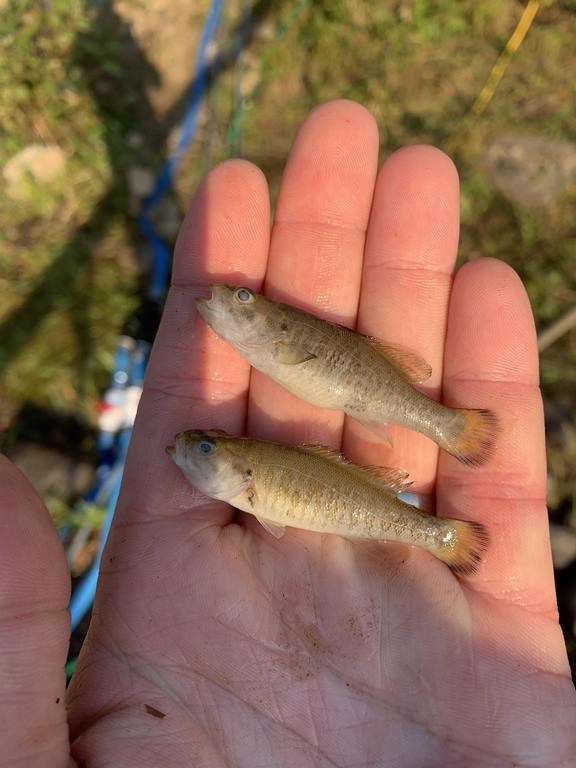
Two young-of-the-year smallmouth bass, as shown in this handout image, removed from the Southwest Miramichi River after a rotenone treatment last fall. Smallmouth of several age classes were observed throughout the area. THE CANADIAN PRESS/HO-Atlantic Salmon Federation-Nathan Wilbur **MANDATORY CREDIT **

“Those two factors were the major considerations in our decision,” Crabbe said in an interview.

Smallmouth bass, first detected in the Miramichi watershed in 2008, can alter ecosystems by preying on native species of fish such as Atlantic salmon and brook trout.

A rotenone treatment in Lake Brook and along a 15-kilometre section of the Southwest Miramichi River in September 2022 killed hundreds of fish: 514 Atlantic salmon and 32 smallmouth bass. Three adult salmon died while the majority were younger — 504 parr and seven grilse.

The results were included in the group’s report to the federal Fisheries Department in December, which also notes that 15 smallmouth bass were found dead just outside the treatment area.

Crabbe, who is also executive director of communications for the Atlantic Salmon Federation, said the results showed the presence of smallmouth bass across the treatment area, adding that a greater number of salmon were killed compared with bass because salmon are more established in the watershed.

“There’s really nothing that can be drawn from those numbers,” he said.

The working group had been trying to use rotenone in nearby Miramichi Lake since the summer of 2021. However, their efforts were blocked by some Wolastoqey women who protested by paddling on the lake, and by a group of cottagers who took legal action.

Crabbe said those protests robbed the working group of valuable time in its fight against the proliferation of bass in the watershed.

“We have no power to move past someone who is standing in our way and I think that was the ultimate weakness of our project,” he said.

But Austin Greenlaw, who owns a cottage on Miramichi Lake and was part of the legal attempts to stop the rotenone use, said Friday that he was pleased to see the end of a “foolhardy” plan.

“We were not in favour of using pesticide to come in here and kill every fish in a lake for questionable results,” Greenlaw said. “If this had gone ahead we were probably looking at multiple applications. This is a relatively large body of water to be doing that in, it’s kind of a complex thing to expect 100 per cent results.”

The retired teacher from Bristol, N.B., said he’d like to see a continuation of the use of net barriers to trap the fish and electro-fishing, which involves temporarily stunning fish with a rod so they can be relocated.

In use since the 1950s, rotenone targets fish gills and inhibits breathing, while leaving birds and mammals unaffected. However, the pesticide will cause all the fish in the treatment area to die.

In late August, nearly one year after Nova Scotia’s Fisheries Department treated a lake with rotenone to eradicate invasive smallmouth bass, there were early signs of success. The department introduced 1,500 litres of a solution containing the pesticide in September 2022 into Dobsons Lake, near Canso, N.S.

Following the treatment, brook trout had been observed naturally migrating upstream, while there had been no signs of smallmouth bass in the lake.

This report by The Canadian Press was first published Sept. 29, 2023.

— By Keith Doucette in Halifax.

Report Error Submit a Tip

More Stories

Chronic kidney disease must be recognized

Carrie Thibodeau 5 minute read 2:00 AM CDT

Canada needs a strong plan of action to tackle chronic kidney disease.

Canada is facing a looming health crisis that remains largely unaddressed and invisible at the policy and health system level. More than four million Canadians live with chronic kidney disease (CKD) and 50,000 currently receive dialysis or are living with a transplant, both life-sustaining but burdensome treatments.

With no cure, CKD profoundly impacts quality of life, contributing to lost income, overall poor health, and uncertainty about the future. The implications of CKD extend far beyond patients and families. CKD is now the 11th leading cause of death in Canada and one of our most expensive chronic diseases. Health-care costs exceed $11.7 billion annually, with most expenses incurred in the later stages of the disease, particularly dialysis and transplantation.

By 2050, the total cost burden of CKD is projected to rise to $17.6 billion and an estimated 6.2 million Canadians will be affected, driven by an aging population and rising rates of diabetes and high blood pressure.

Capital punishment as macabre theatre

Editorial 4 minute read Preview

Capital punishment as macabre theatre

Editorial 4 minute read 2:00 AM CDT

There was already enough to write about the question of capital punishment when the State of Tennessee attempted to execute Christa Pike.

Pike would have been the first woman executed in Tennessee in more than 200 years, but her execution on Sept. 30 did not go as planned — she survived, despite two lethal injections of pentobarbital, and was taken to hospital in critical condition.

Pike was released from hospital and sent back to the same prison where she has been incarcerated for the last 30 years, ever since she was convicted — as an 18-year-old — of the murder of 19-year-old Colleen Slemmer in 1995.

Pike faces a long recovery, and an uncertain one. Tennessee assistant attorney general Will Ayers has not said if the state will attempt to execute Pike again, but Gov. Bill Lee has halted all executions this year and ordered an independent review of what went wrong.

Read
2:00 AM CDT

Slain chef’s family infuriated by stayed charges

Morgan Modjeski 3 minute read Preview

Slain chef’s family infuriated by stayed charges

Morgan Modjeski 3 minute read Wednesday, Oct. 14, 2026

The family of a Ste. Anne chef who died after an altercation at a party says they are angry a manslaughter charge has been stayed against a 46-year-old man.

Read
Wednesday, Oct. 14, 2026

Possibility of Hellebuyck’s return grows each day as pay slips away

Mike McIntyre 7 minute read Preview

Possibility of Hellebuyck’s return grows each day as pay slips away

Mike McIntyre 7 minute read Wednesday, Oct. 14, 2026

CHICAGO — Buckle up, folks. The next plot twist in the ongoing soap opera between the Winnipeg Jets and Connor Hellebuyck could be a doozy.

Let’s start with a few cold, hard facts. Or, if you prefer: “Previously on As the Hellebuyck Turns…”

The franchise goaltender, with five years remaining on a contract extension he willingly signed with Winnipeg in 2023, refused to report to training camp last month as he awaits word on a trade request made at the end of last season. He’s the first NHL player in more than a quarter century to essentially go on strike.

The Jets are under no obligation to move Hellebuyck, but have indicated they would try to accommodate him if another team meets their needs. General manager Kevin Cheveldayoff has made it clear he needs to “get this right” and wants a haul for a three-time Vezina Trophy winner and one-time Hart Trophy recipient.

Read
Wednesday, Oct. 14, 2026

Get to know your Jet: Neal Pionk

Mike McIntyre 6 minute read Preview

Get to know your Jet: Neal Pionk

Mike McIntyre 6 minute read Yesterday at 5:41 PM CDT

“Give it 110 per cent.” “Get pucks in deep.” “One shift at a time.” “Play our game.” “Keep it simple.”

Hockey has a language all its own. Unfortunately, after hearing the same phrases repeated often enough, that language can start to sound a lot like white noise.

So we’re going to try something different.

The Free Press will occasionally sit down with a Winnipeg Jets player at his locker-room stall for a wide-ranging conversation about the stuff you don’t always hear in a media scrum.

Read
Yesterday at 5:41 PM CDT

Hit the brakes on driving lessons from mate

Maureen Scurfield 4 minute read Yesterday at 2:00 AM CDT

DEAR MISS LONELYHEARTS: I’ve been trying to learn to drive in busy traffic. My boyfriend said he would teach me, but he gets too playfully amorous while I’m trying to drive his new car in busier areas like downtown. He thinks it’s a big joke, but when I yelled that he was distracting me, he said, “Good.”

So I pulled over, slammed on the brakes and got out, thinking he would get back into the driver’s seat and drive us home, but he didn’t budge. He was being a real jerk.

I got back in, drove us to my place in silence, left the keys in the ignition and went inside and locked my door. Now we’re not talking and neither one of us is apologizing. What do you think?

— Still Mad, St. James


