Plan now for a dahlia garden next year, and don’t be intimidated

Advertisement

Advertise with us

I’ve always adored dahlias – in other people’s gardens. As much as their cheerful appearance intrigued me, there was something about the planting, staking, digging up and storing-over-winter routine that intimidated me.

Read this article for free:


or

Already have an account? Log in here »

To continue reading, please subscribe:

Subscribe and receive a limited-edition Free Press branded hat or tote.

Digital Subscription

One year of digital access for only $205*

  • Enjoy unlimited reading on winnipegfreepress.com
  • Read the E-Edition, our digital replica newspaper
  • Access News Break, our award-winning app
  • Play interactive puzzles

*First annual payment billed as $205.00 + GST for one year. This annual subscription will automatically renew at $233.00 + GST every 52 weeks (10% off the regular annual price of $259.35). Offer available to new and qualified returning subscribers only. Cancel any time.

To continue reading, please subscribe:

Add Free Press access to your Brandon Sun subscription for only an additional

$1 for the first 4 weeks*

  • Enjoy unlimited reading on winnipegfreepress.com
  • Read the E-Edition, our digital replica newspaper
  • Access News Break, our award-winning app
  • Play interactive puzzles
Start now

*Your next Brandon Sun subscription payment will increase by $1.00 and you will be charged $17.95 plus GST for four weeks. After four weeks, your payment will increase to $24.95 plus GST every four weeks.

Hey there, time traveller!
This article was published 03/10/2023 (1072 days ago), so information in it may no longer be current.

I’ve always adored dahlias – in other people’s gardens. As much as their cheerful appearance intrigued me, there was something about the planting, staking, digging up and storing-over-winter routine that intimidated me.

But the longer I garden, the more I grow to appreciate their beauty and amenability.

For one, they’re available in so many different sizes, colors and even flower shapes that it’s fair to say no two dahlia cultivars are alike. And the choices! There are anemone, cactus, peony, orchid and waterlily types; singles, doubles and even dinner plate dahlias as large as, well, dinner plates.
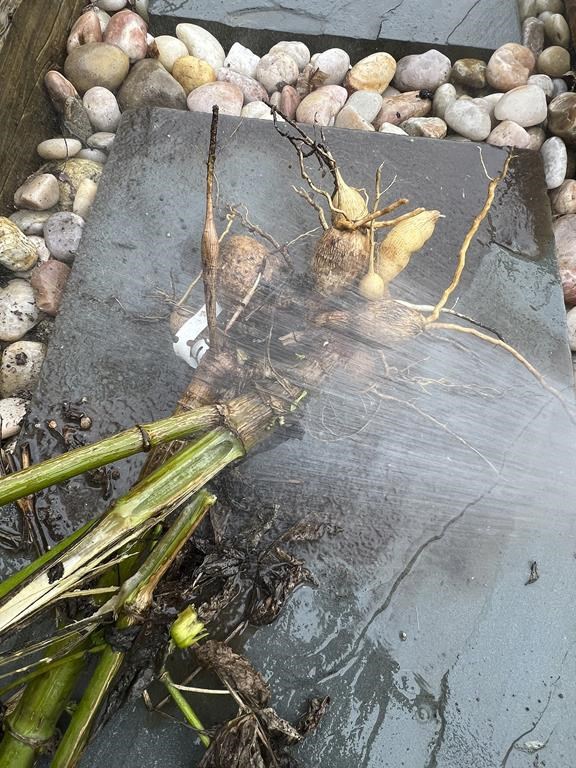
This Sept. 26, 2023, image provided by Lauren E. Sikorski shows freshly harvested dahlia tubers being rinsed before storage. (Lauren E. Sikorski via AP)

With 42 recognized species and hundreds of hybrids, it’s impossible not to find at least one that will complement your garden.

Dahlias bloom in cut-and-come-again fashion, which is to say you can pick bouquets to fill as many vases as you can, and the plants will continue to produce flowers from summer straight through fall.

“Dahlias are actually simple to grow,” Lauren Sikorski, co-owner of Sow-Local, a small, specialty cut-flower farm in Oakdale, New York, told me, and she’s right: Caring for dahlias doesn’t require any advanced skills. They’re just a bit time-consuming and particular about their growing conditions.

The plants do not like heat or “wet feet”, ” gardening term that refers to soggy conditions around roots. And they “detest clay soil,” she said. If you’re working with heavy clay, incorporating a generous amount of compost into beds will improve drainage.

Typically grown in cooler regions and removed from the ground in fall because they will not survive winter outdoors, the plants are considered hardy from USDA zones 8-10.

To grow dahlias in those warmer regions, where the plants bloom from November through December or January, plant tubers in September or October. Cut plants down to the ground after they wither, apply mulch over the soil to keep it cool, and hope for another show from late winter through mid-spring. Then cut them down again, top dress with compost or mulch and leave them be until next year. In the hotter zones 9 and 10, dahlias perform best with some shade.

In the cooler zones 7 and lower, such as where Sow-Local is based, tubers should be harvested after the first hard frost. When the plant’s foliage has turned black and slimy, Sikorski advises, remove dead foliage and cut plants nearly to ground level. After the first couple of dry days, sometime during the next week or two, use a pitchfork to gingerly lift them out of the ground, taking care not to damage the tuber clump.

Gently shake soil off the tubers (they’re fragile), give them a quick rinse and set them out to dry for a few days. Brush off any remaining soil and, if you have different varieties, tag them because I guarantee you won’t remember which is which come spring.

“If you grow a large variety of sizes and colors of tubers, labeling is very important and can be tricky,” Sikorski says, adding that it’s much easier to label plants during the growing season, when you can see what you’re dealing with, than after the first frost.

Sikorski places tubers directly into cardboard boxes and stores them at 40-45 degrees in a dry place. Many growers, however, prefer to place them into gallon-size, perforated (for air circulation) produce bags with four cups of vermiculite, sphagnum peat moss, wood shavings or sawdust, then packing the bags into covered boxes and storing similarly.

Check stored tubers once a month over the winter and, if any are slightly shriveled, sprinkle lightly with water. Severely shriveled ones can be removed and soaked in water overnight in an attempt to rejuvenate them. If they plump up, pat them dry and return to storage; if they don’t, discard them, along with any that are moldy or rotted. Be prepared to lose about 10 percent of stored tubers.

In spring, after the danger of frost has passed, plant tubers in a spot that gets at least six hours of sunlight daily. For an earlier bloom, you can give them a head start by planting them indoors in pots about a month earlier, then transplanting into the garden after the last frost.

Insert 4-to-6-foot stakes (determined by the mature height of the variety you plant) into the soil about an inch away from tubers and secure stems as they grow. This will keep them from flopping over and protect from storm and wind damage.

If you’d like to grow dahlias next year, order tubers now. Most catalogs will ship them in spring, but Southern gardeners will have to store them over summer, as above, for fall planting.

—-

Jessica Damiano writes the award-winning Weekly Dirt Newsletter and regular gardening columns for The AP. Sign up here to get weekly gardening tips and advice delivered to your inbox.

—-

For more AP gardening stories, go to https://apnews.com/search?q=gardening#nt=navsearch

Report Error Submit a Tip

More Stories

Carney warns of tough times ahead in national address as retaliatory tariffs begin

Nick Murray, The Canadian Press 5 minute read Preview

Carney warns of tough times ahead in national address as retaliatory tariffs begin

Nick Murray, The Canadian Press 5 minute read Updated: Yesterday at 4:10 PM CDT

OTTAWA - Canada's pivot away from the United States will "come at a cost" but the alternative would be far worse, Prime Minister Mark Carney said Tuesday.

Carney made the remarks in a video released just hours after his government made good on a promise to implement retaliatory tariffs on the United States. Those tariffs respond to American duties imposed last month by U.S. President Donald Trump, after the two countries could not come to an agreement to settle some outstanding trade irritants.

Carney spent much of the video laying out Canada's response to Trump's protectionist trade policies, including expanding trade with other countries and building more capacity domestically.

But he said it "won't be easy."

Read
Updated: Yesterday at 4:10 PM CDT

Flash, bang … oops: police raid leads to lawsuit

Erik Pindera 4 minute read Preview

Flash, bang … oops: police raid leads to lawsuit

Erik Pindera 4 minute read 6:00 AM CDT

A couple suing the city allege Winnipeg Police Service officers trying to execute a search warrant at their condominium complex rappelled down the side of the building, broke in their glass patio door and fired off a stun grenade before realizing they were in the wrong unit.

Saeid Ghavami and Shahla Shojaei, a married couple who are academics and scientific researchers at the University of Manitoba, filed the lawsuit in Court of King’s Bench last month over the Jan. 31, 2025 incident.

The claim names the City of Winnipeg and several officers involved in the operation, whose identities are, at this point, unknown to the couple, and are referred to as “John Does.”

Officers were attempting to execute the warrant on the third floor of the eight-storey Pembina Highway building, the court filing says. The couple lives on the fourth floor.

Read
6:00 AM CDT

All quiet on the Hellebuyck front

Mike McIntyre 8 minute read Preview

All quiet on the Hellebuyck front

Mike McIntyre 8 minute read Yesterday at 4:58 PM CDT

Pull up a chair, folks, as we address the elephant in the room. Or, to be more precise, the decorated goaltender who is not in the room. Or on the ice. Or even in the city.

Not surprisingly, the Connor Hellebuyck situation took centre stage Tuesday as members of the Winnipeg Jets held their first media session following an informal, pre-training camp skate.

“We’re definitely going to get asked about it. That’s no chirp to anybody. I think that’s just the reality of the situation,” admitted veteran defenceman Dylan DeMelo, who took part in an hour-long practice at Hockey For All Centre that involved nearly every member of the organization.

With one very notable exception, of course.

Read
Yesterday at 4:58 PM CDT

Winkler-based internet provider delivering high-speed service to 30 rural and First Nations Manitoba communities

Nicole Buffie 3 minute read Preview

Winkler-based internet provider delivering high-speed service to 30 rural and First Nations Manitoba communities

Nicole Buffie 3 minute read Yesterday at 7:12 PM CDT

Valley Fiber says it is undertaking one of its largest fibre optic projects and is building infrastructure that will deliver internet to 10,000 homes and businesses in rural and First Nations communities across Manitoba.

“These communities will now have access to the fastest internet network in Manitoba, and it will power their lives and their business,” Ryan Klassen, chief executive officer of the Winkler-based internet provider, said Tuesday from Fisher River Cree Nation.

The province has granted Valley Fiber use of two of its underused cables on the existing Manitoba Hydro fibre optic network for up to 20 years as part of the project, which will connect nearly 30 communities — including Buffalo Point, Hollow Water, Black River and Peguis First Nations, along with Fisher River and Fox Lake Cree Nations — to high-speed internet.

Construction should be finished by 2027.

Read
Yesterday at 7:12 PM CDT

Gym, health pilot program rolls out as Manitoba children go back to school

Maggie Macintosh 2 minute read Preview

Gym, health pilot program rolls out as Manitoba children go back to school

Maggie Macintosh 2 minute read 11:31 AM CDT

There were tears and cheers on an elementary school playground in Rossmere as students arrived for the first day of classes Wednesday.

Seven-year-old Ethan Minski is among tens of thousands of Manitoba students who have officially started a new school year.

Before entering King Edward School, Minski said he was most looking forward to phys-ed class.

“Everybody loves gym. It’s just fun!” the Grade 2 student said.

Read
11:31 AM CDT

Ottawa renews commitment, provides funding, for Lake Winnipeg watershed protection

Nicole Buffie 3 minute read Preview

Ottawa renews commitment, provides funding, for Lake Winnipeg watershed protection

Nicole Buffie 3 minute read 1:36 PM CDT

The federal government has renewed its memorandum of understanding with the province to protect the Lake Winnipeg watershed and is contributing more than $2 million for several projects to protect the basin.

Ottawa and the province have agreed to extend the current MOU for an additional five-year term, to August 21, 2031. The understanding has been in place since 2010.

“Lake Winnipeg is not only an environmental treasure, it’s also an economic treasure. But we also know that Lake Winnipeg is under pressure. Too many nutrients, particularly phosphorus, are entering the lake, contributing to harmful algae blooms and affecting water quality and ecosystem health,” said Terry Duguid, MP for Winnipeg South.

Lake Winnipeg is one of the largest freshwater bodies in the world and its watershed spans parts of four provinces and four American states. It is vulnerable to high levels of nutrients caused by agricultural runoff, sewage and other contaminants that create large algae blooms and affect fisheries.

Read
1:36 PM CDT