Ten billion reasons to care
Advertisement
Read this article for free:
or
Already have an account? Log in here »
To continue reading, please subscribe:

Digital Subscription
One year of digital access for only $205*
- Enjoy unlimited reading on winnipegfreepress.com
- Read the E-Edition, our digital replica newspaper
- Access News Break, our award-winning app
- Play interactive puzzles
*First annual payment billed as $205.00 + GST for one year. This annual subscription will automatically renew at $233.00 + GST every 52 weeks (10% off the regular annual price of $259.35). Offer available to new and qualified returning subscribers only. Cancel any time.
To continue reading, please subscribe:
Add Free Press access to your Brandon Sun subscription for only an additional
$1 for the first 4 weeks*
- Enjoy unlimited reading on winnipegfreepress.com
- Read the E-Edition, our digital replica newspaper
- Access News Break, our award-winning app
- Play interactive puzzles
*Your next Brandon Sun subscription payment will increase by $1.00 and you will be charged $17.95 plus GST for four weeks. After four weeks, your payment will increase to $24.95 plus GST every four weeks.
Read unlimited articles for free today:
or
Already have an account? Log in here »
Hey there, time traveller!
This article was published 24/10/2023 (1046 days ago), so information in it may no longer be current.
It was the 10-billion-crab question.
But no one’s going to like the 10-billion-crab answer.
The crab in question, snow crab (Chionoecetes opilio), lived in the Bering Sea and were the heart of an extremely lucrative fishery, a fishery made recently famous by the reality television show Deadliest Catch.
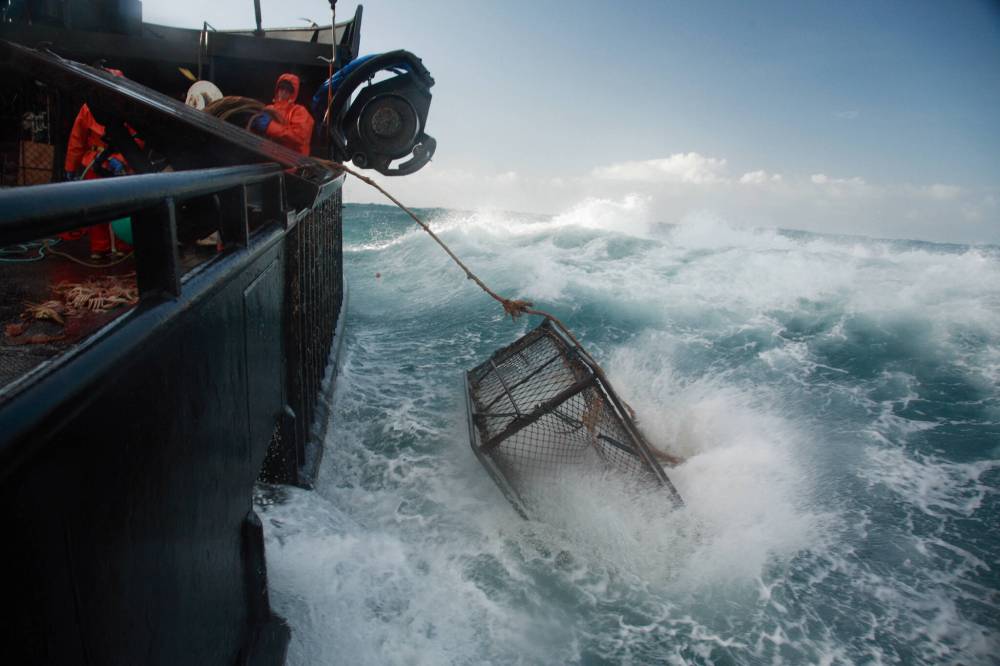
Discovery / CTV Files
Crab pots launched in big seas aboard the Time Bandit, as seen in Deadliest Catch on Discovery Channel.
The crab themselves are hardly an attractive species, complete with bulging eyes on stalks and gangly limbs, but they are an extremely tasty one — and valuable, too, with total catches normally bringing in US$150 million in an average year.
The Alaskan fishery operates under strict conservation regulations, and the crab population in the eastern Bering Sea seemed strong.
But then something happened. Between 2018 and 2021, an estimated 10 billion crab vanished.
It now seems that the disappearance of the crab was due to an increase in water temperatures on the bottom of the Bering Sea.
The temperature at the ocean floor warmed dramatically during a marine heat wave — but the temperature didn’t get so high that it actually killed the missing crab outright.
Instead, it appears the warming temperature sped up the crabs’ metabolism, causing them to need more food — four times as much food as they would need in traditionally colder water.
“The unprecedented caloric demands, coupled with a small area from which to forage relative to historical grounds, suggest that starvation likely played a role in the disappearance of more than 10 billion snow crab,” scientists investigating the collapse wrote in the journal Science.
And the source of that marine heat wave? Well, as with recent weather extremes on land, the culprit is believed to be our globally warming climate.
“Climate change is the next existential crisis for fisheries, and snow crab are a prime example for how quickly the outlook can change for a population. In 2018, catches were projected to increase to levels not seen in decades. Three years later, the population had collapsed,” the study’s authors write.
The problem is that, with a warming climate, it’s hard to predict what’s going to happen with marine populations — precisely because the tried-and-true method for managing marine stocks depends on how those stocks behaved in the past, and the rules of the past won’t work in the future.
“Our current management tools base management targets and projected sustainable yields on the historical dynamics of a population. However, projections based on historical dynamics are unreliable when the future environmental conditions of a region will not resemble the past,” the scientists write. “The Bering Sea is on the front lines of climate-driven ecosystem change, and the problems currently faced in the Bering Sea foreshadow the problems that will need to be confronted globally.”

There are other changes occurring in warming oceans: fish species in the Atlantic Ocean have been moving steadily northwards, sometimes completely vanishing from areas where they used to be commonplace. Things haven’t gone as smoothly for species that can’t move quickly: the adaptive capacity of species to higher temperatures hasn’t always been able to keep up with the rate of temperature increase.
And don’t even begin to consider the ones that can’t move at all: the continuing fate of corals in most of the world’s oceans shows pretty clearly that biology isn’t keeping pace with the speed of climate warming.
You can, if you want, bury your head in the sand and pretend that nothing is happening to the world around you. That won’t do a single thing to stop those changes from continuing to happen.
To put it exceedingly bluntly, we’re surrounded by canaries in the climate-change coal mine.
And 10 billion of them just died.