Fire, other ravages jeopardize California’s prized forests

Advertisement

Advertise with us

KYBURZ, Calif. (AP) — On a mountainside where walls of flames torched the forest on their way toward Lake Tahoe in 2021, blackened trees stand against a gray sky.

Read this article for free:


or

Already have an account? Log in here »

To continue reading, please subscribe:

Subscribe and receive a limited-edition Free Press branded hat or tote.

Digital Subscription

One year of digital access for only $205*

  • Enjoy unlimited reading on winnipegfreepress.com
  • Read the E-Edition, our digital replica newspaper
  • Access News Break, our award-winning app
  • Play interactive puzzles

*First annual payment billed as $205.00 + GST for one year. This annual subscription will automatically renew at $233.00 + GST every 52 weeks (10% off the regular annual price of $259.35). Offer available to new and qualified returning subscribers only. Cancel any time.

To continue reading, please subscribe:

Add Free Press access to your Brandon Sun subscription for only an additional

$1 for the first 4 weeks*

  • Enjoy unlimited reading on winnipegfreepress.com
  • Read the E-Edition, our digital replica newspaper
  • Access News Break, our award-winning app
  • Play interactive puzzles
Start now

*Your next Brandon Sun subscription payment will increase by $1.00 and you will be charged $17.95 plus GST for four weeks. After four weeks, your payment will increase to $24.95 plus GST every four weeks.

Hey there, time traveller!
This article was published 26/10/2023 (1033 days ago), so information in it may no longer be current.

KYBURZ, Calif. (AP) — On a mountainside where walls of flames torched the forest on their way toward Lake Tahoe in 2021, blackened trees stand against a gray sky.

“If you can find a live tree, point to it,” Hugh Safford, an environmental science and policy researcher at the University of California, Davis, said touring damage from the Caldor Fire, one of the past decade’s many massive blazes.

Dead conifers stretch as far as the eye can see. Fire burned so hot that soil was still barren. Granite boulders were charred. Indentations marked fallen logs that vanished in smoke.
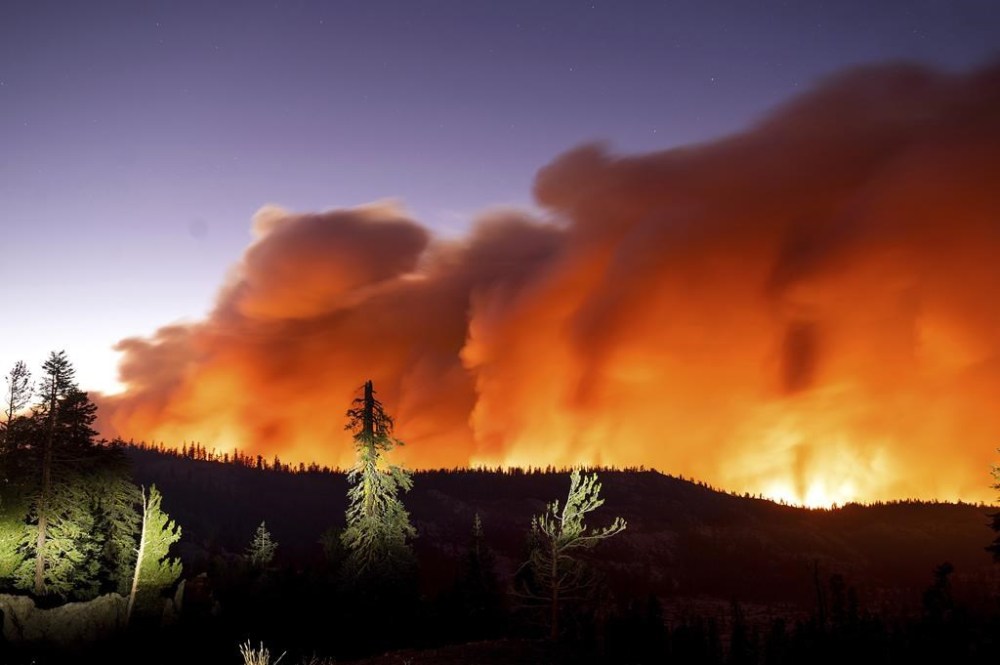
FILE - Seen in a long camera exposure, the Caldor Fire burns on Aug. 29, 2021, in Eldorado National Forest, Calif. Scientists say forest is disappearing as increasingly intense fires alter landscapes around the planet, threatening wildlife, jeopardizing efforts to capture climate-warming carbon and harming water supplies. (AP Photo/Noah Berger, File)

Damage in this area of Eldorado National Forest could be permanent — part of a troubling pattern that threatens a defining characteristic of the Sierra Nevada range John Muir once called a “waving sea of evergreens.”

Forest like this is disappearing as increasingly intense fires alter landscapes worldwide threatening wildlife, jeopardizing efforts to capture climate-warming carbon and harming water supplies, studies say.

In the U.S. West, a century of fire suppression, logging of large fire-resistant trees, and other practices allowed undergrowth to choke forests. Drought has killed millions of conifers or made them susceptible to disease and pests. And a changing climate has brought more intense fires.

“What’s it’s coming down to is jungles of fuels in forest lands,” Safford said. “You get a big head of steam going behind the fire there, it can burn forever and ever and ever.”

Despite mild wildfire seasons last year and this year, California saw 12 of its largest 20 wildfires in the previous five years. Record rain and snowfall this year that mostly ended a three-year drought could lead to explosive growth of fire fuels.

California has lost more than 1,760 square miles (4,560 square kilometers) — nearly 7% — of its tree cover since 1985, a recent study found.

A study of the southern Sierra Nevada — home to Yosemite, Sequoia and Kings Canyon national parks — found nearly a third of conifer forest had transitioned to other vegetation because of fire, drought or bark beetles in the past decade.

“We’re losing them at a rate … we can’t sustain,” said Brandon Collins, co-author of that report and adjunct forestry professor at the University of California, Berkeley.

Not everyone believes forest is disappearing. Some environmentalists, like Chad Hanson of the John Muir Project sponsored by the nonprofit Earth Island Institute, believe there’s a “myth of catastrophic wildfire” to support logging efforts.

Seedlings are rising from ashes in high-severity patches of fire and dead wood provides wildlife habitat, Hanson said. “If everything people are hearing was true, there would be a lot more reason for concern.”

Others are concerned failure to properly manage forests can result in intense fire that could harm habitat, the ability to store climate-warming carbon in trees and the quality of snowmelt for farms and cities.

“Areas where mixed conifer burned at high severity, those are all areas that are vulnerable to total forest loss,” said Christy Brigham, chief of resources management and science at Sequoia & Kings Canyon National Parks.
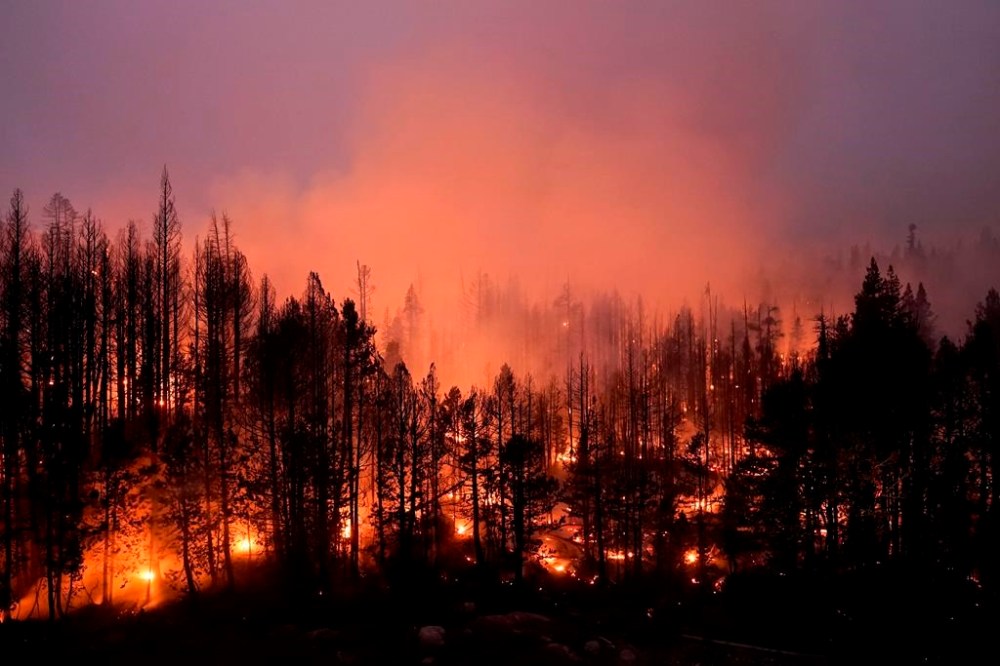
FILE - Trees scorched by the Caldor Fire smolder in Eldorado National Forest, Calif., Friday, Sept. 3, 2021. Scientists say forest is disappearing as increasingly intense fires alter landscapes around the planet, threatening wildlife, jeopardizing efforts to capture climate-warming carbon and harming water supplies. (AP Photo/Jae C. Hong, File)

After wildfires in 2020 and 2021 wiped out up to about a fifth of all giant sequoias — once considered almost fireproof — the National Park Service last week embarked on a controversial project to help the mighty trees recover with its largest planting of seedlings in a single grove.

Before the mid-1800s, fires from lightning or set by Indigenous people kept undergrowth in check. But after settlers drove out Native Americans and logged forests, fighting fires became the mission to protect the valuable trees and homes.

That has allowed forests to become four to seven times more dense than they once were, Safford said.

“John Muir would not recognize any of this,” he said, gesturing at tightly packed dead trees.

The Caldor Fire, which destroyed 1,000 structures, torched forest for the first time in a century, Safford said. Years of drought had made it a tinderbox.

Swaths of Eldorado National Forest burned at such intensity that mature pines went up in flames, their seeds killed. Manzanita and mountain whitethorn — chaparral typical at lower elevations — took root.

A March study of 334 Western wildfires found increasing fire severity made conifer species less likely to regenerate — a problem apt to worsen with climate change.

Along U.S. Highway 50, where the Caldor Fire had burned out of control, Safford pointed out a barren slope where forest from a previous fire had been replaced with chaparral and trees were now unlikely to grow.

To reduce wildfire danger, the federal government, which owns nearly 60% of California’s vast forest, agreed with the state in 2020 to reduce fuels on 1,560 square miles (4,040 square kilometers) a year by 2025.

Fire scientists advocate clearing vegetation by setting fires in ideal conditions and allowing lower-severity fires to burn.

But the Forest Service has historically been risk averse, said Safford, the agency’s regional ecologist for two decades before retiring in 2021. Rather than chance that a fire could blow up, officials have generally snuffed lower-intensity flames that could deliver benefits.

With more than $4 billion from the Bipartisan Infrastructure Law and the Inflation Reduction Act, the Forest Service plans to ramp up thinning where communities are most vulnerable to wildfire.
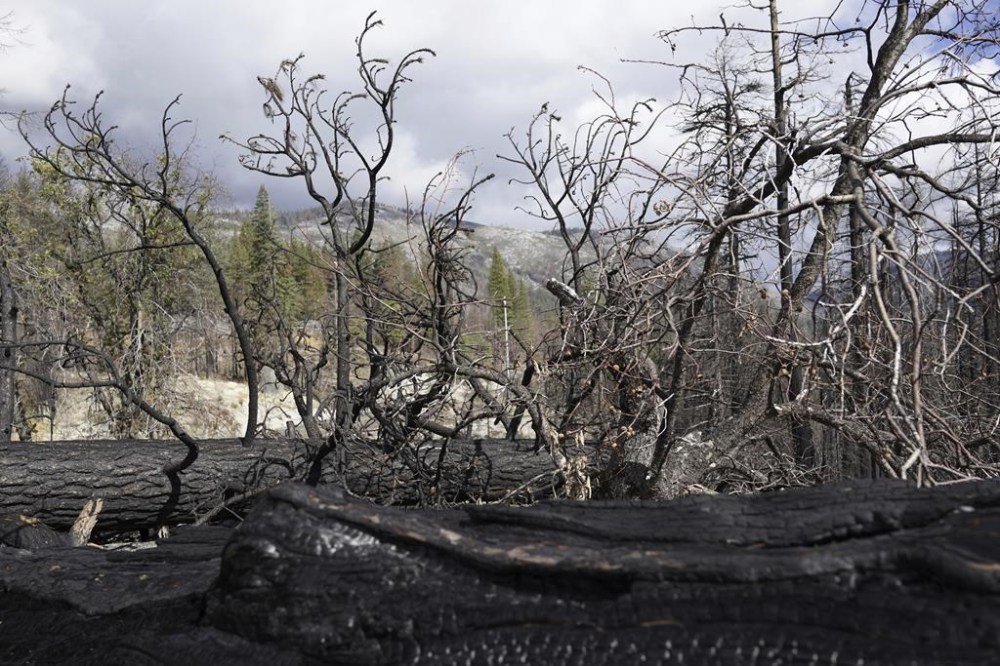
Pines that were cut down after being killed in the 2021 Caldor Fire lie on the floor of Eldorado National Forest, Calif., near Lake Tahoe, on Oct. 22, 2022. Scientists say forest is disappearing as increasingly intense fires alter landscapes around the planet, threatening wildlife, jeopardizing efforts to capture climate-warming carbon and harming water supplies. (AP Photo/Brian Melley)

Susan Britting, executive director of Sierra Forest Legacy, acknowledged any cutting triggers skepticism among conservationists because loggers historically took the largest trees.

“In my experience, things like logging, tree removal, even reforestation, those things happen,” Britting said. “The prescribed fire that needs to happen … just gets delayed and punted and not prioritized.”

The chance of a burn escaping its perimeter remains a big challenge to the strategy. And thinning often faces court challenges.

Safford — now chief scientist at Vibrant Planet, an environmental public benefits corporation — acknowledged larger trees have been logged in the past but said that’s not now envisioned in thinning projects.

Two-thirds of the rugged Sierra is inaccessible or off-limits to logging, so fire will have to do much of the work, he said. But homeowners are anxious prescribed fires will jump perimeters and destroy houses.

“It’s the classic wicked problem where any solution you derive has huge implications for other sides of society and the way people want things to be,” Safford said.

___

The Associated Press receives support from the Walton Family Foundation for coverage of water and environmental policy. The AP is solely responsible for all content.


Report Error Submit a Tip

More Stories

Letters, Aug 24

7 minute read 2:00 AM CDT

The forgotten specialists

The Manitoba government’s recent announcement of 4,724 net new health care workers left out a profession that is critical to the health of Manitobans — clinical psychologists.

Clinical psychologists and clinical health psychology residents play an essential role in our health-care system, working alongside our physicians and allied health colleagues to provide psychological services in both mental health and behavioural health medicine to Manitobans across their lifespan.

Clinical psychologists specialize in the assessment, treatment and diagnosis of complex mental health disorders, neurodevelopmental conditions and physical health conditions. They can be found within hospitals, outpatient clinics and primary care settings throughout the province.

Results Canada fights for the political will to end global poverty

AV Kitching 9 minute read Preview

Results Canada fights for the political will to end global poverty

AV Kitching 9 minute read 6:00 AM CDT

Sitting at home on a wintry day in March last year, Japneet Singh listened intently as members of grassroots advocacy organization Results Canada began their online presentation on the prevalence of tuberculosis in rural India.

Singh knew all about the reality of the disease. Before he moved to Canada in 2013 he had seen family members affected by the bacterial infection which, in its active form, can damage the lungs, spine, brain and kidneys.

Despite being preventable and curable, TB persists among marginalized groups and is closely linked with those experiencing extreme poverty.

The highly infectious disease spreads quickly through transient populations facing housing insecurity and those living in overcrowded homes.

Read
6:00 AM CDT

Senior’s family slams bedbug reaction

Malak Abas 5 minute read Preview

Senior’s family slams bedbug reaction

Malak Abas 5 minute read 6:00 AM CDT

The family of a senior who left his Manitoba Housing apartment after two years of bedbug infestations is accusing the provincial body of being ineffectual and irresponsible in its treatment of the persistent pests.

The senior had lived at the Columbus Courts building at 253 Edgeland Blvd., since 2011, but when he began getting severe skin rashes all over his body about two years ago, his son began to worry.

They found out the 14-storey building was being sprayed for bedbugs after an infestation had impacted several units. After multiple rounds of pesticide treatments, the problem has not subsided, the son told the Free Press.

“They come in, they spray pesticides and then they leave. And it’s been completely ineffectual,” he said. “My dad keeps seeing the bedbugs even the day after the treatments and continuously, they’ve just gotten worse and worse.”

Read
6:00 AM CDT

Five Things: PM Carney explains why Canada left the U.S. negotiating table

David Baxter, The Canadian Press 5 minute read Preview

Five Things: PM Carney explains why Canada left the U.S. negotiating table

David Baxter, The Canadian Press 5 minute read Saturday, Aug. 22, 2026

OTTAWA - Canada is preparing to hit the U.S. with dollar-for-dollar tariffs in response to new 50 per cent duties on $28 billion worth of Canadian products that took effect when talks between the two nations collapsed as negotiations neared the finish line. 

Prime Minister Mark Carney was quiet publicly during the final days of negotiations, but now has now explained his rationale for telling the Canadian negotiating team, led by Canada-U.S. Trade Minister Dominic LeBlanc and chief negotiator Janice Charette, to leave the table.

Restrictions on further trade deals

"The U.S. Introduced at the last hours, in the last hours, efforts to restrict our ability to have other trade deals. You heard me say a moment ago, what we've accomplished in the past year, 20 new deals, economic and security partnerships, the prospect of doubling our market access because we believe in free trade. We're the partner of choice in many respects for countries around the world and the Americans wanted to restrict that. They had language that what they wanted to restrict that, unacceptable," Carney said during a press conference on Parliament Hill.

Read
Saturday, Aug. 22, 2026

Winnipeg team behind national LGBT monument spent six years bringing it to fruition

Nicole Buffie 5 minute read Preview

Winnipeg team behind national LGBT monument spent six years bringing it to fruition

Nicole Buffie 5 minute read Yesterday at 6:05 PM CDT

The Winnipeg team behind a national monument recognizing the LGBT Purge were in Ottawa to celebrate its official unveiling Friday.

Thunderhead is the work of local artists Shawna Dempsey and Lorri Millan, Liz Wreford and Peter Sampson of Public City Architecture, and knowledge keeper Albert McLeod, who served as cultural adviser for the project.

The team beat out 31 international submissions for the project, which is permanently located at 201 Wellington St. in Ottawa along the Ottawa River, in view of Parliament.

“We are a beacon internationally around the world of what democracies can do about inclusion, about human rights,” McLeod said.

Read
Yesterday at 6:05 PM CDT

Frustration mounts as drug raids sweep problems out of downtown, into West End

Scott Billeck 7 minute read Preview

Frustration mounts as drug raids sweep problems out of downtown, into West End

Scott Billeck 7 minute read Friday, Aug. 21, 2026

West End business owners say their neighbourhood has been under siege for months, and some believe downtown police drug sweeps have made things worse by pushing more street disorder in their direction — and pushing customers away.

Read
Friday, Aug. 21, 2026