Twitter takeover: 1 year later, X struggles with misinformation, advertising and usage decline
Advertisement
Read this article for free:
or
Already have an account? Log in here »
To continue reading, please subscribe:

Digital Subscription
One year of digital access for only $205*
- Enjoy unlimited reading on winnipegfreepress.com
- Read the E-Edition, our digital replica newspaper
- Access News Break, our award-winning app
- Play interactive puzzles
*First annual payment billed as $205.00 + GST for one year. This annual subscription will automatically renew at $233.00 + GST every 52 weeks (10% off the regular annual price of $259.35). Offer available to new and qualified returning subscribers only. Cancel any time.
To continue reading, please subscribe:
Add Free Press access to your Brandon Sun subscription for only an additional
$1 for the first 4 weeks*
- Enjoy unlimited reading on winnipegfreepress.com
- Read the E-Edition, our digital replica newspaper
- Access News Break, our award-winning app
- Play interactive puzzles
*Your next Brandon Sun subscription payment will increase by $1.00 and you will be charged $17.95 plus GST for four weeks. After four weeks, your payment will increase to $24.95 plus GST every four weeks.
Read unlimited articles for free today:
or
Already have an account? Log in here »
Hey there, time traveller!
This article was published 26/10/2023 (1055 days ago), so information in it may no longer be current.
SAN FRANCISCO (AP) — One year ago, billionaire and new owner Elon Musk walked into Twitter’s San Francisco headquarters with a white bathroom sink and a grin, fired its CEO and other top executives and began transforming the social media platform into what is now known as X.
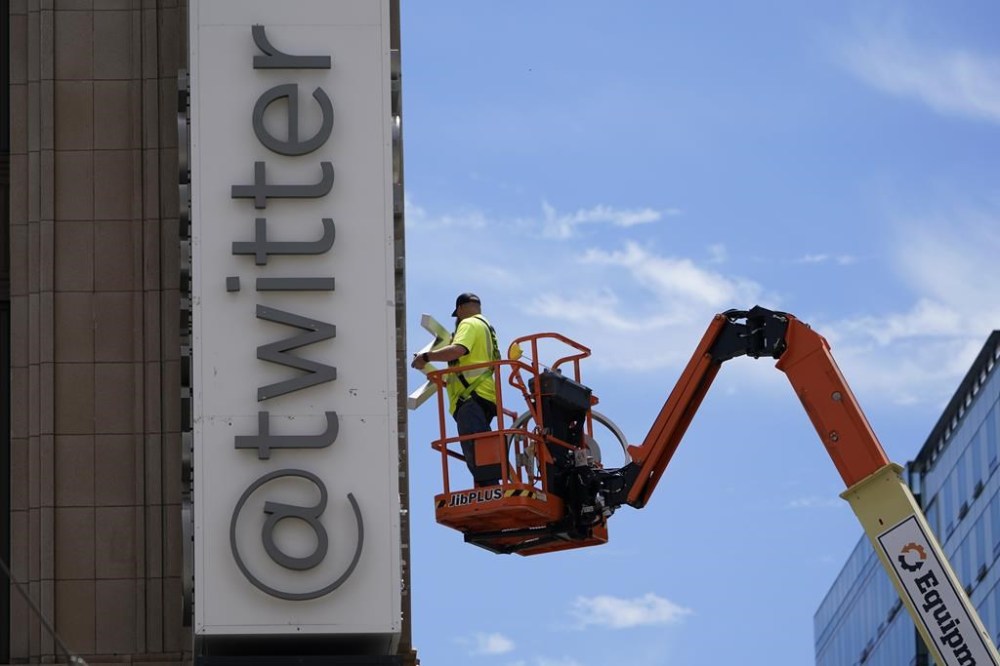
X looks and feels something like Twitter, but the more time you spend on it the clearer it becomes that it’s merely an approximation. Musk has dismantled core features of what made Twitter, Twitter — its name and blue bird logo, its verification system, its Trust and Safety advisory group. Not to mention content moderation and hate speech enforcement.
He also fired, laid off or lost the majority of its workforce — engineers who keep the site running, moderators who keep it from being overrun with hate, executives in charge of making rules and enforcing them.
The result, long-term Twitter watchers say, has been the end of the platform’s role as an imperfect but useful place to find out what’s going on in the world. What X will become, and whether Musk can achieve his ambition of turning it into an “everything app” that everyone uses, remains as unclear as it was a year ago.
“Musk hasn’t managed to make a single meaningful improvement to the platform and is no closer to his vision of an ‘everything app,’ than he was a year ago,” said Insider Intelligence analyst Jasmine Enberg. “Instead, X has driven away users, advertisers, and now it has lost its primary value proposition in the social media world: Being a central hub for news.”
As one of the platform’s most popular and prolific users even before he bought the company, Musk had a unique experience on Twitter that is markedly different from how regular users experience it. But many of the changes he’s introduced to X has been based on his own impressions of the site — in fact, he even polled his millions of followers for advice on how to run it (they said he should step down).
“Musk’s treatment of the platform as a technology company that he could remake in his vision rather than a social network fueled by people and ad dollars has been the single largest cause of the demise of Twitter,” Enberg said.
The blue checkmarks that once signified that the person or institution behind an account was who they said they are — a celebrity, athlete, journalist from global or local publication, a nonprofit agency — now merely shows that someone pays $8 a month for a subscription service that boosts their posts above un-checked users. It’s these paying accounts that have been found to spread misinformation on the platform that is often amplified by its algorithms.
On Thursday, for instance, a new report from the left-leaning nonprofit Media Matters found that numerous blue-checked X accounts with tens of thousands of followers claimed that the mass shooting in Maine was a “false flag,” planned by the government. Researchers also found such accounts spreading misinformation and propaganda about the Israel-Hamas war — so much so that the European Commission made a formal, legally binding request for information to X over its handling of hate speech, misinformation and violent terrorist content related to the war.
Ian Bremmer, a prominent foreign policy expert, posted on X this month that the level of disinformation on the Israel-Hamas war “being algorithmically promoted” on the platform “is unlike anything I’ve ever been exposed to in my career as a political scientist.”
It’s not just the platform’s identity that’s on shaky grounds. Twitter was already struggling financially when Musk purchased it for $44 billion in a deal that closed Oct. 27, 2022, and the situation appears more precarious today. Musk took the company private, so its books are no longer public — but in July, the Tesla CEO said the company had lost about half of its advertising revenue and continues to face a large debt load.
“We’re still negative cash flow,” he posted on the site on July 14, due to about a “50% drop in advertising revenue plus heavy debt load.”
“Need to reach positive cash flow before we have the luxury of anything else,” he said.
In May, Musk hired Linda Yaccarino, a former NBC executive with deep ties to the advertising industry in an attempt to lure back top brands, but the effort has been slow to pay off. While some advertisers have returned to X, they are not spending as much as they did in the past — despite a rebound in the online advertising market that boosted the most recent quarterly profits for Facebook parent company, Meta, and Google parent company, Alphabet.

Insider Intelligence estimates that X will bring in $1.89 billion in advertising revenue this year, down 54% from 2022. The last time its ad revenue was near this level was in 2015, when it came in at $1.99 billion. In 2022, it was $4.12 billion according to the research firm’s estimates.
Outside research also shows that people are using X less.
According to research firm Similarweb, global web traffic to Twitter.com was down 14%, year-over-year, and traffic to the ads.twitter.com portal for advertisers was down 16.5%. Performance on mobile was no better, down 17.8% year-over-year based on combined monthly active users for Apple’s iOS and Android.
“Even though the cultural relevance of Twitter was already starting to decline,” before Musk took it over, “it’s as if the platform no longer exists. And it’s been a death by a thousand cuts,” Enberg said.
“What’s really fascinating is that almost all of the wounds have been self-inflicted. Usually when a social platform, starts to lose its relevance there are at least some external factors at play, but that’s not the case here.”
Related Articles
Elon Musk visits Israel to meet top leaders as accusations of antisemitism on X grow
Advertisement Advertise With Us
Advertisement Advertise With Us